
Energy supply chains and infrastructures swiftly emerged as a central terrain of the US-Israeli war on Iran and Lebanon. The closure of the Strait of Hormuz, the major vein through which roughly one-fifth of global oil and gas flows circulate, sent immediate shockwaves across the entire global energy system.[1] Within days, crude oil prices surged toward $120 a barrel and gas markets registered dramatic increases.[2][3] But while international attention remains fixed on oil markets and maritime trade disruptions, the war’s impact on more local questions of energy justice—and implications for future justice pathways—are being overlooked.
In Lebanon, the shocks of war are multifaceted. Effects have been exacerbated by a pre-existing energy crisis that left relevant infrastructure in a state of acute vulnerability prior to Israel’s latest aggressions. Regardless, the unrelenting brutality of the Israeli air campaign—which commenced on March 2—would have sufficed to devastate the country. Indeed, energy systems and other civilian infrastructure have been purposefully and systematically targeted for destruction.[4] In some ways, this conforms to an established doctrine of infrastructural destruction, one honed across decades of colonial violence. But the current onslaught shows novelties, too, particularly in strategic logic. This time around, Israel’s bombing of Lebanon is in service of larger ambitions—plans to restructure the region itself, its energy systems prominently included. Through control over resources, infrastructures and the circulation of capital, Israel and its backers in Washington aspire to create new dependencies and in so doing, to establish a more comprehensive form of hegemony.
A Long Trajectory of Energy Wars and Impunity
The targeting of energy infrastructure is not an invention of modern warfare. Historically, it can be traced back to World War I, when oil fields, refineries and fuel supply routes became regarded as strategic military assets.[5] A more comprehensive approach took shape during the “Oil Campaign” of World War II, when Allied forces systematically targeted the oil infrastructure sustaining Nazi Germany across Europe.[6] Everything from synthetic fuel plants, major refineries, oil storage depots, and the rail and canal networks that distributed fuel across the German war economy were bombed.[7] Since then, energy’s dual position as both the material basis of military operations and a critical vulnerability has rendered it a primary target in war. The record of imperial wars in Vietnam, Kuwait, Iraq, Gaza, Syria, and Ukraine universally show the devastation of national energy systems.
Attacks on civilian energy infrastructure have rarely resulted in prosecutions, reparations or binding enforcement under international law. Shortcomings in the writing of international humanitarian law are partially to blame. While electricity systems are protected as civilian infrastructures under the Geneva Conventions and Additional Protocol I[8], the protection is only conditional. Per Article 52 of Additional Protocol I, civilian objects — including energy infrastructure — lose their protection and may be targeted where they make an ‘effective contribution’ to military action and where their destruction offers a definite military advantage. This caveat in the law has repeatedly been leveraged to justify attacks on electricity infrastructure classified as dual-use[9], regardless of consequence for civilian life.
During the Gulf War, for example, the US-led coalition legitimated attacks on Iraq’s electricity grid on the grounds that it sustained military command and control systems. That the destruction of the grid crippled water treatment, sanitation and healthcare infrastructure across the country was considered legally immaterial.[10] Similar arguments later reappeared in Gaza. Israel has repeatedly targeted electricity infrastructure, including Gaza’s sole powerplant in 2006.[11] For decades, Israel has also restricted the entry of fuel into Gaza by designating the product as a dual-use commodity. Such actions were widely documented by UN bodies and organisations and deemed human rights violations in official reporting. As with America’s interventions in Iraq, however, they failed to prompt legal proceedings at the International Court of Justice or International Criminal Court. Likewise with the recurring attacks on power infrastructure in Syria[12] and Ukraine in recent years: Though condemned and investigated as potential violations of international humanitarian law, censure was contained to UN fact-finding missions and report writing.[13]
Lebanon too has suffered from the toothlessness of the legal protections assigned to energy infrastructure: As intimated, energy systems have been targeted without fear of liability across each cycle of Israeli aggression. During the 1982 Israeli invasion, electricity was drawn directly into the siege of Beirut:[14] In cutting off the power supply, the Israeli army and its local allies used control of the grid to strangle West Beirut. (Alongside the city’s encirclement and bombardment, the tactic would later be reproduced with far greater brutality during the Gaza genocide.[15]) Even following the end of the civil war in 1990, power stations and transmission lines were to endure as recurring targets of Israeli aggressions. Israel carried out continuous strikes on power facilities from 1993’s “Operation Accountability” until the South’s liberation in May 2000. Though rationalized as a tactic for pressuring the Lebanese government to disarm Hezbollah and other resistance groups[16], in reality, these attacks offered a means for coercing and controlling Lebanon’s political and economic trajectory. At least four power facilities were targeted more than once, plunging large parts of the country into darkness. In each instance, Israel’s attacks disrupted Lebanon’s post-war recovery, including large-scale reconstruction plans, while halting the restoration of electricity supply.
Israeli officials were often quite explicit about their broader intentions in bombing energy infrastructure. After targeting the Jamhour power station and other elements of the electricity grid during 1996’s “Grapes of Wrath” operation, Deputy Defence Minister Ori Orr stated that the purpose was to demonstrate the fragility of Lebanon’s post-war recovery and thereby force political concessions[17]: As he made plain, the bombing campaign stood to collapse investment and push Lebanon back to “the plight of a few years ago.” Similarly, Foreign Minister Ehud Barak said that attacks on electricity systems were intended to show Syria that its “years-long investments in Lebanon… are now in jeopardy.”[18] By targeting a system through which Syria supplied electricity to Lebanon, strikes functioned as a direct lever against Syrian political and economic influence in the country. And during the 2006 July war, the destruction of energy infrastructure was folded into a wider siege of south Lebanon. Notably, this Israeli campaign targeted the Jiyeh power plant, which triggered one of the largest oil spills in the history of the Mediterranean.[19] In cutting electricity and targeting other infrastructural assets such as water, fuel, roads, bridges and telecommunications, Israel ultimately managed to isolate the south and constrain movement and access. However, despite repeated condemnations and some UN non-binding resolutions, these attacks on civilian infrastructure never provoked legal injunction.
Colonial Expansionism, Energy Hegemony and the New Middle East
The wars presently being waged on Palestine, Lebanon and Iran demonstrate the continuities of history. As mentioned, they also reveal an evolving Israeli design for regional energy hegemony, one increasingly bound up with attempts to construct a “New Middle East.” While military dominance remains central to these plots, it is energy indeed that has been elevated as the key sinew of control.
In Lebanon, Israel’s attacks over the past thirty months—from October 8, 2023, through the 66-day war of 2024 and renewed escalations of spring 2026—targeted the country’s energy infrastructure with increasing intensity and extensity. Unlike the 2006 war, where large-scale national infrastructure was a primary target, these rounds of aggressions unfolded against a transformed energy landscape shaped by Lebanon’s prolonged electricity crisis. Due to the central grid’s diminished supply, diesel generators and decentralised solar systems have become lifelines for many communities in recent years.[20] Israel adapted its targeting strategy accordingly, refraining from striking major infrastructure such as power plants and instead targeting substations, transmission and distribution networks and poles, diesel generators, water systems and decentralised renewable energy infrastructure. But while Israel has thus far taken a more localised approach, the targeting of larger energy assets down the line cannot be ruled out. In fact, Israeli officials have repeatedly invoked the possibility of targeting Lebanon’s wider electricity system as a pressure lever against the Lebanese government, echoing earlier patterns of infrastructural coercion. War cabinet member Benny Gantz called for “plunging Lebanon into darkness” in 2024[21], while Energy Minister Eli Cohen later advocated for bombing infrastructure “linked to the Lebanese state itself[22],” including power stations, arguing that no distinction should be made between Hezbollah and Lebanon’s civilian infrastructure.
In 2024, Israeli aggressions were most intense in border villages, where destruction was perpetrated through a scorched-earth policy aimed at erasing not only civilian energy infrastructure but the conditions necessary for return and everyday life. Damage was recorded at 36 public electricity facilities across the south—principally within the governorates of Nabatieh, Baalbek and Baabda. 82 percent of public electricity infrastructure in Nabatieh was reported to be damaged or destroyed.[23]
In 2026, when hostilities re-escalated as part of the US-Israeli war on Iran, Israel’s targeting of energy infrastructure expanded north. Substations in Sultaniyeh were the first to be directly targeted[24], cutting electricity in more than sixty villages within the Marjeyoun and Tyre districts. Later, the Israeli bombing campaign hit the substation in Kfar Roummane, Nabatiyeh.[25] Nor was the south or the Bekaa spared. Throughout, repeated attacks were launched on ambulances, hospitals, water and agriculture infrastructure across these regions. In April, footage from the southern village of Debel[26] showed the direct excavation and destruction of solar installations. Fuel supply was hit, too, with Al Amana gas stations attacked in multiple locations[27]. The pattern of destruction is one where Israeli violence moved methodically through every link of the energy chain: the grid, energy for water pumping, solar systems, generators and fuel.
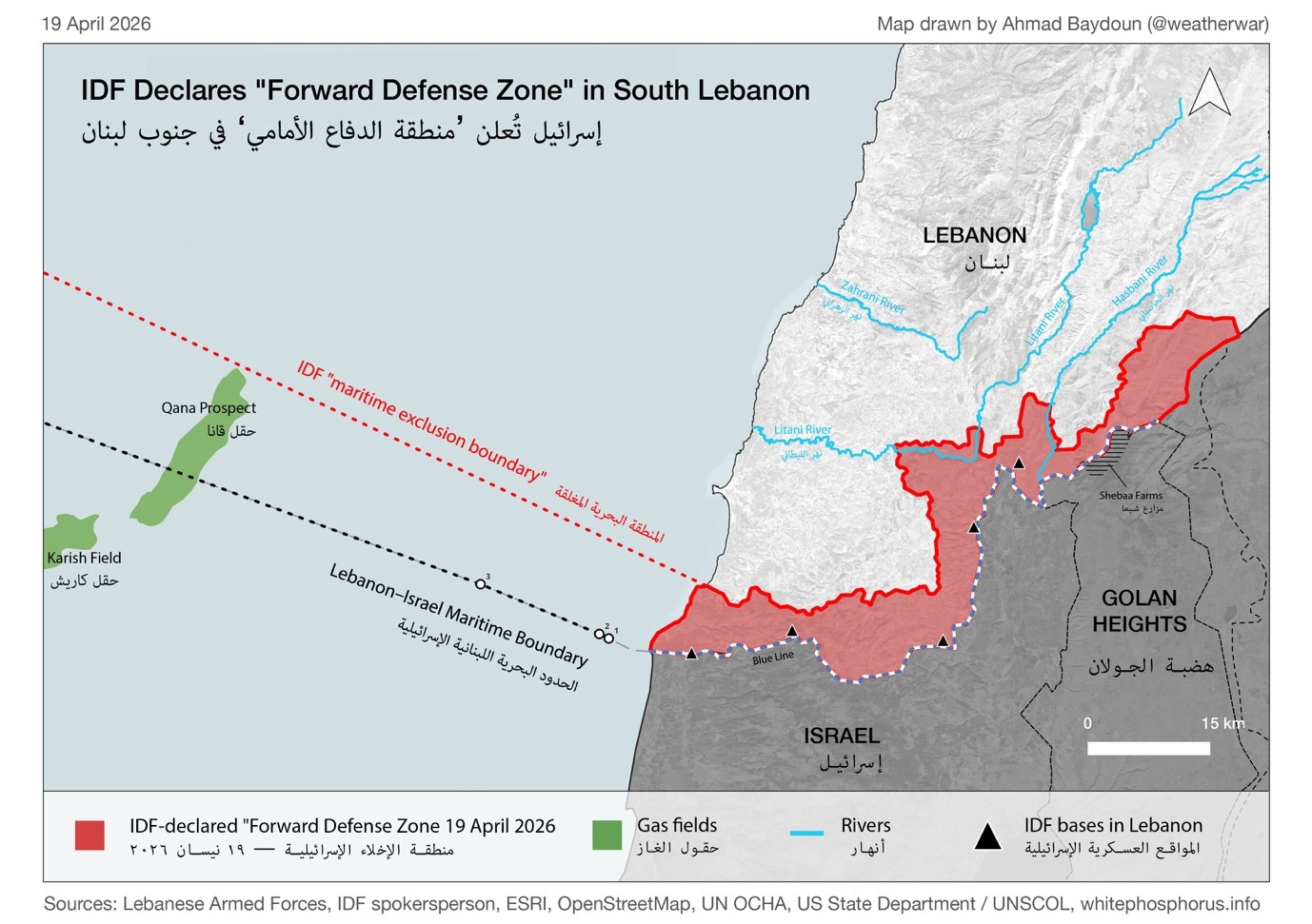
On April 17, 2026, a so-called “ceasefire” agreement was brokered[28] and announced by Trump. In practice, however, the agreement had little effect on the ground, as the Israeli war machine continued its campaign, albeit with a greater focus on south Lebanon and, to a lesser extent, the Bekaa. Saliently, it was at this stage that Israel’s expansionist ambitions became most visible through the declaration of a “Forward Defence Zone” or “yellow line”. The demarcation encompassed more than fifty-five villages in south Lebanon, formalising new geographies of aerial surveillance, military occupation and territorial control[29] (see Figure 1). Ethnic cleansing, urbicide and ecocide has since then continued through altered spatial and military configurations across southern Lebanon.
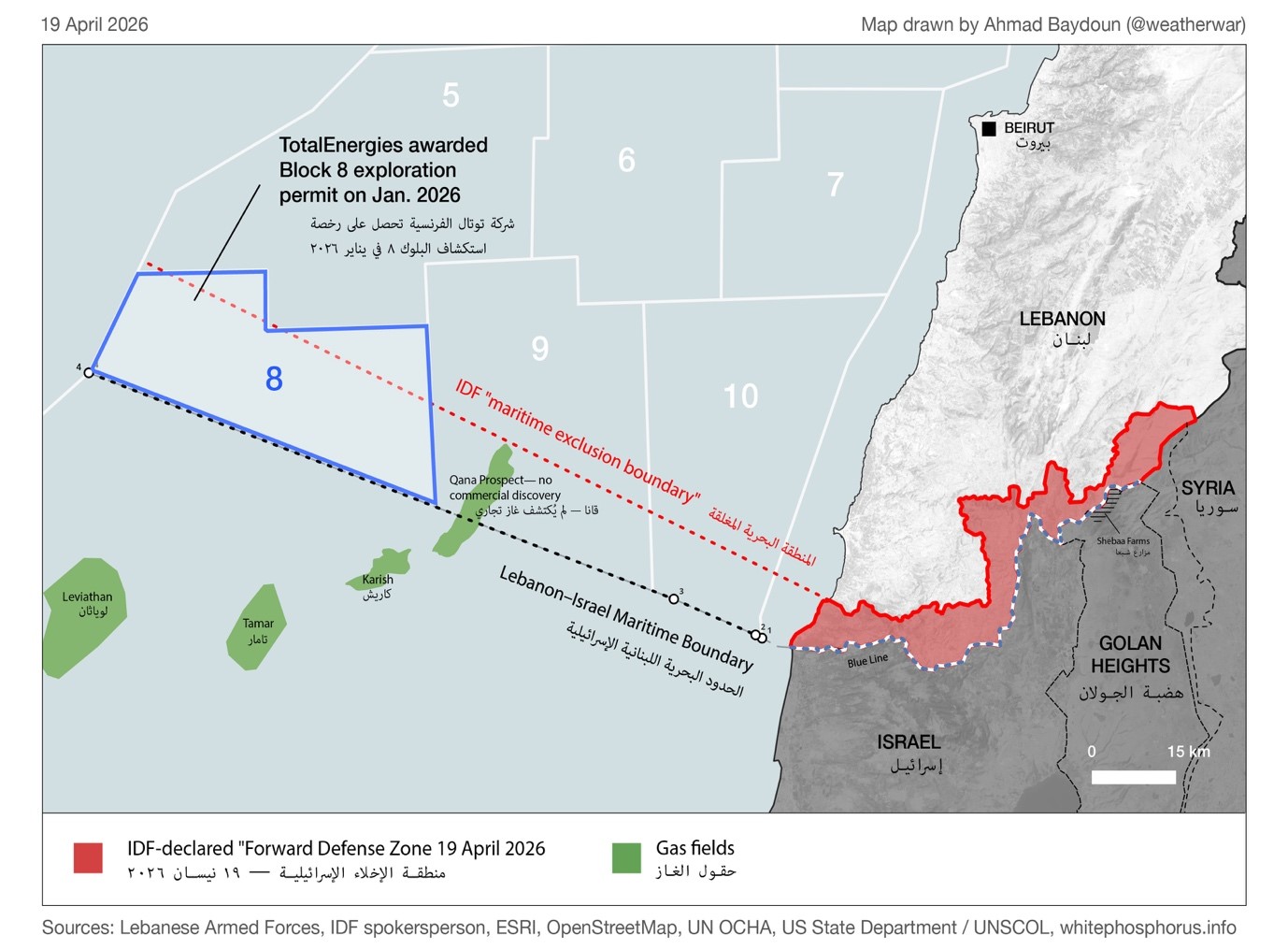
Critically, Israel’s drawing of a Forward Defence Zone also brought into relief the energy dimensions of its colonial venture. Alongside the newly declared “defence zone” in South Lebanon, Israeli maps depict a maritime exclusion boundary stretching towards Lebanon’s offshore energy resources, including Block 8 and the Qana gas field in Block 9, where exploration rights had been guaranteed to Lebanon under the 2022 US-brokered maritime agreement[30]. Inasmuch as that agreement itself codified a resource snatch—with US envoy Amos Hochstein repeatedly insisting that Lebanon abandon expectations of “getting everything” and even stop thinking about “being right”, Israel walked away with the larger share of the disputed waters[31]–Israel’s latest appropriation is all the more brazen.
Figure 1. Israeli-declared “Forward Defence Zone” in South Lebanon alongside offshore gas fields[32]
Furthermore, it is critical to note that Israel’s plans for Lebanese energy converge with its designs for the country’s water. Indeed, control over water has been a central pillar of Israeli regional domination for some time. Historically, the Jordan River basin and surrounding transboundary resources has been at the heart of the matter.[33] Since the Johnston negotiations of the 1950s, Israeli strategy has consistently aimed not only to secure control over regional water flows, but also to prevent neighbouring states from independently developing shared resources outside Israeli geopolitical terms.[34] In Lebanon, this logic surfaced repeatedly around the Wazzani Springs and the Hasbani River, where even limited Lebanese attempts to utilise water resources triggered Israeli accusations of threatening the regional balance. Sometimes, efforts to draw on these waters even provoked explicit threats of war.[35]
Under the latest round of Israeli violence, water again factors into the Israeli calculus. Attacks on Lebanese substations, fuel supplies and decentralised renewable systems destroyed the energy systems on which water pumping and distribution depend: In fact, research[36] found that nearly half of the municipal solar systems destroyed during the 2024 war had been dedicated to water pumping and distribution. As such, the assault on electricity infrastructure amounted to an assault on water access. The targeting of water and energy in Lebanon, then, are not parallel processes but a single colonial strategy through which territorial fragmentation and the destruction of the conditions necessary for everyday life are pursued together.
Reconfiguring Corridors for Energy Hegemony and Beyond
At this point, we can turn to the large picture: war on Lebanon has unfolded alongside wider attempts to reorganise the circulation and control of resources across the region itself.
Since the United States and Israel commenced their campaign against Iran in February, the subsequent closure of the Strait of Hormuz (and later, an American blockade of Iranian ports) have exposed the extent to which the global capitalist economy remains tethered to a small number of maritime routes. As recent months have made plain, it is not only hydrocarbons that flow through the Strait of Hormuz, but critical commodities including fertilisers, helium, sulphur, and food stuffs. Likewise, this period has reaffirmed the centrality of “route-making”[37]—both as a response to, and driver of, wars. As Khalili argues, routes are actively produced through imperial projects that seek to govern the movement of commodities, capital and military power. Viewed holistically, routes extend beyond pipelines and energy infrastructure to encompass ports, shipping lanes, logistics hubs and overland transport corridors through which commodities and geopolitical influence circulate.
Though the prospects of US-Israeli route-making remain uncertain at our present juncture, the venture is certainly one of the strategic considerations underpinning the war on Iran. The objective here is to turn Israel into a dominant player in the Eastern Mediterranean’s natural gas economy and an indispensable intermediary linking Gulf energy and trade flows to Europe.
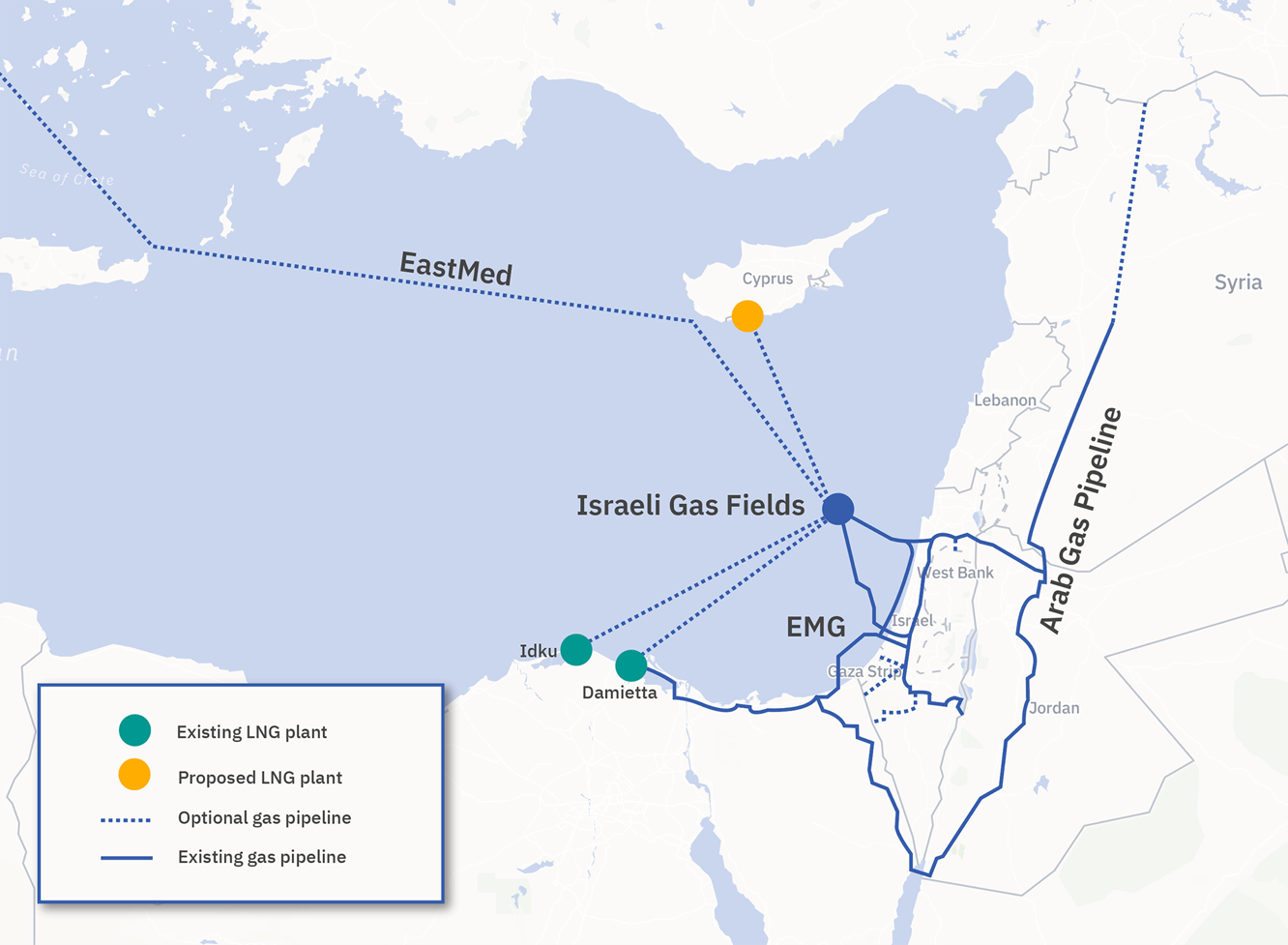
In advance of these plans, Israel has been working to reorganise Mediterranean and Red Sea energy flows around its gas exports.[38] Egypt’s declining gas production, Jordan’s growing energy needs and sustained US support for regional integration have been critical in these regards. By dint of these factors, a material architecture centred on Israel has already taken shape. War disruptions withstanding, a tripartite memorandum signed with the EU in 2022 has led to Israeli gas from the Leviathan field, located off the coast of Haifa, traveling westward through the reversed EMG pipeline (see Figure 2[39]) to Egypt’s LNG plants at Idku and Damietta, where it is liquefied and re-exported to European markets.[40][41] Separate agreements, meanwhile, have seen the establishment of a parallel route running northward, with pipelines from Leviathan connecting to the Arab Gas Pipeline network in Jordan’s Mafraq governorate, from which gas flows southward toward Egypt.[42] The Arab Gas Pipeline was originally conceived as a project of Arab energy cooperation, running from Egypt’s El Arish through Taba, Aqaba and Amman then north toward Damascus, Homs and Tripoli. However, shifts in the energy configurations of Egypt and Jordan[43] have gradually transformed the pipeline’s function within the regional energy system into one in which Israeli gas assumes a pivotal role. In that sense, even gas formally entering the system through Aqaba circulates into a shared flow in which Israeli supply is dominant.
Expectantly, the arrangements built upon the Arab Gas Pipeline come with significant downsides for Arab countries. When Israel suspended gas exports on 28 February 2026[44], invoking force majeure following the escalation with Iran, flows to Jordan and Egypt stopped immediately, triggering electricity crises in both countries. The episode revealed how this energy hegemony operates through dependencies that transform shared infrastructure into a source of fragility, exposing neighbouring countries to disruptions generated by Israel’s endless wars.
Figure 2: Regional Gas Infrastructure linking Israeli gas fields to neighbouring countries and proposed EastMed Export Routes
The implications of Israel’s energy designs are equally stark for Lebanon. Lebanon’s energy future is in fact, deeply entangled with the aforementioned regional infrastructures, from Iraqi oil pipelines and the Trans-Arabian Pipeline to the Arab Gas Pipeline.
As Lebanon revisits prospective energy agreements, greater attention must be paid to a regional landscape increasingly organised around Israeli energy hegemony. In May 2026, Jordan, Syria and Lebanon formalised a trilateral gas swap agreement following years of stalled negotiations. Under the arrangement, Jordan imports LNG, re-gasifies it and pumps it northward through the Arab Gas Pipeline, which operates through the same network in which Israeli gas remains central to regional supply. Any future rehabilitation or repair of regional pipeline infrastructure therefore requires safeguards extending beyond technical concerns over efficiency and supply security. This includes greater transparency over gas origins and blending arrangements, parliamentary oversight of agreements, explicit disclosure of indirect reliance on Israeli supply networks, and contractual protections against long-term lock-in to regional energy systems organised around Israeli gas.
Importantly, the political economy underpinning these developments extend beyond gas into broader trade and climate arrangements. And as with the gas deals, the larger arrangements embed similar asymmetries and dependencies into Israeli-Egyptian and Israeli-Jordanian relations.
This is perhaps most visible with schemes around Qualifying Industrial Zones (QIZ), which were set-up in 1996, two years after the signing of the Israeli-Jordanian Peace Treaty. In substance, QIZs have granted Jordanian and Egyptian manufacturers tariff-free access to US markets, contingent upon their production process integrating Israeli materials, components, or intermediate goods.[45] Explicitly, then, access to the US market is conditionalized upon economic partnership with Israel. But just as QIZs helped embed segments of Jordan and Egypt’s domestic industry within Israeli circuits of accumulation, so too have arrangements aimed at regional climate cooperation. Under the UAE-brokered “Project Prosperity” agreements signed during COP27, Jordan agreed to purchase desalinated water from Israel in exchange for renewable electricity generated on Jordanian soil. This too is poised to deepen infrastructural interdependence, pending on the project’s actual advance[46].
IMEC and Structural Dependence
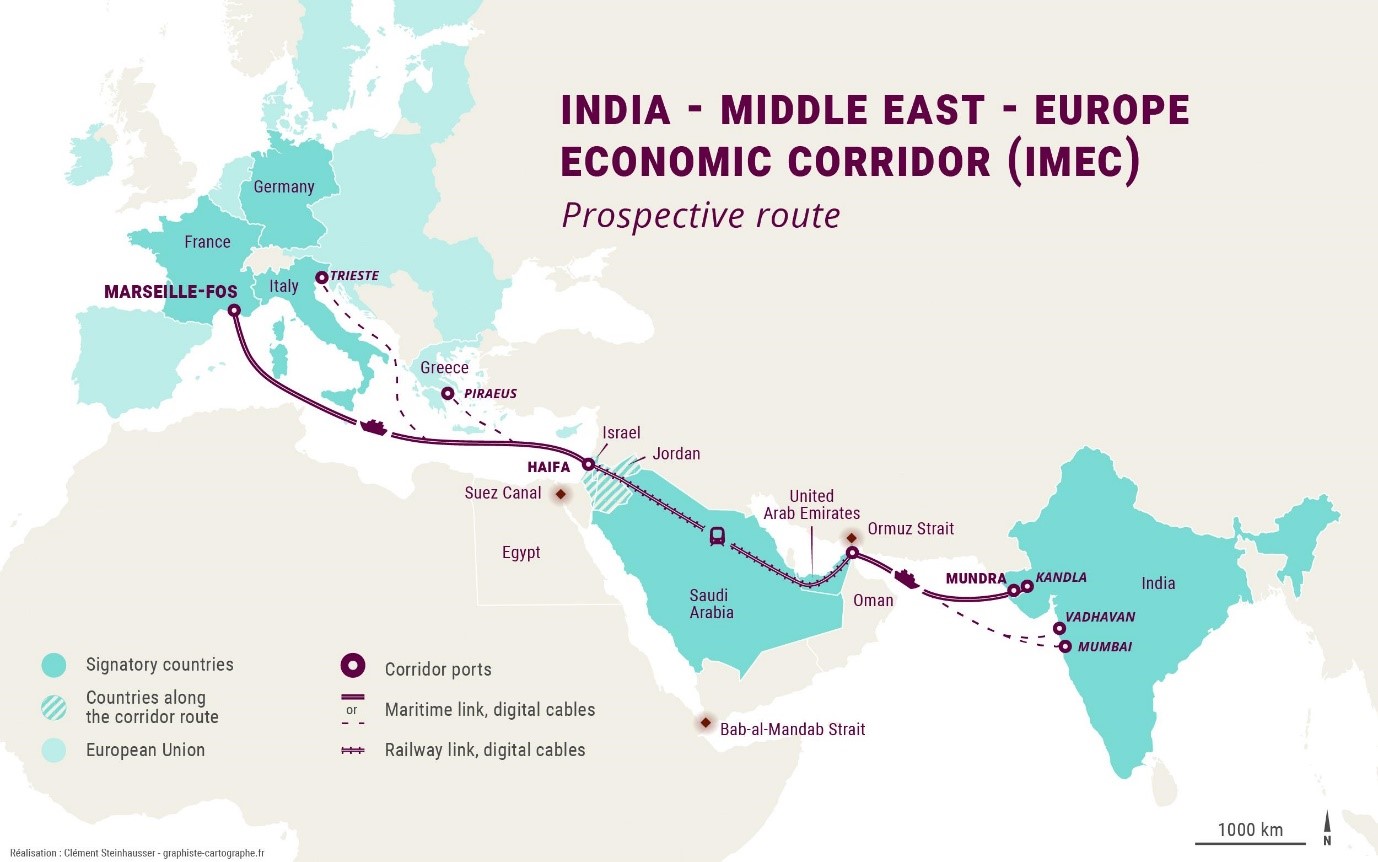
Projects such as the India-Middle East-Europe Economic Corridor (IMEC), announced in 2023 through a memorandum signed by India, the UAE, Saudi Arabia, the European Union, France, Germany, Italy and the United States, also bear mentioning when it comes infrastructural subordination.[47] The corridors in question would link Indian ports to the Gulf before continuing through rail infrastructure that would cross the Arabian Peninsula toward Israeli Mediterranean ports and eventually connect to European markets (see Figure 3[48]). Alongside freight transport, IMEC proposes to incorporate electricity interconnections, hydrogen supply chains and digital infrastructure, embedding future energy transitions within new regional corridors of circulation. If earlier imperial projects depended upon control over shipping lanes, canals and hydrocarbon routes, IMEC suggests new forms of imperial integration through infrastructures presented as transition and connectivity. In this configuration, Israeli territory would be centred not only within existing hydrocarbon systems, but as an intermediary connecting Gulf production, future hydrogen exports and Asian-European trade flows. Netanyahu made this vision explicit in 2026, arguing for Gulf oil and gas pipelines to run “through the Arabian Peninsula, right up to Israel, right up to our Mediterranean ports,” adding that this would eliminate strategic “choke points” and constitute “a real change that will follow this war[49].”
Radical Energy Justice for Survival, Resistance and Liberation
Israeli and American attacks on energy infrastructure across the region are not isolated episodes, but the latest salvos in a much longer war. Herein, infrastructures sustaining petro-capitalism have served simultaneously as instruments of imperial and colonial powers and as objects of their wars. One must be willing to look at this clearly, without the comfort of euphemism, and recognise that what is unfolding with the destruction of Lebanon and Palestine’s energy systems is not collateral damage, but systematic and deliberate strategies of dispossession.
There are moments when the scale of destruction appears so overwhelming that justice itself begins to feel utopian, and that, too, is by design. Fanon understood this well: colonialism is not satisfied merely with holding a people in its grip; it works, by a kind of perverted logic, to convince the dispossessed that the order which produced their dispossession is the only order possible. Yet the persistence of resistance across generations, and across the rubble of repeated destructions gives lie to that claim. Political orders, however entrenched, are made by human hands and can be unmade by them, too. Any meaningful vision of energy justice must therefore begin with a new political order committed to dignity, self-determination and the right of people to remain on their land. The considerations that follow emerge from that conviction.
Energy Justice as Sumud and Continuity
Current events have primarily exposed the fragility of energy systems and the injustices they perpetuate, but they have also revealed the extent to which decentralised renewable energy systems have become essential infrastructures of resistance and survival.
In South Lebanon, solar systems increasingly function as lifelines for communities facing bombardment and electricity system collapse. Indeed, solar’s proliferation partly reflects the capacity of decentralised systems to withstand what highly centralised grids cannot, while also rendering attacks on infrastructure materially more difficult and costly. Nor has the generation of renewable energy only enabled survival: it is enabling displaced people to return and remain rooted in their lands.[50] Indeed, across successive periods of escalation and de-escalation, recourse to locally generated, solar-powered electricity has allowed many communities to refuse displacement in the face of aggression.
Remaining in their homes is a positive political act, an assertion of presence against sustained attempts at erasure. By making this possible, renewable energy became part of the praxis of steadfastness, or sumud, standing in direct opposition to the logic through which certain communities and territories are rendered sacrifice zones, deemed expendable by the very political and economic order that profits from their dispossession. These energy technologies are therefore now entangled in questions of return, territorial continuity, and the inalienable claim to land. The rejection of territorial abandonment they enable is not incidental to energy justice but constitutive of it.
Energy Justice Beyond Fragmentation
Nonetheless, the current wars have also demonstrated that decentralisation alone cannot shield infrastructure from colonial violence. In both Lebanon[51] and Gaza[52], renewable energy systems are directly targeted with growing frequency: Everything from rooftop panels to larger decentralised installations have been elevated as strategic assets in the eyes of Israeli war planners. This reality challenges assumptions that renewable energy systems, and their decentralized iterations most especially, offer an escape valve from war and dispossession. At the end of the day, these systems too can be destroyed.
And the limits of decentralisation are not only military. Operating at the household or community level, these systems remain structurally incapable of guaranteeing electricity, water, healthcare and mobility at the scale that energy justice demands. If decentralised systems do carry genuine emancipatory potential, they cannot substitute for wider public infrastructures capable of guaranteeing collective access to basic services. As such, while the fragmentation of energy infrastructure can be conducive to forms of resilience and survival, it cannot deliver energy justice on its own.
What is required is not simply the proliferation of localised solutions, but the reconstruction of public infrastructures for sustaining collective life. Under current conditions, even reconstruction has become a terrain of struggle, tied to disarmament, subordinated to external financial agendas, and made contingent upon political compliance. The challenge, therefore, is not only to rebuild infrastructure, but to reclaim the political conditions under which it can be rebuilt on just and sovereign terms.
Energy Justice as Anti-Colonialism, Sovereignty and Liberation
At the regional level, anti-colonialism and anti-normalisation must remain central to any meaningful vision of energy justice. The folding of climate and energy transitions into corridor politics and infrastructural dependency is not incidental. These arrangements seek to reorganise regional energy systems around Israeli supply, infrastructure and transit, using the language of sustainability to legitimise what are ultimately colonial relations and imperial ambitions.
In this context, energy justice frameworks must not be reduced to technological considerations around carbon reduction alone, nor can they remain silent on the terms through which future regional energy systems are being reorganised. Instead, they must reject arrangements that deepen dependence on Israeli gas, position Israel as an indispensable transit hub, or normalise occupation through climate and infrastructure cooperation. This does not imply rejecting regional cooperation itself. It does, however, require resisting forms of integration that normalise occupation, embed dependence within shared infrastructures, and subject countries to systems vulnerable to war, coercion and geopolitical leverage. The alternative is a regional energy strategy built explicitly around containing Israeli hegemony rather than consolidating it.
However, resistance alone cannot be the horizon. Across the region, communities have spent decades developing their own infrastructures of survival amid war, sanctions, occupation and state abandonment. These forms of praxis, built around care, coordination and collective provision, sustain access to electricity, water, food and livelihoods precisely where states and markets have failed or been deliberately destroyed. These practices are not substitutes for public infrastructure or institutional responsibility, nor can they be romanticised as sufficient under conditions of ongoing colonial dispossession and imperialist war. Their significance lies in what they demonstrate; that the capacity to sustain collective life is itself a political achievement, one that energy justice must take as its starting point rather than as an afterthought. This is particularly urgent as Israeli military strategy has increasingly targeted electricity, water, agriculture and health systems together, making the destruction of energy infrastructure inseparable from the destruction of the conditions for life itself.
Any meaningful alternative therefore rests on holding together two positions: resisting regional integration organised around occupation, American-Israeli hegemony, and imperialist war machines, while defending and rebuilding the material foundations of collective life. The challenge is not simply to oppose regional arrangements, but to create the conditions through which communities can remain rooted, rebuild on their own terms and exercise greater control over the infrastructures upon which their futures depend. We pursue these dual tasks in the knowledge that they are inseparable from the longer work of constructing a third way — one that refuses both the logic of imperial integration and a future delimited to mere survival.

This publication has been supported by the Rosa-Luxemburg-Stiftung. The positions expressed herein do not necessarily reflect the views of Rosa-Luxemburg-Stiftung.
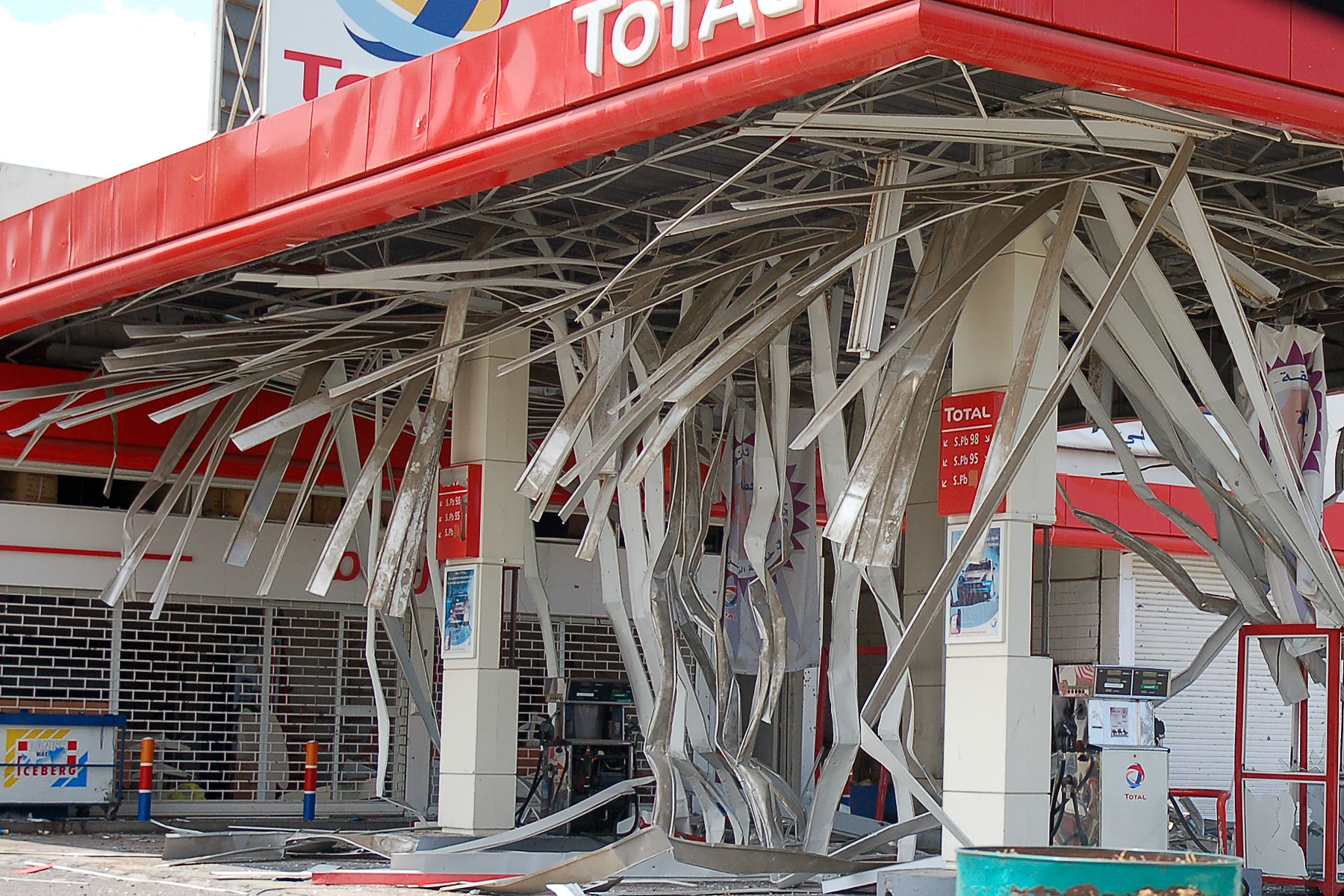
Cover Photo: Masser, “Bombed petrol station” (2006).
[1] Malcolm Moore, “Iran War Is the Greatest Threat to Global Energy ‘in History’, Warns IEA,” Financial Times, March 20, 2026, https://www.ft.com/content/09524a74-db3c-4aef-b4f7-51eda3068320
[2] Jillian Ambrose, “Oil and Gas Prices Jump after Iran and Israel Attack Gasfields,” The Guardian, March 19, 2026, https://www.theguardian.com/business/2026/mar/19/oil-prices-gas-prices-rise-iran-israel-donald-trump?
[3] “Prices for Oil, Fuel Cargoes Smash Record Highs as Iran War Chokes Middle East Supply,” Reuters, March 19, 2026, https://www.reuters.com/business/energy/prices-oil-fuel-cargoes-smash-record-highs-iran-war-chokes-middle-east-supply-2026-03-19/
[4]“Israeli Attacks on Lebanon Kill More than 3,000 Since March,” The Irish Times, May 18, 2026, https://www.irishtimes.com/world/middle-east/2026/05/18/lebanons-death-toll-nears-3000-since-march/
[5] Jonathan Conlin, “The Battle for Oil in the First World War,” History Today 68, no. 1 (2018).
[6] Richard G. Davis, Bombing the European Axis Powers: A Historical Digest of the Combined Bomber Offensive, 1939–1945 (Maxwell Air Force Base, AL: Air University Press, 2006).
[7] Alfred C. Mierzejewski, The Collapse of the German War Economy, 1944–1945: Allied Air Power and the German National Railway (Chapel Hill: University of North Carolina Press, 1988).
[8] Protocol Additional to the Geneva Conventions of 12 August 1949, and Relating to the Protection of Victims of International Armed Conflicts (Protocol I), June 8, 1977, art. 52.
[9] Oona A. Hathaway et al., “The Dangerous Rise of ‘Dual-Use’ Objects in War,” Yale Law Journal 130, no. 6 (2021): 1750–1858.
[10] Human Rights Watch, Needless Deaths in the Gulf War: Civilian Casualties During the Air Campaign and Violations of the Laws of War (New York: Human Rights Watch, 1991).
[11]Human Rights Watch, “Gaza: Israeli Offensive Must Limit Harm to Civilians,” June 28, 2006, https://www.hrw.org/news/2006/06/28/gaza-israeli-offensive-must-limit-harm-civilians?
[12] Jeannie L. Sowers, Erika Weinthal, and Neda Zawahri, “Targeting Environmental Infrastructures, International Law, and Civilians in the New Middle Eastern Wars,” Security Dialogue 48, no. 5 (2017): 410–430.
[13] Amnesty International, “Ukraine: Russian Attacks on Critical Energy Infrastructure Amount to War Crimes,” October 20, 2022, https://www.amnesty.org/en/latest/news/2022/10/ukraine-russian-attacks-on-critical-energy-infrastructure-amount-to-war-crimes/
[14] Mahmoud Soueid, “Beirut Under Fire,” Institute for Palestine Studies, 1982, https://www.palestine-studies.org/en/node/41243
[15] Fabian Hamilton, “Israel Defence Minister Orders ‘Complete Siege’ on Gaza,” Reuters, October 9, 2023, https://www.reuters.com/world/middle-east/israel-defence-minister-orders-complete-siege-gaza-2023-10-09/
[16] Human Rights Watch, Civilian Pawns: Laws of War Violations and the Use of Weapons on the Israel-Lebanon Border (New York: Human Rights Watch, 1996).
[17] Human Rights Watch, Operation Grapes of Wrath: The Civilian Victims (New York: Human Rights Watch, 1997).
[18] Ibid, 16
[19] Amnesty International, Deliberate Destruction or “Collateral Damage”? Israeli Attacks on Civilian Infrastructure (London: Amnesty International, 2006).
[20] El Amine, Yasmina. Pathways for Energy Justice in Lebanon’s Post-war Reconstruction. Beirut: Arab Reform Initiative, October 2025. https://d2uecu6cucl1lj.cloudfront.net/ari/2025/10/25180118/Yasmine-El-Amine-ENGLISH-Pathways-for-Energy-Justice-in-Lebanon-for-the-printer-1.pdf
[21] Benny Gantz, quoted in Nahal Toosi and Alexander Ward, “Iran Threatens ‘Obliterating War’ if Israel and Hezbollah Clash Escalates,” Politico, June 28, 2024, https://www.politico.eu/article/iran-threaten-obliterating-war-israel-attack-lebanon/.
[22] Eli Cohen, quoted in “Israeli Energy Minister Says Israel Should Bomb Civilian Infrastructure in Lebanon,” L’Orient Today, April 12, 2026, https://today.lorientlejour.com/article/1503200/israeli-energy-minister-says-israel-should-bomb-civilian-infrastructure-in-lebanon.html
[23] United Nations Development Programme (UNDP), The Socioeconomic Impacts of the 2024 War on Lebanon (Beirut: UNDP, 2025), https://www.undp.org/sites/g/files/zskgke326/files/2025-07/report_socioeconomic-impacts-lebanon-2024-war-english.pdf
[24] “Sultaniyah Power Station Targeted by Israeli Aircraft, Causing Power Cuts in More than 60 Southern Villages,” National News Agency (Lebanon), March 19, 2026, https://www.nna-leb.gov.lb/en/news/153152/sultaniyah-power-station-targeted-by-israeli-aircraft-causing-power-cuts-in-more-than-60-southern-villages-2
[25] “Israel Spills More and More Blood in Southern Lebanon, Hezbollah Continues Its Attacks,” L’Orient Today, May 8, 2026, https://today.lorientlejour.com/article/1506385/israel-spills-more-and-more-blood-in-southern-lebanon-hezbollah-continues-its-attacks.html
[26] “Israel Destroys Power and Water Systems in Christian Town in South Lebanon,” Middle East Eye, April 27, 2026, https://www.middleeasteye.net/live-blog/live-blog-update/israel-destroys-power-and-water-systems-christian-town-south-lebanon
[27] “Israeli Strikes Target Al-Amana Fuel Stations Across South Lebanon,” The Cradle, March 18, 2026, https://thecradle.co/articles/israeli-strikes-target-al-amana-fuel-stations-across-south-lebanon
[28] “Celebrations in Lebanon as 10-Day Ceasefire with Israel Begins,” Al Jazeera, 17 April 2026, https://www.aljazeera.com/news/2026/4/17/celebrations-in-lebanon-as-10-day-ceasefire-with-israel-begins
[29] “Israel Draws ‘Yellow Line’ Across South Lebanon Villages amid Escalating Attacks,” L’Orient Today, April 20, 2026, https://today.lorientlejour.com/article/1504127/israel-draws-yellow-line-across-south-lebanon-villages-amid-escalating-attacks.html
[30] “Israel-Lebanon Maritime Border Deal Gives Lebanon Rights to Qana Field,” Reuters, October 27, 2022, https://www.reuters.com/world/middle-east/israel-lebanon-sign-us-brokered-maritime-deal-2022-10-27/
[31] “US Mediator to Lebanon: ‘Being Right Can Give You Nothing.’” The Cradle. June 15, 2022. https://thecradle.co/articles-id/3725
[32] Ahmad Baydoun (@weatherwar), “IDF Declares ‘Forward Defence Zone’ in South Lebanon,” map, X, April 19, 2026, https://x.com/weatherwar/status/2046552672904331361
[33] Zeitoun, Mark, and Jeroen Warner. Hydro-Hegemony: A Framework for Analysis of Transboundary Water Conflicts. London: Routledge, 2008
[34] Lowi, Miriam R. Water and Power: The Politics of a Scarce Resource in the Jordan River Basin. Cambridge: Cambridge University Press, 1993.
[35] Israeli Prime Minister Ariel Sharon described Lebanon’s Wazzani pumping project as a potential casus belli and “grounds for war” in 2002. See Molly Moore, “Water Dispute Raises Fears of Conflict Between Israel and Lebanon,” The Washington Post, September 18, 2002, https://www.washingtonpost.com/archive/politics/2002/09/18/water-dispute-raises-fears-of-conflict-between-israel-and-lebanon/
[36] Yasmina El Amine, “Pathways for Energy Justice in Lebanon’s Post-war Reconstruction,” Arab Reform Initiative, October 17, 2025, https://www.arab-reform.net/publication/pathways-for-energy-justice-in-lebanons-post-war-reconstruction/
[37] Laleh Khalili, Sinews of War and Trade: Shipping and Capitalism in the Arabian Peninsula (London: Verso, 2020), chap. 1, “Route-Making,”
[38] Julian Bowden and Elad Golan, East Mediterranean Gas: A Triangle of Interdependencies, Energy Insight 151 (Oxford: Oxford Institute for Energy Studies, May 2024), 1–5, https://www.oxfordenergy.org/wpcms/wp-content/uploads/2024/05/Insight-151-East-Mediterranean-gas-%E2%80%93-a-triangle-of-interdependencies.pdf
[39] Frederick University, H2Zero Research Unit, “Hydrogen to Zero Emissions & Renewable Options (H2Zero),” accessed May 27, 2026, https://www.frederick.ac.cy/en/research-unit-hydrogen-to-zero-emissions-and-renewable-options-h2zero
[40] “Mideast War Highlights Egypt’s Energy Weak Spot,” Reuters, June 30, 2025, https://www.reuters.com/markets/commodities/mideast-war-highlights-egypts-energy-weak-spot-2025-06-30/
[41] “Israel’s Mediterranean Gas: The Potential for Gas Export to Europe and the Dynamic of Regional Cooperation,” OSW Commentary 466, Centre for Eastern Studies, August 12, 2022, https://www.osw.waw.pl/en/publikacje/osw-commentary/2022-08-12/israels-mediterranean-gas-potential-gas-export-to-europe-and
[42] Hisham Bustani, “Arab States Should Beware of Israel’s Hegemonic Energy Expansion,” Al Jazeera, March 21, 2026, https://www.aljazeera.com/opinions/2026/3/21/arab-states-should-beware-of-israels-hegemonic-energy-expansion
[43] “Energy, Water and the Cost of Jordan’s Dependence on Israel,” Middle East Report Online, October 2025, https://www.merip.org/2025/10/energy-water-and-the-cost-of-jordans-dependence-on-israel/.
[44] “Israel Shuts Down Gas Fields after US-Israel Strikes on Iran,” Reuters, February 28, 2026, https://www.reuters.com/business/energy/israel-shuts-down-gas-fields-after-us-israel-strikes-iran-2026-02-28/
[45] Shamel Azmeh, “Trade Regimes and Global Production Networks: The Case of the Qualifying Industrial Zones (QIZs) in Egypt and Jordan,” Geoforum 57 (2014): 57–66, https://doi.org/10.1016/j.geoforum.2014.08.012.
[46] Manal Shqair, “Arab–Israeli Eco-Normalisation: Greenwashing Settler Colonialism in Palestine and the Jawlan,” Transnational Institute, November 16, 2023, https://www.tni.org/en/article/arab-israeli-eco-normalisation
[47] India-Middle East-Europe Economic Corridor (IMEC), “Home,” accessed May 27, 2026, https://www.imec.international/
[48] Jean-Baptiste Luciani, “IMEC, Suez Canal of the XXIst Century,” La Jaune et la Rouge, accessed May 27, 2026, https://www.lajauneetlarouge.com/imec-suez-canal-of-the-xxist-century/
[49] Benjamin Netanyahu, quoted in “Netanyahu Wants Oil, Gas to Flow Through Israel Post-Iran War,” Reuters, March 19, 2026, https://www.reuters.com/world/middle-east/netanyahu-says-iran-no-longer-has-uranium-enrichment-capacity-2026-03-19/
[50] Yasmina El Amine, “Rethinking Energy Justice in Geographies of War: Care and Solidarity Practices in South Lebanon,” Sifr, 9 December 2025, https://alsifr.org/rethinking-energy-justice-geographies-war
[51] Sally Abou Al Joud, “From Pride to Ruin: Israel Shatters Self-Financed Solar Microgrid Supplying Water to Southern Village,” L’Orient Today, November 16, 2023, https://today.lorientlejour.com/article/1357597/from-pride-to-ruin-israel-shatters-self-financed-solar-microgrid-supplying-water-to-southern-village.html
[52] Middle East Eye (@MiddleEastEye), “Israeli drones are systematically targeting and destroying solar energy panels across northern Gaza, wiping out the area’s last remaining source of power,” X, February 14, 2026 , https://x.com/MiddleEastEye/status/2022630766774227247