
The American-Israeli military campaign against Iran that began on 28 February 2026 has produced consequences that reach far beyond the battlefield. The kinetic dimension— leadership decapitation, the degradation of Iran’s missile and naval forces, and the effective closure of the Strait of Hormuz—dominated early international attention. Yet the more enduring transformations are unfolding in quieter domains: energy markets, capital allocation, investment flows, and the political economy of regional and extra-regional security.
Eight months into the conflict, the war has exposed the structural fragility of Gulf energy logistics. It has accelerated divergent strategic visions among the Gulf monarchies. It has elevated the Red Sea and Bab al-Mandab into a second critical theatre of economic coercion. And it has forced energy importing powers in Europe and Asia to confront another major supply shock, less than five years since the one triggered by Russia’s full scale invasion of Ukraine. These developments are interconnected. Disruptions in oil and gas flows reshape fiscal and investment calculations, those calculations drive realignments in diplomatic and military partnerships, and those realignments alter how external powers understand, engage, and seek to shape the region.
This paper argues that the most consequential geopolitical outcomes of the war are being driven primarily by structural changes in energy sourcing, investment patterns, and the cumulative costs of prolonged disruption, rather than by purely military or diplomatic calculations. It examines three tightly linked domains. First, the energy channel and the emergence of a dual chokepoint crisis linking the Strait of Hormuz to the Bab al-Mandab. Second, the macroeconomic dimension, with particular attention paid to trade and investment. Third, interstate relations. As will become clear, our present juncture is seeing political, economic, security, and energy dynamics reinforce one another in a single system of mutual causation.
The Energy Channel: From Hormuz to Bab al-Mandab
Prior to February 2026, approximately 20-25% of global seaborne oil trade and nearly 20% of liquefied natural gas (LNG) shipments passed through the Strait of Hormuz.[1] The extremity of concentration had long created vulnerabilities for the world economy and Gulf petro-states alike. The war on Iran has swiftly seen these exploited. Iranian efforts to assert control over the strait, combined with U.S. naval responses, reciprocal tanker attacks, and the broader atmosphere of insecurity, reduced non-Iranian crude flows to as low as 500,000 barrels per day in the early months of the conflict, down from nearly 14 million barrels per day in the pre war period. By mid-2026, Gulf oil production had recovered partially, yet exports remained constrained by tanker availability, sharply elevated insurance premiums, and intermittent escalations. Saudi production at certain points fell to levels not recorded since the 1990s. Qatar’s LNG exports collapsed by roughly 96 – 97 % in the second quarter of 2026 compared with the same period in 2025, with only 18 cargoes shipped in the first six months of the war versus 509 in the corresponding period of the previous year.² The attack on Qatar’s Ras Laffan facility early in the conflict inflicted damage estimated in the tens of billions of dollars and reduced LNG export capacity for several years even under optimistic repair scenarios.
The economic logic of the war quickly expanded beyond Hormuz. As Saudi Arabia and the UAE accelerated use of existing and expanded bypass infrastructure—the East-West Pipeline to the Red Sea port of Yanbu and the Habshan-Fujairah pipeline on the Gulf of Oman—Iran and its regional allies responded by targeting the alternative routes. In September 2026, drone attacks attributed to Iran backed groups operating from Iraqi territory forced the temporary shutdown of the East-West Pipeline, which had been running at elevated capacity of up to 5-7 million barrels per day. Simultaneously, Houthi forces launched a rapid coastal offensive in Yemen, seizing the port city of Mocha, advancing toward the Bab al-Mandab, and capturing Perim Island.³ This gave the group physical proximity to the narrow shipping lanes through which Saudi crude, rerouted from the Gulf, must pass in order to reach Asian and European markets. Saudi Red Sea exports, which had risen sharply as a Hormuz bypass, fell dramatically, by some estimates approaching 97 % in the immediate aftermath of Houthi territorial gains. Tanker traffic through Bab al-Mandab contracted, insurance costs surged, and major shipping lines suspended Saudi-linked voyages. Brent crude, which had spiked above $120 earlier in the conflict and later stabilized in the $90-110 range, responded immediately to each new disruption.
The result has been a dual chokepoint crisis. Control of a single maritime chokepoint is no longer sufficient for either coercion or resilience, both Iran and the Gulf producers now operate within a system of interconnected vulnerabilities stretching from the Persian Gulf through the Strait of Hormuz to the Bab al-Mandab and the southern Red Sea. Gulf states are responding by investing heavily in additional pipeline capacity, expanded storage at ports outside Hormuz (Fujairah, Salalah, Sohar), and regional interconnections designed to reduce dependence on any single waterway. Storage capacity at free zones in Egypt and further afield is also emerging as a target for some producers seeking additional flexibility. Analysts project that expanded bypass infrastructure could replace a substantial share of pre-war Hormuz oil volumes by the late 2020s, though precise figures remain subject to project timelines and security conditions.⁴ At the same time, the crisis has intensified global efforts to diversify away from Gulf supply through alternative producers, strategic petroleum reserves, and accelerated renewable energy deployment in major importing countries. The energy channel is thus producing both acute short-term volatility and deeper structural reorientation of global energy logistics.
Investment, Trade Flows, and Macroeconomic Consequences
The energy shock has translated into sharp and differentiated macroeconomic pressure across the Gulf. IMF estimates revised GCC growth projections downward significantly for 2026, with some oil exporters facing contractions of up to 14-15 percentage points relative to pre-war forecasts.⁶ Qatar and Kuwait appear most exposed due to their heavy reliance on LNG and limited physical bypass options. Saudi Arabia and the UAE, while still facing estimated GDP declines in the 3-5 % range under prolonged conflict scenarios, possess greater fiscal buffers and alternative export routes. The damage to Qatar’s Ras Laffan facility has reduced LNG capacity for years, compounding the immediate loss of export revenues. In some cases, Qatar has been forced to purchase U.S. LNG cargoes in order to fulfil a share of its outstanding contractual commitments to consumers.⁵
Trade and investment flows have been equally disrupted. Portfolio outflows occurred from several Gulf markets. Stock indices in Dubai and Qatar recorded double digit percentage declines relative to global benchmarks. Tourism and real estate sectors, particularly in Dubai, suffered sharp contractions during what should have been peak seasons. Shipping routes have been redrawn toward Arabian Sea ports outside the Strait of Hormuz, increasing both costs and transit times as operators sought safer alternatives.¹⁰ Reconstruction and infrastructure needs are already being quantified in the tens of billions of dollars: estimates for repairing damaged energy assets across the region reach $50 – 60 billion, while broader pipeline, storage, and port expansions are projected to require $100 billion or more over the coming years.
These costs are reshaping capital allocation decisions. Sovereign wealth funds and national budgets are being redirected toward domestic resilience projects, defense industrial localization, energy infrastructure hardening, and the building of fiscal buffers, rather than outward investment in U.S. technology, private equity, or real estate. Gulf capital that previously flowed freely into Western markets is under pressure as governments’ priorities internal security and economic survival. At the same time, the war has created openings for alternative partners. China’s long-term energy relationships with Gulf producers remain largely intact, and the crisis has reinforced Beijing’s interest in securing supply chains less vulnerable to Western led military actions or maritime disruptions. European importers, facing higher gas prices, low storage levels relative to historical norms, and intensified competition with Asia for flexible LNG cargoes, are accelerating diversification while simultaneously seeking diplomatic off-ramps that might restore more predictable flows. The macroeconomic picture is therefore one of differentiated vulnerability. States with geographic or infrastructural alternatives (Saudi Arabia, the UAE, Oman) have absorbed the shock more effectively than those locked into Hormuz-dependent LNG or crude exports. This differentiation is already feeding into political calculations about the relative value of alliances and the distribution of risk.
Interstate Realignments, Divergent Gulf Visions, and External Actors
The material pressures described above are driving the most visible geopolitical shifts. The Gulf Cooperation Council has not fractured formally, but its members are pursuing increasingly divergent strategies rooted in distinct assessments of risk, opportunity, and the limits of external protection.
The United Arab Emirates has moved furthest toward operational alignment with Israel and a more autonomous commercial security posture. The deployment of Israeli air defense systems, including Iron Dome batteries, on Emirati territory, repeated intelligence coordination visits, and the decision to exit OPEC signal a vision in which Abu Dhabi prioritizes technological and military self-reliance, deeper integration with U.S. and Israeli security architectures, and freedom from Saudi dominated energy frameworks. For the UAE, the war has confirmed that proximity to decisive military partners offers more reliable protection than collective Gulf arrangements, while also creating commercial space to expand export capacity outside traditional OPEC constraints.
Saudi Arabia has adopted a more measured hedging strategy, Riyadh continues to value the American security umbrella and has deepened certain bilateral tracks with Washington, yet it has simultaneously accelerated defense cooperation with Pakistan and Turkey through arrangements such as the Mecca Defense Framework, invested heavily in pipeline and Red Sea export infrastructure, and avoided full diplomatic rupture with Tehran. The Saudi vision appears oriented toward long-term multi-alignment: reducing exclusive dependence on any single external power, protecting the kingdom’s position as a swing energy supplier through physical diversification of routes, and preserving strategic autonomy in a more contested regional order. The war has reinforced Riyadh’s calculation that pure reliance on U.S. guarantees is insufficient when Iranian retaliation and proxy actions can still impose heavy economic costs.
Qatar has emphasized mediation and inclusive security architectures. Doha’s severe exposure, particularly the damage to Ras Laffan and the near collapse of LNG exports, has reinforced a preference for de-escalation and for any future regional security framework that includes Iran rather than isolates it. Qatari officials have publicly floated the idea of a collective Gulf security system that does not leave any state permanently exposed. This vision reflects both economic necessities, given the shared South Pars/North Dome gas field, and a longstanding diplomatic identity as an intermediary. For Qatar, binary choices between Washington and Tehran carry unacceptable costs.
Oman has leaned on its traditional posture of neutrality and geographic advantage, Muscat’s ports lie outside the Strait of Hormuz, giving it relative resilience, and its historical role as discreet mediator has been reaffirmed. Oman’s vision prioritizes dialogue, de-escalation, and the preservation of open channels with all parties, viewing prolonged conflict as more damaging to regional stability than any short-term military gains.
These divergent visions are not abstract, they are shaping concrete choices about defense partnerships, energy infrastructure investments, and diplomatic signaling. The UAE’s operational tilt toward Israel, Saudi Arabia’s simultaneous pursuit of U.S. ties and alternative defense arrangements, Qatar’s mediation track, and Oman’s neutral facilitation together illustrate a region moving from relatively coherent collective security assumptions toward more differentiated national strategies.
Israel has used the war to expand its strategic footprint in ways that directly engage the dual chokepoint reality. Its formal recognition of Somaliland in December 2025, followed by a high level state visit in 2026, the signing of a Strategic Cooperation Declaration, and reports of security training and intelligence cooperation, represents an explicit attempt to secure influence over the southern approaches to the Bab al-Mandab and the Gulf of Aden.⁸ Somaliland’s long coastline and the port of Berbera offer potential value for surveillance, logistics, and operations against the Houthis. This move has drawn sharp criticism from Somalia, Turkey, Egypt, and a wider group of Arab and African states, illustrating how recognition of breakaway entities can become an instrument of maritime strategy in a contested chokepoint environment.
At the same time, the Abraham Accords framework has been reactivated and deepened. In September 2026, Israel and Morocco agreed to upgrade diplomatic relations to full embassies, expand direct flights (including by Moroccan carriers), and conclude investment protection and double taxation agreements by the end of the year.⁹ Combined with the UAE-Israel operational defense partnership, these steps create an emerging east-west axis of normalization and security cooperation stretching from the Gulf to the Maghreb. This axis carries defense industrial, intelligence, and maritime implications that intersect with Red Sea security and the protection of energy corridors.
External powers are recalibrating under the same pressures. Europe, which after 2022 reduced dependence on Russian pipeline gas by turning heavily to LNG—sourced primarily in the United States and Qatar—now faces a second major supply shock. The Hormuz crisis removed a significant share of global LNG, driving European gas prices higher, leaving storage levels below historical norms ahead of winter, and intensifying competition with Asia for flexible cargoes. Germany’s first high level diplomatic meeting with Russia since the 2022 invasion, between Foreign Minister Johann Wadephul and Sergey Lavrov on the sidelines of the United Nations General Assembly in September 2026, occurred against this backdrop of elevated energy costs and political pressure.⁷ Meanwhile, Germany’s far right Alternative for Germany (AfD) party has engaged Russian interlocutors, including Gazprom, on the possible return of Russian gas supplies, giving testament to domestic political dynamics generated by high prices. France and other European states remain exposed through industrial energy costs, inflationary transmission, and the need to secure alternative LNG cargoes. The post Ukraine diversification strategy has revealed a new vulnerability: dependence on maritime LNG routes that can be disrupted by conflict far from European shores.
Asian importers are responding by seeking non-Hormuz supply sources. China and other major buyers are pursuing long-term contracts from Canada, Mozambique, Indonesia, Papua New Guinea, Argentina, and other producers whose export routes do not depend on the Persian Gulf. In the short term, some Asian buyers have increased coal consumption and accelerated renewable energy targets to manage price and availability risks. The crisis has reinforced the strategic logic of geographic diversification of both energy sources and maritime routes.
The United States remains central as both the principal military actor in the Gulf and a major LNG supplier to Europe. Its dual role, security provider and energy exporter, creates complex and sometimes competing incentives. OPEC and related energy organizations face the challenge of managing production decisions and market signaling amid extreme geopolitical uncertainty, with member states themselves experiencing highly differentiated impacts from the war. The organization’s capacity to stabilize markets is constrained by the fact that several of its key members are simultaneously victims of, and actors in, the conflict’s energy dimensions.
These strands are deeply interconnected. Energy disruption raises costs in Europe and Asia, which intensifies competition for alternative supplies and accelerates diplomatic engagement with both Gulf producers and potential new sources outside the region. Gulf states’ differentiated vulnerabilities drive divergent alignment strategies. Israel’s pursuit of footholds near chokepoints and the deepening of the UAE-Morocco axis via the Abraham Accords represents attempts to shape the security architecture of the very waterways through which energy and trade flow. Political choices, economic pressures, security partnerships, and energy logistics form a single system of mutual reinforcement. A disruption in Hormuz raises European gas prices, which increases domestic political pressure in Germany for engagement with Russia, which in turn affects European cohesion on Ukraine policy. Simultaneously, the same disruption accelerates Gulf investment in Red Sea infrastructure, which increases the strategic value of Bab al-Mandab, which incentivizes Israeli engagement with Somaliland and deeper UAE–Israel security coordination. The system is closed and self-reinforcing.
Conclusion
The American-Israeli war on Iran is producing its most lasting effects not through territorial conquest or regime change, but through the reconfiguration of energy logistics, investment priorities, and the political economy of risk. Gulf states are responding according to distinct strategic visions: the UAE moving toward tighter operational alignment with Israel and greater commercial autonomy, Saudi Arabia pursuing multi-alignment and infrastructural resilience, Qatar prioritizing inclusive security arrangements and mediation, and Oman reinforcing its traditional neutral facilitation. External powers are adjusting in parallel.
The dual chokepoint reality linking Hormuz and Bab al-Mandab transmits costs across regions and policy domains. The longer the conflict persists, the more entrenched these structural shifts become. Pipeline capacity built under wartime urgency, defense partnerships forged in crisis, new recognition relationships near strategic waterways, revised energy security doctrines in Europe and Asia, and the emerging east-west normalization axis will outlast any ceasefire.
Understanding the war’s geopolitical fallout requires seeing the interconnected whole: energy markets shape fiscal and investment decisions; those decisions reshape alignments, alignments alter the security of the corridors on which energy and trade depend; and external powers recalibrate their strategies in response. The quieter transformations in markets, infrastructure, and the material foundations of power are rewriting both regional and international understandings of the Middle East and its place in the global energy and security order.
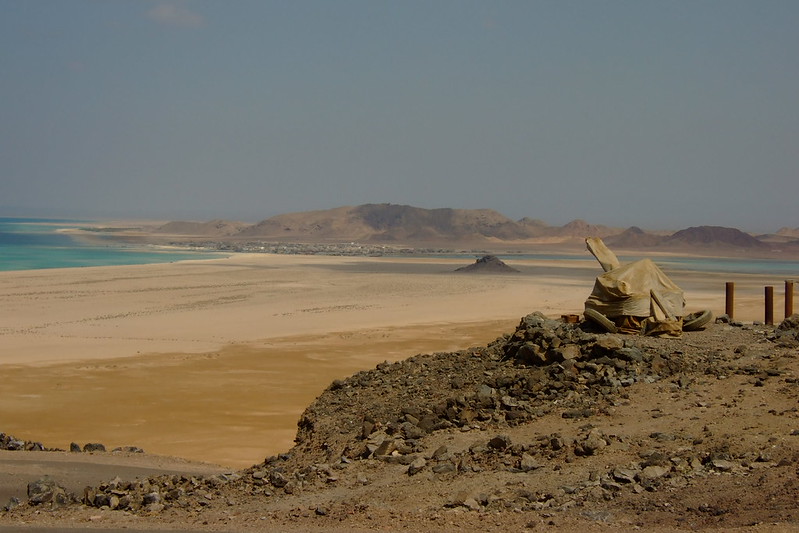
Photo credit: “bab al mandab security” by ninjawil is licensed under CC BY-NC-ND 2.0.
¹ Pre-war estimates of Hormuz’s share of global seaborne oil and LNG trade are drawn from International Energy Agency and U.S. Energy Information Administration data for 2025.
² Figures on Qatari LNG cargoes compiled from industry tracking data reported in mid – 2026 market analyses.
³ Reporting on the September 2026 pipeline attacks and Houthi territorial gains draws on contemporary accounts from regional and international media.
⁴ Projections on the potential scale of Gulf bypass pipeline and storage expansion by the late 2020s are based on analyst estimates circulating in 2026, actual volumes will depend on project execution and security conditions.
⁵ Reports in 2026 indicated that Qatar purchased U.S. LNG cargoes on the spot market to help meet certain long-term contractual obligations amid the disruption of its own exports.
⁶ IMF regional growth revisions for 2026 are drawn from the Fund’s updated assessments following the outbreak of the conflict.
⁷ The September 2026 meeting between the German and Russian foreign ministers on the margins of the UN General Assembly, and subsequent reports of contacts involving the AfD and Russian energy representatives, were widely covered in European media.
⁸ Israel’s recognition of Somaliland in December 2025 and the subsequent high-level engagement in 2026, including the Strategic Cooperation Declaration, are a matter of public record.
⁹ The September 2026 agreement between Israel and Morocco to upgrade diplomatic relations, expand flights, and advance economic agreements was announced jointly with U.S. participation.
¹⁰ The shift of some shipping traffic toward Arabian Sea ports outside Hormuz was reported by maritime tracking services and industry sources during 2026.