
Introduction
The story of Gulf financial power begins in the autumn of 1973.
In 1970, American oil production reached a peak. The US economy grew steadily more dependent on imported crude thereafter while also facing increasing inflationary pressures after 1971, when Richard Nixon ended the dollar’s convertibility into gold. On October 6, 1973, Egypt under Anwar Sadat and Syria under Hafez al-Assad launched a surprise attack on Israel on Yom Kippur. Washington rushed arms to its ally, and Nixon announced a $2.2 billion military aid package for Israel. In response, the Organization of Arab Petroleum Exporting Countries (OAPEC), with Saudi Arabia’s King Faisal as its driving force, announced escalating production cuts and an embargo on the United States and the Netherlands, later extended to other countries. By January 1, 1974, the posted price of Arabian Light, the Gulf’s benchmark for crude, had nearly quadrupled—leaping from $3.01 to $11.65 a barrel[1]. As a result, Western economies faced fuel shortages and stagflation, while Gulf producers benefited from a massive jump in oil revenues. Oil producers had gained significant pricing power, and the financial gains were unlike anything they had experienced before. Saudi Arabia’s current account surplus reached close to 51 percent of GDP in 1974.
Suddenly, Riyadh found itself asking: where to put all this money?
The answer was worked out in an unlikely place. At the Saudi Arabian Monetary Agency in Jeddah, a team of six, advised by a young American banker named David Mulford, worked in a dilapidated building with a single sluggish telex as their link to the outside world. The task of this team was to place a fortune that grew by $5 billion, and later $10 billion, every month.
Oil was already priced overwhelmingly in dollars, and only American markets could absorb sums on that scale. Elsewhere, a currency trade of just $10 million could move prices and markets. So, the kingdom placed its surpluses in dollar deposits and US Treasuries, with King Faisal insisting its purchases of American bonds remain secret, as well they did for four decades[2]. Abu Dhabi followed, creating the Abu Dhabi Investment Authority in 1976, and Kuwait, which had been investing its oil income abroad since the 1950s, scaled up. This is essentially how petrodollar recycling worked. Gulf countries sold their oil in dollars and placed much of those revenues in US Treasuries and in dollar deposits with Western banks, many of them in London’s Eurodollar market. And more than fifty years later, the dollar still plays a central role in Gulf economies. Most oil revenues are earned in dollars, five of the six GCC currencies are pegged to it, and Gulf sovereign wealth funds manage several trillion dollars in assets today.
Oil revenues financed much of the Gulf’s economic transformation, from infrastructure development to the accumulation of financial reserves. But this dependence on oil income also created structural vulnerabilities: swings in global oil prices could rapidly undermine fiscal and external stability. From mid-2014 to early 2016, oil prices collapsed from more than $100 a barrel to below $30. Saudi Arabia’s fiscal balance swung from a surplus of 5.5 percent of GDP in 2013 to a deficit of nearly 15 percent in 2015, and the central bank’s net foreign assets fell from a peak of $737 billion in August 2014 to $529 billion by the end of 2016. Chastened by the tumult, in 2016, Saudi Arabia launched Vision 2030 as governments across the region turned diversification from a long-standing aspiration into economic policy.
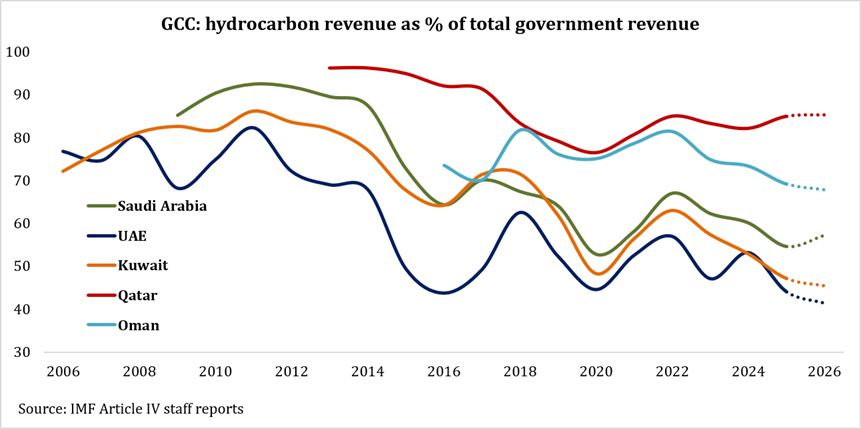
Each country followed its own path to fulfill similar goals: less reliance on hydrocarbons, more private investment, new sectors and a larger role for foreign capital. One and all made meaningful progress. In 2011, oil provided more than 90 percent of Saudi government revenue; by 2025, the IMF put the share at about 55 percent. In the UAE, the hydrocarbon share fell from over 80 percent to under half[3].
Chart 1: Hydrocarbon revenue as a share of total government revenue, GCC, 2006–2026
Diversification made the Gulf more resilient. It has not, however, made them less exposed. Indeed, diversification is no escape from geography, and the region’s economies still depend on a few maritime chokepoints. The process also opened new channels of risk, from mobile foreign capital to imported technology, while the dollar pegs tie the cost of financing diversification to US monetary policy, which tightened again during the war.
The Macro Context
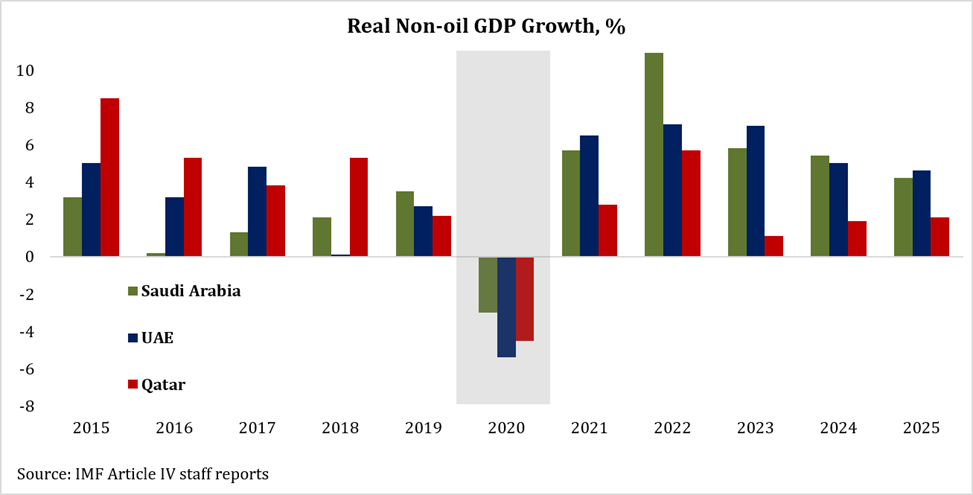
As reflected in the charts above, at the start of 2026, the Gulf’s diversification plans were yielding real dividends. In fact, non-oil activity in Saudi Arabia and the UAE was growing by 4 to 7 percent annually[4]. Saudi Arabia had been investing billions in Vision 2030 projects, while the UAE had become an important financial and commercial center for the region, with many industries such as banking and tourism expanding steadily. Qatar was expanding its LNG capacity alongside investments in other sectors, such as tourism and entertainment, particularly in the run-up to the 2022 World Cup.
At the same time, Gulf investors were putting money into artificial intelligence, data centers and defense. The scale of Gulf investment ambitions became particularly clear in May 2025, when Saudi Arabia, Qatar and the UAE announced economic agreements and investment commitments with the United States worth trillions of dollars during Donald Trump’s visit to the region.
Chart 2: Real non-oil GDP growth, 2016–2026
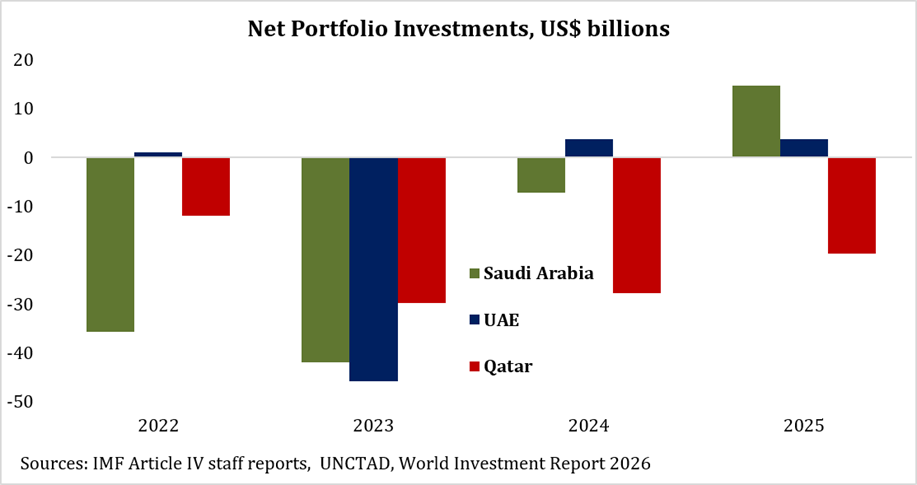
In 2025, foreign investment was also flowing into the Gulf. The UAE received $48 billion in foreign direct investment, while Saudi Arabia attracted $32.6 billion, its strongest year since at least 2020. But FDI is only part of the picture In the UAE, net portfolio flows swung from an outflow of about $46 billion in 2023 to small net inflows in 2024 and 2025, as foreign portfolio investment rose to $54 billion in 2024. Unlike FDI, portfolio investments are generally easier to sell and move across borders[5].
Chart 3: Portfolio investment flows, 2022–2025
2026: A Test of Endurance
Then came the US and Israeli strikes on Iran on February 28, 2026. Within days, Iran had effectively closed the Strait of Hormuz. The Revolutionary Guards also began systematically striking energy infrastructure across the region.
Initially, it seemed that most Gulf governments could absorb the shock, especially when it seemed to war might be brief. A ceasefire brokered by Pakistan and entering into effect on April 8 gave some hope, even if its application was highly uneven: Iran kept traffic through Hormuz tightly restricted thereafter, and on April 13 the United States imposed a naval blockade on Iranian ports. More optimism arrived in June, when Washington and Tehran signed the Islamabad Memorandum, which extended the ceasefire and reopened the strait to commercial shipping. But the truce collapsed in July, the blockade was reimposed, and by October, attacks on tankers had increased again. On October 11, 2026, only 2.9 million barrels of oil crossed the strait, compared with a pre-war average of 17.1 million barrels a day[6].
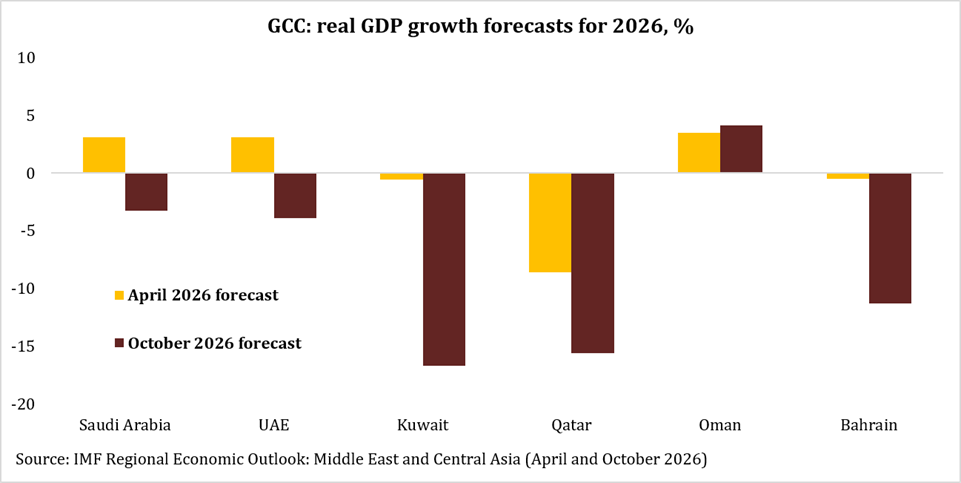
Eight months into the conflict, the economic consequences are becoming increasingly difficult to contain. Forecasting is also becoming a harder exercise by the day. In April, the IMF expected the GCC to grow by 2 percent this year. In October, it projected a contraction of 4.8 percent. That difference is staggering. More importantly, the IMF now expects non-oil activity to contract by 0.8 percent[7]. Kuwait, Qatar and Bahrain face double-digit contractions, while Oman is the only Gulf economy still expected to grow. The Fund expects growth to rebound by around 9 percent in 2027, assuming hostilities end and the Strait of Hormuz reopens in early 2027[8]. For now, however, this remains far from certain. The reversal begs questions as to the protection that economic diversification affords in the face of a regional conflict.
Chart 4: IMF 2026 growth forecasts for the GCC, April vs October 2026
Vulnerabilities Exposed
Physical vulnerability
Before the war, roughly a fifth of the world’s oil and a large share of Gulf LNG exports moved through the Strait of Hormuz. Once the strait became unsafe, the situation became a real problem for Gulf economies. An increase in oil prices can benefit exporters, but a barrel can either be exported or be stuck.
In March, Middle Eastern crude grades such as Oman and Dubai became the most expensive in the world as supply could not meet demand anymore: Overnight, Asian refiners competed for the oil that could still be delivered. Exporters with another way out could benefit from those prices, but those without one could not.
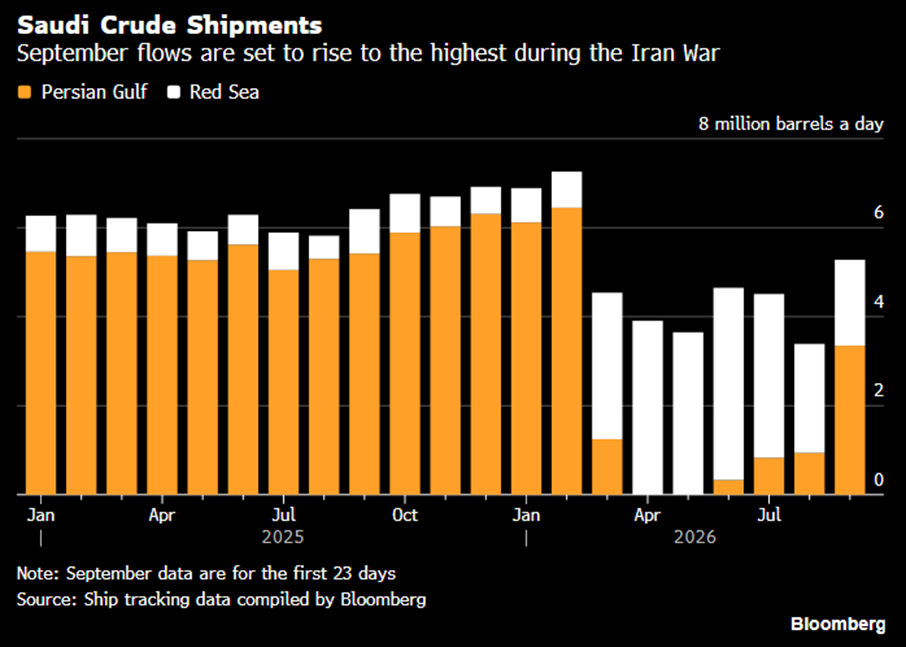
Saudi Arabia had an alternative: The East-West pipeline, completed in 1981 during the Iran–Iraq war, carries crude across the kingdom to Yanbu on the Red Sea. During the war, it allowed a large share of Saudi exports to continue moving despite the disruption in Hormuz.
Chart 5: Crude Flows Through the Gulf and Red Sea (January 2025-September 2026)
Source: Bloomberg Terminal via Ziad Daoud, Bloomberg Chief Economist MENA
The UAE had a smaller version of the same solution: the Habshan–Fujairah pipeline, which allows part of its crude to reach the Gulf of Oman without passing through the strait[9].
Qatar, however, had no comparable solution because its LNG exports depend on specialized liquefaction plants and dedicated shipping, and much of its export capacity is concentrated at Ras Laffan. In March, Iranian strikes damaged two liquefaction trains, taking about 17 percent of export capacity offline. QatarEnergy expects repairs to take three to five years and estimates the losses at around $20 billion annually[10]. Despite its strong fiscal position, Qatar cannot simply replace damaged LNG infrastructure overnight.
But Saudi Arabia’s alternative also has its limits. Its route west depends on the security of the Red Sea and on the transit corridor being used, Bab el-Mandeb or the Suez Canal. In September, drone attacks forced the East-West pipeline to shut for about eleven days, and when it restarted, flows were running at around 40 percent of their earlier level[11]. With the Houthis also targeting Saudi shipping, the kingdom now faces risks on both sides.
Unfortunately, the problem goes beyond oil and gas. Gulf states import much of what they consume, from food to manufactured goods and equipment needed for their industries. When ships must reroute, insurance becomes more expensive and ports become targets, the consequences are felt across the whole economy.
Financial exposure
Over the past decade, GCC governments have also changed how they finance their economies. Banks lend more, governments and state-owned companies issue debt, and equity markets have opened to international investors. Sovereign wealth funds have also become increasingly active, both at home and abroad.
This gave governments more options when the war began. They could borrow from international markets, provide liquidity and support affected businesses. Even Bahrain, which entered the conflict with public debt of around 145 percent GDP, was able to issue a $1 billion bond in June, after securing a $5.4 billion swap line with the UAE in April. The UAE, in turn, sought a dollar backstop from the United States[12]. But there is another side to relying on international capital markets: the cost of borrowing.
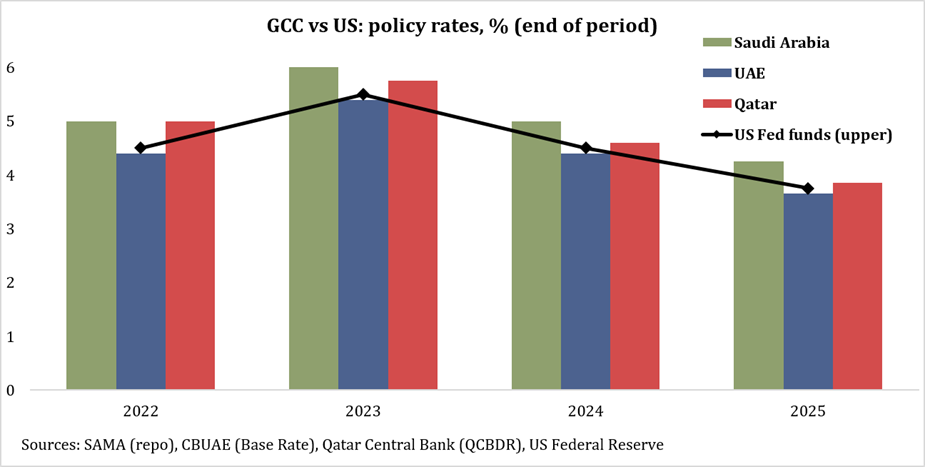
The war pushed energy prices higher, adding to inflationary pressures and complicating the prospect of lower global interest rates. This is particularly important for the Gulf’s dollar-pegged economies. In practice, when the US Federal Reserve keeps rates high, borrowing costs in these economies also tend to remain elevated, even when their domestic economic conditions would justify lower rates. Gulf economies that can still export may benefit from additional revenues, but financing new projects becomes more expensive.
Chart 6: Policy Rates 2022 – 2025
This matters particularly for Saudi Arabia. Vision 2030 was launched when global capital was relatively cheap. Today, the kingdom is financing projects ranging from NEOM and industrial development to tourism infrastructure, at a time when borrowing is more expensive and foreign investors are becoming more cautious. Net foreign direct investment into Saudi Arabia fell by about 12 percent in the first half of 2026 compared with a year earlier, and by more than 19 percent in the second quarter alone[13].
Its sovereign wealth provides considerable resources, but the scale of these projects means that Saudi Arabia still needs access to international financing and private investment.
Hot money
The UAE faces a different problem, particularly in Dubai.
Over the years, Dubai has built a reputation as a safe and profitable destination for international capital and wealthy individuals. Russian money after 2022, investors from emerging markets and regional wealth all contributed to the expansion of its real estate and financial sectors. But this is capital that can leave at any moment.
As we saw earlier, foreign portfolio money had been flowing in just before the war,, while Dubai’s property market had experienced several years of rapid growth. The war has now introduced another consideration for international investors: the possibility of direct military risks in a city that has long benefited from its reputation for safety. This does not mean Dubai is facing a financial crisis. But foreign investors do not necessarily need to withdraw their money for the economy to feel the consequences. Some may postpone investments, demand higher returns or simply look elsewhere. And for an economy that relies heavily on international business and capital, even a slowdown in new investment can matter.
Diversification has given Gulf economies more financial resources and new sources of growth, but it has not eliminated their dependence on oil exports, international trade routes and foreign capital. In some cases, it has even created new vulnerabilities, and the extent of these risks differs significantly from one Gulf country to another.
The potential shift in economic and investment priorities
If the first lesson of the war was where the vulnerabilities lie, the second is what governments are beginning to do about them. But it’s important to note that the economic and strategic shifts did not start in February 2026.
First, Saudi Arabia had already begun slowing and reassessing some of its giga-projects before the war. Project approvals were becoming more selective, financing was increasingly being moved toward private investors, and the government was paying greater attention to fiscal discipline. The war therefore arrived in the middle of an adjustment rather than at the beginning of one. The kingdom still needs diversification, and the war did not change that. If anything, it reinforced the need for it. But with large projects such as NEOM becoming more expensive than initially expected, partly because of sustained high interest rates, the question is increasingly how to finance them and which investments should take priority. This is partly why the development of deeper domestic capital markets is becoming more important. Saudi Arabia needs businesses and private investors to take on a larger share of the investment, supported by local capital markets that can help finance these projects.
The war has also raised questions about where Gulf governments should be directing their investments, particularly when it comes to security. Gulf states spent enormous sums on advanced missile-defense systems, yet they still faced attacks on cities, airports and energy infrastructure. And there is also a question of cost: expensive interceptors are being used against drones that can cost a fraction of the price. This is one reason why developing a domestic defense industry is becoming increasingly important.
Saudi Arabia had already begun this process before the war. By the end of 2024, close to 25 percent of its military spending had been localized, with the government targeting more than 50 percent by 2030[14]. The UAE has also been developing its own defense industry through EDGE. Developing a domestic defense industry helps create jobs and keep more spending inside the economy. But more importantly, it reduces dependence on foreign suppliers, especially when military equipment needs to be replaced during a conflict.
And the same reasoning applies to infrastructure. Saudi Arabia’s East-West pipeline allowed the kingdom to continue exporting oil when Hormuz was disrupted. Alternative railways, ports and trade routes are becoming more important, not only for oil exports but also for food and other essential imports. Building a railway through Jordan or Syria also means depending on the stability of those countries. So these infrastructure projects also have political implications for the Gulf’s relationships with its neighbors.
There is, however, another question worth considering when looking at the future of Gulf diversification. Saudi Arabia, the UAE and Qatar are investing heavily in artificial intelligence, data centers and other technology-intensive industries. These are meant to develop new sources of growth outside oil and gas, but they also require resources and technologies that Gulf countries do not necessarily control. Data centers need huge amounts of electricity and cooling, while AI depends on advanced semiconductors and computing equipment produced by a relatively small number of countries and companies. The same applies to advanced manufacturing, which relies on imported technology, equipment and critical minerals.
But Saudi Arabia is also trying to turn some of these dependencies into economic opportunities. In early 2025, Saudi had started to position itself in the global competition over rare earths, a market whose processing is heavily dominated by China. In November 2025, during Crown Prince Mohammed bin Salman’s visit to Washington, Saudi Arabia’s state-owned mining company Maaden, American company MP Materials, owned mainly by the US Department of Defense, announced plans to establish a rare-earth processing facility in the kingdom[15]. For Riyadh, this is also an opportunity to become part of a supply chain that Washington is actively trying to strengthen to diversify away from China.
The political realignment that follows
The US–Israeli war on Iran is also putting the Gulf’s political alliances under pressure. It is one thing to show solidarity for a couple of weeks, and another to maintain the same strategies and policies in the long run.
For decades, Gulf countries have relied heavily on the United States for their security. Washington maintained military bases across the region, supplied advanced weapons and provided the security umbrella that allowed Gulf governments to concentrate on their economic development. In return, Gulf states remained important energy suppliers, purchased billions of dollars of American military equipment and maintained close economic and political relations with Washington. But this relationship has been evolving in recent times. The last decades have seen Gulf countries develop closer economic ties with China, build relationships with other regional powers, and more independently pursue their own interests. Saudi Arabia’s restoration of diplomatic relations with Iran in 2023, brokered by China, was one example.
Then came the war. Iran attacked Gulf countries that had spent years trying to avoid direct confrontation with Tehran, including Qatar and Oman, which had both played mediation roles. But Gulf governments also found themselves paying a high economic and security price for a war they had not chosen, while American military protection had not prevented attacks on their cities, territories and energy infrastructure.
So where does this leave the US–Gulf relationship?
For now, there is no immediate alternative to Washington. Gulf militaries remain heavily dependent on American weapons, training and defense systems. China, despite being one of the region’s largest trading partners, does not offer an equivalent military presence or security guarantee. Gulf countries are, however, increasingly looking for additional partnerships, without necessarily abandoning their traditional relationship with the United States.
For example, in August 2026, Riyadh signed the Mecca Joint Defense Agreement with Türkiye and Pakistan. Under the agreement, an armed attack against one of the three countries is considered an attack against all, alongside commitments to strengthen defense cooperation and military production. For context, Saudi Arabia and Pakistan signed a bilateral mutual defense agreement in 2025, building on a long-standing military partnership: Pakistani troops have been stationed in the kingdom since the late 1970s, including in the oil-rich Eastern Province. Türkiye’s relationship with Riyadh, by contrast, had not developed at the security level, and Ankara has moved more cautiously: its parliament ratified the agreement only in November 2026, and any deployment of Turkish troops requires separate approval.
It did not take long for the agreement to face its first test. In October, the three countries agreed to activate collective deterrence measures following renewed Houthi attacks against Saudi Arabia. As we saw earlier, the Houthis have also threatened shipping in the Red Sea, putting pressure on the kingdom’s alternative oil export route through Yanbu. While Türkiye has ruled out sending troops to fight in Yemen, the agreement illustrates Riyadh’s efforts to strengthen its security relationships beyond Washington.
This is particularly important for Saudi Arabia because its economic transformation increasingly depends on regional stability. Vision 2030 requires foreign investment, secure trade routes and economic relations with neighboring countries. Riyadh therefore has an interest in strengthening its military partnerships while avoiding another prolonged confrontation with Iran, whose ability to disrupt Gulf trade and energy infrastructure has become clear during the war.
Differences between Gulf countries had already started to emerge before February 2026, particularly between Saudi Arabia and the UAE. This war has only made them more difficult to ignore.
UAE – Saudi Arabia divergence:
In April 2026, the UAE announced its withdrawal from OPEC, ending almost six decades of membership. The decision surprised oil markets, but it had been building for years. In fact, Abu Dhabi had invested heavily in expanding its oil production capacity, but OPEC quotas continued to limit how much it could produce. With a relatively low fiscal breakeven oil price and substantial spare capacity, the UAE had a strong economic incentive to seek greater production flexibility. Saudi Arabia, on the other hand, has higher fiscal financing needs and a greater interest in maintaining coordinated production policy to support oil prices.
Divergences between the two Gulf powers have also showed up in foreign policy. The example of Pakistan here is pertinent. In April, the UAE withdrew approximately $3.5 billion in deposits from Pakistan’s central bank, while Saudi Arabia moved to provide $3 billion in financial support, right as the UAE money went out[16]. Pakistan described the repayment to Abu Dhabi as a routine financial transaction, dismissing any underlying political motivation. But the timing of the two transactions—at a moment when Islamabad was playing a key role in mediating the US/Israeli-Iran conflict—pointed to an intra-Gulf division on how the war should be ended.
The two countries have also been pursuing different objectives in Yemen. Saudi Arabia has supported the internationally recognized government, while the UAE backed the Southern Transitional Council, which sought independence for southern Yemen. In January 2026, Saudi-backed forces reversed territorial advances made by UAE-backed separatists. The two countries had originally entered the conflict as allies against the Houthis, but they no longer necessarily agree on what Yemen’s political future should look like. Finally, Sudan. Saudi Arabia has been involved in diplomatic efforts to end the civil war and has supported Sudanese state institutions, while the UAE has repeatedly faced allegations of providing military support to the Rapid Support Forces, which have been fighting the Sudanese army since 2023.
All those events and decisions reflect a visible divergence between Riyadh and Abu Dhabi over their economic and geopolitical interests. Nevertheless, Saudi Arabia and the UAE remain close economic partners. They trade extensively, attract many of the same international investors and share important security interests.
The Iran question
Despite the military pressure it has faced, Tehran has demonstrated that it can impose enormous economic costs on its neighbors without defeating them militarily. The disruption of Hormuz and attacks on energy infrastructure have shown the limits of military protection when economies depend so heavily on maritime trade and regional stability. This gives Gulf governments an incentive to strengthen their defense capabilities, but also to maintain diplomatic channels with Tehran, even when relations are tense. Qatar and Oman have been particularly active on this side of diplomacy, and their exposure helps explain why. Qatar shares its main source of wealth, the North Field, with Iran, and Oman’s waters cover part of the Strait of Hormuz itself. For both, engagement with Tehran is a way of managing a dependence they cannot remove.
The same logic shaped the UAE’s choices. Abu Dhabi took the hardest military line in the first weeks of the war, yet moved toward a détente after the April truce, because Dubai’s role as a trade hub depends heavily on Iranian commerce. The August embargo showed how quickly that calculation can reverse when attacks resume. Bahrain, which hosts the US Fifth Fleet and has no diplomatic relations with Tehran, has much less room to maneuver. Saudi Arabia is hedging on both sides, signing a defense pact with Türkiye and Pakistan while sending its defense minister to Tehran. The result is a set of national strategies, each shaped by the country’s own exposure, and no common Gulf policy. For Iran, this is an advantage: it can deal with each government separately. For the Gulf, it means the cost of the war is negotiated country by country.
Conclusion
The war has shown that diversification made the Gulf more resilient, but not less exposed. Fiscal buffers, access to markets and alternative export routes helped absorb the shock, yet the region remains dependent on chokepoints, on borrowing costs set in Washington and on capital that can leave. The consequences will be profound and lasting, for these economies, for the region’s reputation as a safe hub, and for its strategic alliances.
Since the 1970s, the Gulf and the United States have been bound by an arrangement in which oil revenues were recycled into US assets while Washington provided the security umbrella. That arrangement is no longer exclusive. Gulf states are looking inward, building their own industries, including defense, and outward, diversifying their partners so as not to depend on a single guarantor. This reflects the broader geoeconomic fragmentation under way globally, where regional and bilateral arrangements are taking precedence over multilateral ones. The Gulf is no exception: even within the GCC, each country is responding to the war according to its own exposure. For a region whose wealth was built on the dollar system, the next phase of diversification will be as much political as economic.
Photo Credit: Official Navy Page from United States of America QM1 Thomas E. Dowling/U.S. Navy, Public domain, via Wikimedia Commons

[1] Daniel Yergin, The Prize: The Epic Quest for Oil, Money, and Power (New York: Simon & Schuster, 1991); U.S. Department of State, Office of the Historian, “Oil Embargo, 1973–1974,” Milestones in the History of U.S. Foreign Relations.
[2] Paul Blustein, King Dollar: The Past and Future of the World’s Dominant Currency (New Haven, CT: Yale University Press, 2025); David E. Spiro, The Hidden Hand of American Hegemony: Petrodollar Recycling and International Markets (Ithaca, NY: Cornell University Press, 1999).
[3] Author’s calculations from IMF Article IV staff reports, latest available vintage: International Monetary Fund, Saudi Arabia: 2015 Article IV Consultation, IMF Country Report No. 15/251 (Washington, DC: IMF, September 2015), and Saudi Arabia: 2026 Article IV Consultation, IMF Country Report No. 26/210 (Washington, DC: IMF, July 2026); International Monetary Fund, United Arab Emirates: Staff Report for the 2014 Article IV Consultation, IMF Country Report No. 14/187 (Washington, DC: IMF, July 2014), and United Arab Emirates: 2025 Article IV Consultation, IMF Country Report No. 25/327 (Washington, DC: IMF, December 2025). Saudi figures refer to the central government; UAE figures to the general government.
[4] International Monetary Fund, Saudi Arabia: 2026 Article IV Consultation, IMF Country Report No. 26/210 (Washington, DC: IMF, July 2026), Table 1; International Monetary Fund, United Arab Emirates: 2025 Article IV Consultation, IMF Country Report No. 25/327 (Washington, DC: IMF, December 2025), Table 1. Real non-oil GDP growth, 2023–2025.
[5] United Nations Conference on Trade and Development, World Investment Report 2026 (Geneva: United Nations, July 2026), annex table 1; International Monetary Fund, United Arab Emirates: 2025 Article IV Consultation, IMF Country Report No. 25/327 (Washington, DC: IMF, December 2025), balance of payments table.
[6] Government of Pakistan, Office of the Prime Minister, announcement of the U.S.–Iran ceasefire, April 7, 2026; U.S. Central Command, statement on the blockade of Iranian ports, April 12, 2026; Islamabad Memorandum between the United States and the Islamic Republic of Iran, signed June 17, 2026; Kpler vessel-tracking data, as reported in “Iran Steps Up Hormuz Surveillance: Attacks Soar, Oil Flows Crash Again,” Al Jazeera, October 14, 2026.
[7] International Monetary Fund, Regional Economic Outlook: Middle East and Central Asia (Washington, DC: IMF, April 2026); International Monetary Fund, Regional Economic Outlook: Middle East and Central Asia (Washington, DC: IMF, October 2026).
[8] International Monetary Fund, Regional Economic Outlook: Middle East and Central Asia, October 2026.
[9] U.S. Energy Information Administration, “Amid Regional Conflict, the Strait of Hormuz Remains Critical Oil Chokepoint,” Today in Energy, June 16, 2025.
[10] QatarEnergy, statement by Saad Sherida Al-Kaabi, Minister of State for Energy Affairs and President and CEO of QatarEnergy, on damage to Ras Laffan Industrial City, March 19, 2026.
[11] Reuters, “Saudi Arabia Restarts East-West Oil Pipeline, Sources Say,” September 22, 2026.
[12] International Monetary Fund, “IMF Executive Board Concludes 2025 Article IV Consultation with the Kingdom of Bahrain,” Press Release No. 26/23, January 27, 2026; Central Bank of the UAE, “CBUAE and CBB Sign AED 20 Billion AED/BHD Currency Swap Agreement,” press release, April 8, 2026; Kingdom of Bahrain, US$1 billion 10-year sovereign bond, settled June 10, 2026; “UAE Discusses Financial Backstop With US as Iran War Threatens Economy,” Bloomberg, April 19, 2026, citing the Wall Street Journal.
[13] General Authority for Statistics (GASTAT), Foreign Direct Investment, Q2 2026 (Riyadh: GASTAT, 2026); GASTAT, Foreign Direct Investment, Q2 2025 (Riyadh: GASTAT, 2025). First-half comparison based on net inflows in the first and second quarters of each year.
[14] General Authority for Military Industries (GAMI), “GAMI Reports Localization of Military Spending in Saudi Arabia Increases to 24.89%,” press release, Riyadh, November 10, 2025.
[15] MP Materials, “MP Materials and the U.S. Department of War Partner with the Saudi Arabian Mining Company Maaden to Develop Rare Earth Refinery Joint Venture,” press release, November 19, 2025.
[16] State Bank of Pakistan, confirmation of the repayment of US$3.45 billion in UAE deposits, April 24, 2026, as reported in “Pakistan Repays $3.45bn to UAE, Confirms Central Bank,” Dawn, April 24, 2026; Muhammad Aurangzeb, Federal Minister for Finance of Pakistan, remarks at the IMF–World Bank Spring Meetings, Washington, DC, April 15, 2026, as reported in Arab News, April 15, 2026.