
Introduction
On October 7th 2026, Iraq modified its official foreign exchange rate system and increased the public cash dollar buying price from 1,320 to 1,520 Iraqi dinars per U.S. dollar. The Central Bank of Iraq also established three exchange rates: 1,500 dinars to purchase dollars from the Ministry of Finance; 1,510 dinars to sell dollars to banks; and 1,520 dinars to sell cash dollars to the general public. The government stated that the changes were made in response to current financial and economic conditions.[1]
The alteration is important for more than just the fact that the dinar will buy fewer dollars under the new official exchange rate. More broadly, it reveals an essential weakness in Iraq’s economic system. Most government revenue comes from oil exports, and much of domestic demand is financed through public spending. Therefore, when oil revenues experience disruptions, the impacts extend far beyond the petroleum industry, affecting government expenditures, currency management, goods imports, and household purchasing power. As such, the devaluation of October 2026 at once constitutes an external shock and an evolution of a longstanding structural problem.
For households across Iraq, the outlook hinges on how exchange rate shifts affect imported goods, transportation, and business expenses, as well as how these shifts affect real wages. Public sector employees could be especially vulnerable if consumer prices rise while their salaries, denominated in dinars, remain fixed. For households in the Kurdistan Region, additional variables further complicate the picture: Public finances in these semi-autonomous jurisdictions depend heavily on transfers from the federal budget in Baghdad, so pressure on federal oil revenue passes directly to Erbil. High degrees of dependence on merchandise dispatched from federal Iraq and neighboring states, meanwhile, heighten the risks of imported inflation.
The war exposes an existing vulnerability
Iraq’s financial exposure to the US-Israeli war on Iran stems from its heavy reliance on oil export revenue. As oil sales represent the primary source of revenue for the federal budget, the government is vulnerable to any disruption in its ability to produce, transport, or sell this commodity. The 2025 Article IV Assessment by the International Monetary Fund (IMF) highlighted several key vulnerabilities, including high levels of public expenditure, limited non-oil revenue sources, funding constraints, and risks associated with declining oil prices, noting that fiscal adjustments in government spending would take time to implement.[2]
The point on lag effects when it comes to fiscal adjustments is salient. Recurring expenditures, principally salaries and pensions, create a high level of fixed demand in the budget. By the IMF’s estimations, those two line items alone accounted for spending in the area of 24% GDP last year. For reasons of domestic politics and social stability, allocations to the public sector (retirees included) cannot easily be reduced. But meeting liabilities of this magnitude amidst collapsing oil revenues comes at a steep financial cost, as the devaluation last month lays bare.
And oil revenues have indeed collapsed. Seaborne exports averaged about 1.31 million barrels per day in the first seven months of 2026, almost 60% below the same period in 2025, before rebounding to about 2.34 million in August, still below the pre-war level of roughly 3.4 million. [3]
What the exchange-rate change means
The devaluation shifts part of the oil shock from the state to importers and consumers. In nominal terms, the 15.2% increase in the dinar price of a dollar translates to a gain for the government: The dollars brought in through the exportation of oil convert to a larger sum of Iraqi Dinar than they did prior to the devaluation.
For companies with import-based business models, the math works out quite differently. Needing to pay suppliers in dollars—dollars which are now more expensive in terms of Iraqi Dinar—devaluation raises the price of foreign exchange and with it, the cost of doing business. Where cost increases cannot be absorbed by lowering profit margins, firms face a choice: they can raise their own prices, cut back on the volume of items ordered, or delay purchasing. The overall effect will depend on market competition for each product (price elasticity), inventory levels, contractual obligations, transportation costs, and whether sufficient U.S. dollars are available through authorized government channels. But uncertainty and volatility isn’t good for anybody. Baghdad’s main wholesale markets temporarily closed after the devaluation because traders could not reprice goods and commitments swiftly enough to ensure continuity of trading.
As mentioned, the Central Bank of Iraq’s announcement maintains distinct rates applicable to different transactions in the economy: the rate at which it purchases dollars from the Ministry of Finance, the rate at which it sells dollars to commercial banks, and the cash rate applicable to the general public. While the headline rate applies to official transactions, it is not representative of all individual transactions throughout the economy market.[4] The parallel exchange market is equally significant. The AP reported that prior to the announcement of the new exchange rate, the unofficial (parallel) rate exceeded 1,600 dinars per dollar. Following the announcement, the unofficial rate increased further. According to the AP, many exchange shops actually opted to close in Erbil in the face of profound unpredictability.[5]
These reports demonstrate the difficulty for businesses and households in determining which exchange rate would be applicable to them. A large differential between the official and parallel markets can complicate international trade. It can also dampen competition by widening gaps between market insiders and outsiders: businesses authorized to purchase dollars at an officially determined price have lower costs than those purchasing on the open market.
Reserves and the limits of short-term protection
The impact of the devaluation also raises concerns about whether Iraq’s foreign exchange reserves are adequate to support international payments and provide sufficient foreign exchange within the domestic economy.
The IMF’s estimate of Iraq’s gross reserves for 2025 was approximately $91 billion. At the time, the Fund projected modest declines for 2026. Due to the war on Iran, however, the decline has proven more precipitous. The CBI’s own data show reserves falling from $97.4 billion at the end of 2025 to $80.6 billion by the end of July 2026, before edging up to $81.5 billion in August.[6] Outside estimates are more cautious. Moody’s, which excludes gold and SDRs from its calculations, put reserves at around $73 billion at the start of 2026 and projects the stock to fall to $51 billion by the end of 2027. Standard Chartered, meanwhile, has warned of a fall to roughly $60 billion by year’s end.[7]
The reason for the decline is simple enough to parse. Reserves have been the government’s main buffer against a fairly cavernous budget gap. As of August, the government had collected about 45.3 trillion dinars in revenues on the year against 78.9 trillion in spending. Domestic borrowing helped cover some of the spread. But reserves did the heavy work, ultimately dictating that Baghdad devalue the currency and open discussions about a new borrowing arrangement from the IMF.[8]
Assessing the adequacy of reserves in crisis times is a complex science. Short-term import needs, expected foreign currency inflows, and the anticipated duration of the disruption all need be factored in. On the day the Central Bank announced it the devaluation, the institution stated that reserves were sufficient support all of the country’s current and future monetary needs, and that it would provide foreign currency to finance foreign trade, settle foreign card transactions abroad, and supply U.S. dollars to travelers. But given the decline observed this year, the projection of confidence, particularly when it comes to the future, does not quite pass muster.[9]
Distributive Effects of Devaluation
Devaluation’s distributive consequence ultimately run through two things: whether a worker’s income can be adjusted, and whether a firm can pass higher costs on.
Projecting effects for workers requires familiarity with the Iraqi labor market. Herein, the public sector remains outsized. State payroll covers nearly four and a half million employees and around three million pensioners.[10] Expectantly, salaries and pension payments are both denominated in Iraqi dinar. Prima facie, then, devaluation implies a real decline in income for these two large social categories. And the decline might be larger than appears at first blush. Accounting for dynamics in the parallel exchange market and rising shipping costs, one Iraqi economist projects the decline in purchasing power could be as high as 36%.[11]
The odds that these declines are offset through renegotiated pay packages, meanwhile, are fairly low. Compensation schemes in the public sector are fairly inflexible, with raises (alawa) evaluated annually and tied to period of service.[12] Pay increases also have a history of failing to keep the pace with inflation.[13] And the more immediate risk for public employees are delays in payments brought on by liquidity troubles at the Ministry of Finance. It was such troubles, after all, that helped force the October devaluation, and lest oil revenues start flowing at pre-war levels, liquidity will remain a recurring issue.
Against this backdrop, an uptick in public sector labor militancy would hardly shock. Mobilizations have been successful in the past: Protests in Basra in 2020 involved over 30,000 daily-wage government workers[14], ultimately forcing Baghdad to make 500,000 contract and daily-wage workers permanent.[15] Securing wage gains, alas, may prove a more challenging undertaking, all the more so given ongoing discussions with the IMF and policymaker fears over inflation.
Private and informal workers, a majority in the labor force are in an even more vulnerable state. In terms of scale, OECD estimates show 66.6% of Iraq’s workforce is in informal employment. In Kurdistan, construction employs about 11% of the private workforce, mostly as informal day labourers without social protection.
Even prior to the devaluation, this segment of Iraqi labor had been rocked by the war. In March alone, the ILO estimated around 100,000 job losses across Iraq, mainly in tourism, hospitality, oil services and bakeries. For those who kept their jobs, dollar compensation, more common in the private sector, did offer some relief against the devaluation. But it is hardly an escape valve from the economy’s wider pricing issues. In the first instance, a worker paid in dollars still faces higher dinar expenses. A day after the devaluation, Shafaq News price checks found increases of up to 15.4% for some staple foods.[16] In the weeks since, there is also data to suggest that prices for goods like detergent have more than doubled. Such changes more than offset whatever gains the dollar has made against the Iraqi Dinar, and are in keeping with what was observed after the devaluation of 2020.[17] Furthermore, in Erbil, rent is often set in dollars, and liable to increase in an inflationary period. All in all, the picture points to a declining labor share of income, with losses distributed unevenly across public and private sectors.
The distributive costs of the devaluation are set to be equally pronounced at the firm-level.
The sharpest losses are to accrue among importers with dollar debts and dinar revenue. An illustrative example is offered by one Baghdad clothing importer, who told AP that customers owe him in dinars while he owes Chinese suppliers in dollars.[18] More generally, in Ramadi, traders who sold goods bought on deferred dollar terms at pre-devaluation prices say they face higher costs settling with suppliers, while retailers struggle to raise prices because goods have established market prices. One economist argued that even if the dollar reached 200,000 dinars per $100, merchants could not pass on the full increase, because sales would fall.2
At the sectoral level, the devaluation blow is likely to be suffered disproportionately by domestic producers. This is partially due to the government’s removing certain protective measures at the same time as it weakened the currency. On October 13th, imported food and medicine were exempted from customs duties and import restrictions on vegetables, introduced earlier in 2026 in order to protect domestic growers, were partially lifted.
In the Kurdistan Region, the Agriculture Ministry has already warned that suspending poultry import duties could harm local producers. The ILO, meanwhile, has highlighted that agriculturalists face pressures brought on by rising dinar-denominated fuel and fertiliser prices, just as small manufacturers—employing 12% of the private sector in Kurdistan, and highly reliant on imported inputs—are seeing their expenses jump precipitously. As for those cashing in, early indications point to the financial industry. An Iraqi expert, recalling 2020, said private banks and speculators are best positioned to arbitrage gaps between official and parallel exchange rates.[19]
Kurdistan: shared exposure, distinct uncertainties
As mentioned in the introduction, though the Kurdistan Region faces the same general economic risks as federal Iraq, there are certain idiosyncrasies of the local economy which could intensify the effects of the devaluation.
First bearing mentioning is a lower capacity to absorb the devaluation itself. After the October 7th announcement, parallel-market quotes in Erbil spiked beyond what was seen elsewhere in Iraq, with dollars trading at up to 180,000 dinars per $100 against roughly 170,000 in Baghdad and 179,000 in Basra. Even if the gap proved short-lived—by late October, Erbil and Baghdad were trading at nearly the same rate, still well above the official 152,000—it was revelatory of the region’s lower levels of dollar liquidity and the impacts this can have on foreign exchange. And capacity to absorb the devaluation is further hindered by heightened exposure to imported goods. Comparative to other parts of Iraq, the Kurdistan region relies heavily on products brought in from Turkey and Iran. This squeezes local economic activity not only because of issues with dollar trade settlement, but because of imported goods’ relatively higher transport costs.
Secondly, there are unique fiscal dynamics at play. The Region’s salary bill is funded by Baghdad, but subjected to conditionalities. Under the 2023 federal budget law, the KRG must transfer half of its non-oil revenues and a share of oil income to Baghdad in return for a fixed monthly allocation for salaries and services. In practice, salary transfers have been tied to a monthly remittance of 120 billion dinars in non-oil revenue. But the arrangement has been unreliable. In May 2026, Baghdad sent about $675 million of the more than $735 million needed for salaries and pensions, forcing Erbil to borrow ahead of Eid.
The KRG also argues that Baghdad’s “actual spending” rule leaves the Region with less than its full share. Between 2014 and 2025, the KRG claims federal transfers covered only 46 of the 144 monthly payrolls owed. These numbers can be taken with a grain of salt; Baghdad disputes them, reminding that transfers depend on compliance with revenue-sharing obligations. Nevertheless, they reveal a tense fiscal picture, and one that could be complicated further by the devaluation.
Conclusion: The cost of an oil-dependent adjustment
Iraq’s October 2026 dinar devaluation illustrates how an external shock exposes the structural flaws of an economy reliant almost exclusively on oil revenue. The disruptions to Iraq’s oil export capacity and subsequent foreign exchange inflows caused by regional conflict, combined with existing fiscal obligations, have strained foreign currency inflows and constrained the government’s policy options. The devaluation enables the government to generate more dinars per dollar of oil revenue; however, this shift entails significant risks, including higher costs for importers and reduced real incomes for dinar-denominated wage earners.
These dynamics underscore the need for caution. The conflict intensified pressure on an already fragile economy. And a temporary increase in fiscal flexibility resulting from an exchange rate adjustment will not substitute for structural reforms. Stabilizing export revenues, building budget credibility, and cultivating a diversified productive base remain the orders of the day. Making progress on these fronts will require addressing the political economy of coalition-making in post-2003 Iraq. Salient here is the muhasasa quota system. Allowing members of governing coalitions to distribute state jobs, services and contracts so to build loyalty among key constituencies, muhasa has created a fiscal albatross—more than 800,000 people were added to the public payroll in 2023 alone. With current expenditures eating up the lion’s share of the budget, one upshot is insufficient allocations into capital expenditures and the kinds of investments needed to diversify the economy. Another is to turn sectors and markets into partisan fiefdoms, depriving the economy of the dynamism and competitive energies. Until these types of bargains are addressed, Iraq will face great difficulty in reducing the economy’s structural weaknesses.
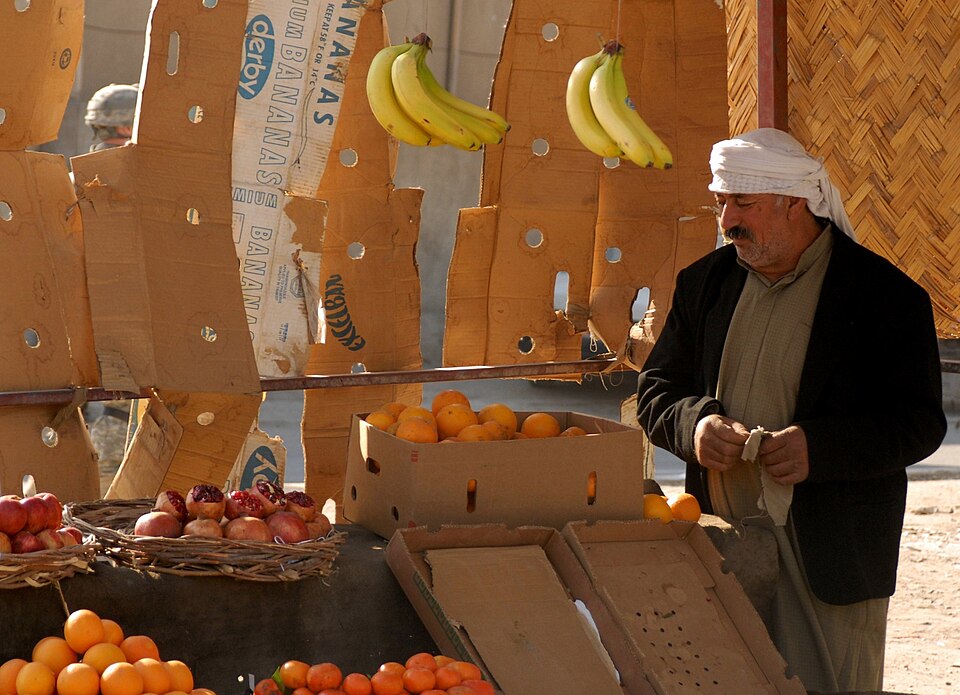
Photo Credit: James (Jim) Gordon, CC BY 2.0, via Wikimedia Commons

[1] Central Bank of Iraq, “A Strategic Step to Enhance Financial Stability,” 7 October 2026, official announcement in Arabic, specifying the new exchange rates and the CBI’s position on reserve adequacy and foreign-exchange provision: https://cbi.iq/news/view/3355.
[2] Ibid
[3] BigGo Finance (via BASNews), “Iraqi Crude Exports Jump to 2.34 Million Barrels a Day in August,” 2 September 2026, news report tracking SOMO export volume recovery to 2.34 million barrels per day following Strait of Hormuz bottleneck relief: https://finance.biggo.com/news/9fd9a39c-332c-448f-9879-a607d3592fc0.
[4] Central Bank of Iraq, “A Strategic Step to Enhance Financial Stability,” 7 October 2026, official announcement in Arabic, specifying the new exchange rates and the CBI’s position on reserve adequacy and foreign-exchange provision: https://cbi.iq/news/view/3355.
[5] Associated Press, “Iraqi Dinar Slumps Further on Parallel Market Following Official Currency Adjustment,” 8 October 2026, news report covering market volatility, parallel exchange rates exceeding 1,600 IQD per dollar, and currency trader closures in Erbil: https://apnews.com/article/iraq-currency-devaluation-oil-hormuz-3a6ffba435ac71a667b8a60ea77fff11
[6] Central Bank of Iraq (CBI), “Monthly Financial Statements and Reserve Statistics Data,” 2026: https://cbi.iq/
[7] Iraqi News, “Iraq’s foreign reserves may fall to $60 billion by end of 2026,” 8 October 2026: https://en.hathalyoum.net/articles/300447
[8] International Monetary Fund (IMF), “Iraq: 2025 Article IV Consultation—Press Release; Staff Report; and Informational Annex,” IMF Country Report No. 25/183, July 2025: https://www.imf.org/en/Publications/CR/Issues/2025/07/11/Iraq-2025-Article-IV-Consultation-Press-Release-Staff-Report-and-Informational-Annex-568569
[9] Ibid
[10] Reuters via TradingView, “Can Iraq fund projects and pay wages after dinar devaluation?,” 8 October 2026, quoting the prime minister’s economic adviser on payroll size: https://www.tradingview.com/news/reuters.com,2026-10-08:newsml_Zaw4cNW0R:0-can-iraq-fund-projects-and-pay-wages-after-dinar-devaluation/ ↩
[11] 964media, “Economists warn devaluation will raise costs and dampen demand, question budget’s export assumption,” 7 October 2026: https://en.964media.com/53515/ ↩ ↩2
[12] Staff writer, “Iraqi government resumes public sector raises and promotions”, +964 (June 21, 2026).
[13] The New Arab, “Iraqi civil servants demand pay raise as government negotiates largest budget in history,” 11 May 2023: https://www.newarab.com/news/iraqi-civil-servants-demand-more-pay-inflation-skyrockets ↩
[14] People’s Dispatch, “Multiple protests hit Iraq over currency devaluation, non-payment of salaries,” 23 December 2020: https://peoplesdispatch.org/2020/12/23/multiple-protests-hit-iraq-over-currency-devaluation-non-payment-of-salaries/ ↩
[15] The National, “Iraq’s biggest ever budget for 2027 built for boom times amid economic bust,” 26 October 2026: https://www.thenationalnews.com/business/economy/2026/10/26/iraqs-biggest-ever-budget-for-2027-built-for-boom-times-amid-economic-bust/ ↩
[16] FreshPlaza, “Iraq eases vegetable import restrictions following currency devaluation,” 15 October 2026: https://www.freshplaza.com/north-america/article/9883289/iraq-eases-vegetable-import-restrictions-following-currency-devaluation/ ↩ ↩2
[17] The National, “Iraq’s dinar devaluation tests efforts to protect consumers from rising prices,” 18 October 2026: https://www.thenationalnews.com/news/mena/2026/10/18/iraqs-dinar-devaluation-tests-efforts-to-protect-consumers-from-rising-prices/ ↩
[18] Associated Press via Fortune, “Iraq devalued its currency as the Iran war squeezes its oil exports,” 7 October 2026: https://fortune.com/2026/10/07/iraq-devalues-currency-iran-war-exports/ ↩
[19] Al Jazeera, “Iraq devalues its currency but some MPs oppose it,” 8 October 2026: https://www.aljazeera.com/economy/2026/10/8/why-has-iraq-devalued-its-currency-and-why-are-some-mps-against-it ↩