
Introduction
Since the US-Israeli war on Iran began in February, Qatar, which in normal times supplies roughly a fifth of the world’s LNG exports, has seen its output sharply curtailed. Closures of Hormuz made delivering existing orders effectively impossible. Iranian attacks on Ras Laffan in early March, which disabled a gas-to-liquids plant alongside two liquefaction trains, the processing units that chill gas into liquid, knocked out 17 percent of national LNG capacity.[1] In navigating these troubled waters, Doha has needed make some difficult decisions. One was announced in the last week of October. QatarEnergy, one of the world’s largest producers of liquefied natural gas (LNG)—and a company whose receipts constitute the primary source of the Qatari state’s revenues—agreed to buy LNG from American competitors: On the 22nd, the firm signed for up to four million tonnes a year from Cheniere and, a week later, up to three million a year from Woodside. H.E. Saad Sherida Al-Kaabi, QatarEnergy’s chief executive and Qatar’s Minister of State for Energy Affairs, described the purchases as a hedge against future closures of Hormuz.[2]
With war having now lasted nearly nine months, the six economies of the Gulf Cooperation Council are facing compounding challenges. The latest forecasts from the International Monetary Fund, released in October, project only Oman to achieve a positive growth rate (4.1 percent) this year. By the IMF’s account, Saudi Arabia’s GDP will contract by 3.3 percent, the UAE by 3.9, Bahrain by 11.3, Qatar by 15.6 and Kuwait by 16.7.[3] Lost output, direct strikes, dependence on hydrocarbons and the resilience of domestic activity all move numbers like these. In the uneven spread between Kuwait and Saudi Arabia, a sense of chokepoint vulnerability comes through.
But if GDP figures give an indication of where things lie today, the outlook for investment offers a view into where things may be headed. Herein, a case study of Qatar, set in comparison with the UAE, is revelatory. In Doha as in Abu Dhabi, the evidence shows that a continuity premium is guiding how capital is being deployed. Simply put, a continuity premium is the extra value that accrues to an asset by way of it keeping an essential service or export running. And at our present juncture, the abiding investment objective appears to be building up and diversifying the types of assets which can ensure that, hell or high water, essential domestic services keep working and critical export flows keep reaching external markets.
Interconnected infrastructure as a wartime vulnerability
On essential domestic services, it is appropriate to focus on water. To differing degrees, desalination is a critical part of this story throughout the Gulf. Qatar is the most reliant: desalination meets 77.3 percent of total water demand while supplying nearly 99 percent of potable water. In Bahrain, the corresponding figure on water demand is 67.5 percent, 52.1 percent for the UAE, and 42.2 and 31 percent in the cases of Kuwait and Oman, respectively. For the GCC’s largest member, Saudi Arabia, higher availabilities of groundwater and treated wastewater mean desalination need only cover 18.1 percent of demand.[4]
The war has brought into view a long-standing risk: dependence on desalination, most acute in Qatar, makes the power plants that feed these facilities a major point of vulnerability. Per David Michel of the Center for Strategic and International Studies (CSIS), roughly three-quarters of the region’s desalination plants are integrated power and water facilities, single plants that generate electricity and desalinate seawater on the same site.[5] At Umm Al Houl in Qatar, an electricity plant with 2,520 MW of capacity sits beside a desalination plant able to produce 197.9 million imperial gallons a day (MIGD), part of it thermal distillation that draws steam from the turbines next door.[6] Even if the desalination units themselves go unharmed, this means water can swiftly cease being available if generators feeding the plant are hit, or if grid connections are severed.
To manage such a contingency, the expansion of storage capacity is essential. Fortunately, Gulf states had already recognized this need prior to the war presently raging in the neighbourhood. In Qatar’s case, the Water Security Mega Reservoirs Project was inaugurated in December 2018 at a cost of QAR 14.5 billion. The forward looking venture managed to raise storage capacity by 155 percent, with the Qatar General Electricity and Water Corporation (KAHRAMAA) reporting storage capacity of 2,417 million gallons distributed across 42 reservoirs as of 2024. Usable volume is lower, of course, as losses are incurred in conveying water from reservoir to household tap. Nevertheless, these sums are not nothing: at full capacity, they equal almost six days of normal water demand, or about four and a half days of output from desalination facilities. Such are the fruits of prudent emergency planning.[7]
All indications point to Qatar investing further in infrastructural resilience. Indeed, if planning and tendering for a number of large projects preceded the war, their advance has continued during it.
First worth mentioning are capital deployments into electricity generation and the grid. In April, KAHRAMAA tendered a $650 million expansion of the transmission network and received bids in August.[8] On June 24th, the Corporation also awarded more than QAR 2.2 billion in engineering, procurement and construction contracts for substations, cables and overhead lines in Qatar’s western region.[9] Critically, these projects will connect the 2 GW Dukhan solar plant, contracted in September 2025, to the national grid.[10] KAHRAMAA says that, beyond boosting the grid’s capacity to absorb renewable energy, these investments will also make the network more efficient and flexible, improving the reliability of service in support of security of supply. Abu Dhabi is following a similar path, evinced in the launch of a power plant and battery energy storage system project by Masdar, the Emirates Water and Electricity Company (EWEC) and TAQA Transmission in January 2025. The venture pairs 5.2 GW of solar electricity generation capacity with 19 GWh of battery storage, allowing one gigawatt of power to be delivered around the clock. The project reached financial close, the point at which its funding is signed, on July 13th of this year on $6.1 billion of investment, $5.1 billion in the form of debt financing extended by a consortium of thirteen lenders.[11] In the face of war, that policymakers in Qatar and the UAE facilitated the advance of these efforts speaks to the seriousness of commitments to enhancing baseload energy and future energy security.
In Qatar’s case, the commitment to consolidating water security is equally apparent. As with energy, major steps in this direction were actually taken prior to the war. In May 2025, KAHRAMAA, QatarEnergy and the Qatar Electricity and Water Company signed an agreement for a power and desalination facility priced at QAR 13.5 billion. Once completed, this Facility E at Ras Abu Fontas will have an electricity generation capacity of 2,400 MW and turn out approximately 110 MIGD. In relative terms, the plant is expected to provide about 23 percent of Qatar’s power and 20 percent of its water production. The plant is being developed by a consortium led by Japan’s Sumitomo Corporation, with Mitsubishi Power supplying the gas turbines, an order it announced on 14 January 2026. Five days later the Japan Bank for International Cooperation announced up to $990 million of lending for the project alongside roughly $3 billion in co-financing. Under a 25-year offtake agreement, KAHRAMAA will buy the plant’s electricity and water.[12]
Alternative Investment Strategies on the Export Front
On the export side, geography left Doha far fewer options than it had at home. As the conflict heated up, no viable workarounds to the Hormuz chokepoint were in place: Gas was liquefied, stored and loaded at a single location, Ras Laffan, with every LNG cargo needing to traverse the strait in order to reach external markets. With few alternatives available, QatarEnergy’s wartime improvisations were necessarily limited in scale. To manage storage at Ras Laffan and keep parts of the complex running at minimum levels, LNG was loaded onto available empty tankers inside the Gulf, and some fuel was exported to Kuwait. To keep gas flowing to buyers, costly ship-to-ship transfers, a technically complex operation rarely used outside emergencies, were also carried out this summer. In August three cargoes of Qatari and Emirati LNG were moved in this manner in open water off Oman and the UAE, two of them involving vessels that had been damaged or caught up in incidents near Hormuz in July. Bogdan Ratiu of LNG Synergy put the cost at more than $1 million a transfer, with each operation taking 30 to 35 hours. Force majeure, the contractual clause that suspends a supplier’s delivery obligations when events beyond its control intervene, was declared in March and now runs to the end of December. While Al-Kaabi says the undamaged plants at Ras Laffan could return to full production within a week of a peace deal (provided ships are available), this offers no fix while the war continues.[13]
To future-proof petroleum revenues against the kinds of income losses which war and the closure of Hormuz imposed this year, the UAE and Qatar are following different playbooks. In the case of the former, the focus is on building up pipeline infrastructure so as to reduce reliance on transits through the Strait. Investments in redundancy precede the current war, of course. In 2012, the Abu Dhabi National Oil Company (ADNOC) opened a pipeline capable of carrying 1.5 million barrels of crude a day from oil fields in Abu Dhabi to terminals in Fujairah on the Gulf of Oman. As is well documented, the pipeline offered the UAE a lifeline this year: Between 20 and 24 March, loadings out of Fujairah averaged 1.9 million barrels a day, some 57 percent above the 2025 average. And thereafter, Fujairah kept up the quickened pace: Across the duration of the war, exports ran some 74 per cent above their prewar average reaching 2.28 million barrels a day in July. In September, Kpler estimates that the port handled almost a quarter of the crude leaving the Gulf region.[14]
But policy planners in the Emirates are not content with these figures and have taken steps to expand pipeline throughput. On 15 May Abu Dhabi’s Crown Prince, Sheikh Khaled bin Mohamed bin Zayed, instructed ADNOC to speed up a second, 406-kilometre line to Fujairah, on which construction had begun in 2025. Five days later, ADNOC’s managing director and chief executive, Sultan Ahmed Al Jaber, said it was “already 50 percent complete, and we are accelerating delivery toward 2027.” And Abu Dhabi may go further still. In early November, Bloomberg reported that ADNOC was weighing a third pipeline to Fujairah that could serve Asian customers; the plans were not settled, and ADNOC called the report “not accurate and purely speculative.”[15] Although details are difficult to verify independently, these undertakings are likely to be costly. In Abu Dhabi, however, insuring future income flows via pipeline workarounds appears to outweigh the financial cost of investments, and war is only speeding up delivery schedules.[16]
Doha weighed investments in logistical bypasses, too, but opted against them in the final instance. Unlike crude, which can be piped and loaded without any transformation required, gas must be liquefied before it can be shipped: As such, a workaround to Hormuz would require that QatarEnergy build a second set of liquefaction trains at the terminus of a prospective pipeline, an expensive and duplicative undertaking. By September, H.E. Al-Kaabi said the option had been ruled out on commercial and technical criteria. In October, he further justified the decision in view of truths that had been revealed by war: “As we have seen, pipelines and pump stations or compression stations can be also targets.” On that reasoning, a bypass would only have given existing risk a new address.[17]
Rather than hedge Hormuz risk through building out an entirely new circuitry for LNG exportation, Doha’s approach, revealed in recent contracts with American producers, is to secure supply, and with it revenue, from places far from the Gulf. Through the deal with Cheniere, QatarEnergy has contracted up to four million tonnes of LNG a year from its supplier’s Sabine Pass and Corpus Christi facilities. The product is to be sold free on board, priced off Henry Hub plus a fixed fee, and will be ready for delivery from the early 2030s through 2054. Free on board means QatarEnergy takes ownership of each cargo at the American terminal and arranges its own shipping. Henry Hub is the benchmark price for US natural gas, so the cost will track American prices, plus a fixed fee per unit that, in contracts of this kind, pays for liquefaction. (A quarter of this volume is not yet guaranteed: it depends on Cheniere taking a final investment decision, its formal go-ahead, on the first phase of an expansion at Sabine Pass.) QatarEnergy’s agreement with Woodside, meanwhile, locks in up to three million tonnes per annum of Louisianan LNG across twenty years, with deliveries likewise expected to commence around 2030.[18] These operations run through QatarEnergy’s trading arm.
H.E. Al-Kaabi has been candid about the strategic reasoning at play, which took shape about three months before the October signings. A future closure of the strait is “the true contingency that we’re looking to have [cover for],” he told Reuters. Purchases of American LNG, Al-Kaabi noted, require no capital spending, cost far less than pipelines or extra liquefaction trains, and in normal circumstances should make “a reasonable return.” In the event of a closure of Hormuz, meanwhile, gas bought in the United States—in Cheniere’s case at a price tied to Henry Hub—lets the company profit from the gap between prices, an arbitrage that, in Al-Kaabi’s words, “would make up some of the loss” from lost Qatari exports.[19] But what the American volumes cannot do is back up long-term customer contracts, which are point-to-point: each links supply from Qatar’s own plants to particular buyers, so a Louisiana cargo cannot simply stand in for one from Ras Laffan. The hedge therefore protects revenue, not deliveries. What the hedge is worth cannot yet be stated: the Cheniere fixed fee and Woodside’s terms are undisclosed, and the payoff depends on price gaps that will open only in a future disruption.
Qatar’s investment in LNG capacity abroad is not new. Years ago, QatarEnergy took a 70 percent stake in Golden Pass, a Texas terminal which it co-owns with ExxonMobil, and one which produced its first LNG in late March and loaded its first cargo on April 23rd. Muez Ali of the Qatar Foundation’s Earthna Center for a Sustainable Future has argued for exactly this kind of resilience, built through “geographically diversified overseas investments and supply relationships.”[20] What is new in October’s contracts with Cheniere and Woodside, then, is the move from owning production to holding a trading position.
At home, lastly, QatarEnergy’s prewar investment in North Field East, the first phase of its LNG expansion, should soon begin to make up for some of the capacity lost at Ras Laffan. After delays caused by Covid-era restrictions, the prewar expectation was that first production from North Field East would be “somewhere in mid-2026, in the third, fourth quarter ‘26 maximum.” This September, Al-Kaabi updated the timetable, projecting the complex’s first train to begin operations in the first half of 2027. Al-Kaabi attributes the delay to disrupted sea lanes, which have held up imports of essential equipment. Qatar’s target for total LNG capacity by 2030 remains 142 million tonnes a year.[21] Table 1 summarises the record.
Table 1: Protection in place, wartime response and documented change to an investment decision
| System | Protection already in place | Response during the war | Documented change to an investment decision |
| Grids | Dukhan solar contracted September 2025; its grid connection awarded June 2026. | No reported national interruption. | None identified. The June 2026 award connects a plant contracted before the war. |
| Water | 538 MIGD production against 420 MIGD demand in 2024; reservoirs from 2018; Facility E signed May 2025, financed January 2026. | No interruption reported. | None identified. |
| Renewables | 5.2 GW of solar with 19 GWh of storage, announced January 2025 for one gigawatt of baseload. | Construction and financing continued. | None identified. Financial close July 2026 on the original reliability case. |
| LNG, Qatar | One sea route. Golden Pass equity in Texas, first cargo April 2026. | Ship-to-ship transfers, chartering inside the Gulf, force majeure to end December. | Up to 7 mtpa of US LNG contracted October 2026 as a hedge, no new capital. First NFE train moved to H1 2027. |
| Crude, UAE | Fujairah line since 2012, about 1.5m b/d; second line begun 2025. | Fujairah loadings about 1.9m b/d, 20 to 24 March. | Second line accelerated May 2026, targeting 2027. |
Note: mtpa, million tonnes a year; b/d, barrels a day; NFE, North Field East; H1, first half.
The Potential Fiscal Consequences of Hedging on Hormuz
Unable to move its coastline, Qatar has to buy continuity in other ways. The hedge itself, by Al-Kaabi’s account, needs no new capital and should even earn a reasonable return in normal market conditions. What continuity costs in a crisis will depend on contract terms not yet disclosed and on the ancillary costs of chartering vessels and shifting cargoes to free up storage. As such, who ultimately carries the cost of this insurance policy, and whether any of it reaches the public purse, remains very much up in the air.
The Cheniere deal specifies that from the early 2030s, QatarEnergy will take cargoes at American terminals on free-on-board terms, paying the cost of the gas itself as well as the fixed fee and for the voyage.[22] Woodside’s terms have not been published. But in brass tacks, QatarEnergy has committed to pay, from around 2030, for gas meant to offset losses from a future Hormuz closure, and it made that commitment at a time when an existing closure has reduced company revenues significantly. Prima facie, the logic and business rationality are sound. One major question is left unanswered, though: who, amongst the two contracted partners, bears the risk for emergency contingencies? Qatar’s existing contracts offer little guidance, as their published terms do not show whether buyer or seller bears the cost of transfers at sea or emergency charters. Typically, however, force majeure clauses in commodity trades leave buyers to replace missing cargoes at their own expense.
While Qatar’s force majeure declaration legally relieves it of delivery obligations, QatarEnergy has actively purchased and supplied third-party cargoes to help meet its customers’ needs. Were American suppliers to invoke force majeure, the hit to the energy market might be heavy. It could also leave the hedge empty at the moment it was needed.
All this pertains to Qatar’s fiscal outlook because QatarEnergy is state-owned. Whatever reduces its earnings—be it gas that goes unshipped because of a Hormuz closure, or deals gone awry with American suppliers—means lower receipts for the treasury. Utilities and diversification projects would feel the effect only at a further step, if budget allocations change.
Budget figures from this year can give a sense of the stakes. Approved on 11 December 2025, the 2026 budget was drawn up in another time: it assumed oil at $55 a barrel, for one. It also projected a deficit of QAR 21.8 billion on spending of QAR 220.8 billion, of which QAR 62.8 billion was allocated to major capital projects.[23] By midyear, alas, the best laid plans for fiscal planners had been overtaken by events. After running a first quarter deficit of QAR 10.3 billion, the second-quarter figure jumped to QAR 21.2 billion on revenue of QAR 25.6 billion and spending of QAR 46.8 billion. To wit, the deficit for the first half of the year was about 45% higher than what had been planned for the entire fiscal year.
Evidence suggests that to date, the squeeze has not affected the outlook for public investments. The expenditure side of the ledger in Q2 shows capital spending continuing, with QAR 8.748 billion going to major projects alongside QAR 17.611 billion for salaries and wages. Foreign Ministry spokesman Majed bin Mohammed Al Ansari confirmed the state’s commitment to national development projects, publicly asserting that savings on the spending side have been sought in cuts to “operational expenditure only”.[24] The picture, then, shows no sign that wartime continuity spending has displaced prewar investment plans. In the disclosures examined here, no solar project has been cancelled, deferred or redesigned, no rise in Qatari household electricity or water tariffs has been announced, and Doha Investment, launched on September 20th to consolidate existing domestic holdings in non-hydrocarbon sectors, does not name energy or utilities among its sectors.
But the long-term risk to investment turns on the duration of the war. In March, QatarEnergy estimated that the damage at Ras Laffan would cost around $20 billion a year in lost revenue. Repairs to the two trains damaged at Ras Laffan are expected to take three years on the minister’s estimate, while the gas-to-liquids plant is due back in the first quarter of 2027: Investments in LNG production capacity meant to lift revenue this year now wait for next.[25] And the horizon is cloudy indeed. In April, the World Bank projected a 5.7 percent contraction in Qatar’s real GDP; the IMF’s October forecast put it at 15.6 percent. The Fund’s forecasts assume only a gradual reopening of the strait from March 2027, with a return to prewar conditions by October 2027. Kpler data, meanwhile, showed clearance, meaning the volume of oil confirmed as having passed through the strait, at roughly 11.9 million barrels a day in mid-October, about 30 percent below the prewar baseline.[26]
For Doha, the consequences could prove compounding. Diversification away from hydrocarbons remains a national priority. Investment for this project, however, depends on hydrocarbon surpluses, which are likely to be smaller for some years. The 2027 budget, due in December, will be the first attempt at resolving this dilemma. How long the war lasts will decide how hard that becomes.
Conclusion
Faced with the same closed strait, two of the Gulf’s most exposed exporters reached for different instruments. The UAE brought forward a bypass it was already building, a capital decision measured in kilometres of pipe and a delivery date. Qatar, having ruled out a pipeline on commercial, technical and security grounds, built its protection through a commodities trading desk at QatarEnergy, contracting up to seven million tonnes of LNG a year from outside the Gulf. A material response on the one hand, a financial one on the other. But both pointed at ensuring continuity in hydrocarbon income in the face of future emergency.
The domestic record in Qatar and the UAE points to continuity planning of a quieter kind. The grid programme, the water plant and the solar scheme examined here were all justified on reliability and security of supply before the war began. Built to serve the energy transition and continuity at once, they are neither wartime conversions nor a retreat from decarbonisation.
What happens next will show whether the hedge hardens into strategy. Al-Kaabi says “There’s more to come,” with a target “much higher” than seven million tonnes a year and further agreements of 20 to 25 years expected before the end of 2026.[27] December’s budget will show whether any of the strain reaches domestic allocations, and the pace of reopening will decide how long the workarounds have to run. For Qatar, continuity used to rest on the strait staying open. From the 2030s it will rest partly on contracts, signed against a closure that has not yet come.

This publication has been supported by the Rosa-Luxemburg-Stiftung. The positions expressed herein do not necessarily reflect the views of Rosa-Luxemburg-Stiftung.
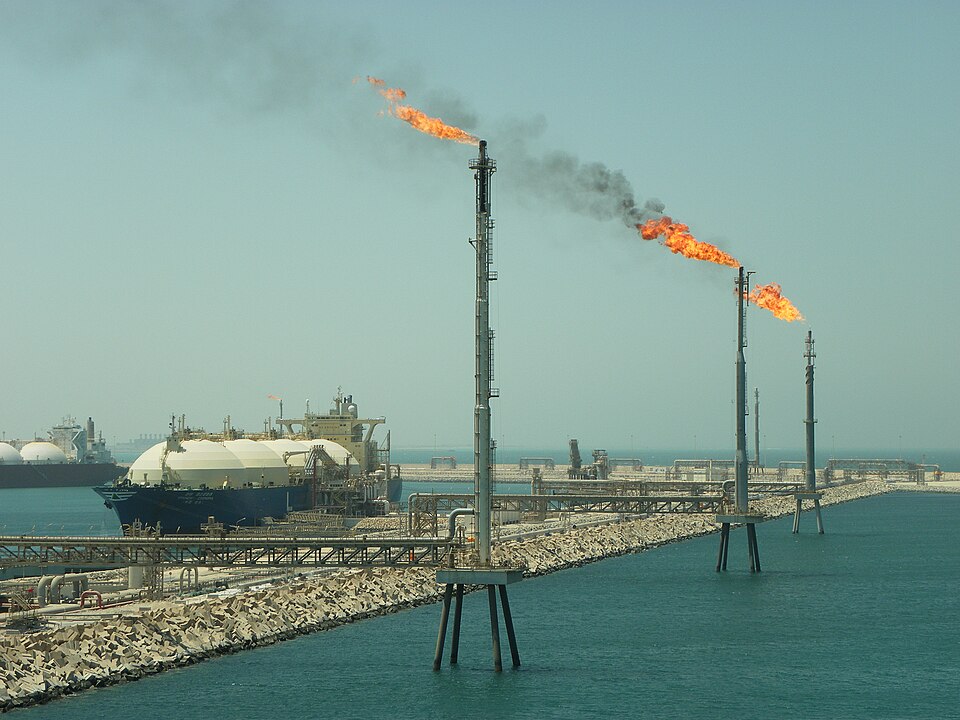
Photo Credit: Matthew Smith @ Flickr, CC BY 2.0, via Wikimedia Commons

[1] On Qatar’s share of global exports, Mills and El Dahan, “QatarEnergy buys US, other LNG.” On the damage, Reuters, interview with Saad Sherida Al-Kaabi, 19 March 2026, https://www.reuters.com/business/energy/iran-attack-damage-wipes-out-17-qatars-lng-capacity-three-five-years-qatarenergy-2026-03-19/; train identities and ratings are from Jack Sharples and Bill Farren-Price, “The Iran War and Disruption to LNG Supply from the Persian Gulf,” Oxford Institute for Energy Studies, March 2026, https://www.oxfordenergy.org/wpcms/wp-content/uploads/2026/03/Comment-The-Iran-War-and-Disruption-to-LNG-.pdf.
[2] Andrew Mills and Maha El Dahan, “Exclusive: QatarEnergy buys US, other LNG to hedge future Hormuz disruptions,” Reuters, 29 October 2026, https://www.reuters.com/business/energy/qatarenergy-buys-us-other-lng-hedge-future-hormuz-disruptions-2026-10-29/. On the agreements, Cheniere Energy, press release on long-term sale and purchase agreements with QatarEnergy, 22 October 2026, https://lngir.cheniere.com/news-events/press-releases/detail/348/cheniere-signs-long-term-sale-and-purchase-agreements-to; and “QatarEnergy turns to US LNG with Woodside deal as Hormuz force majeure drags on,” The National, 29 October 2026, https://www.thenationalnews.com/business/2026/10/29/qatarenergy-turns-to-us-lng-with-woodside-deal-as-hormuz-force-majeure-drags-on/.
[3] International Monetary Fund, World Economic Outlook, October 2026, real GDP growth projections for 2026, https://www.imf.org/external/datamapper/NGDP_RPCH@WEO; and “IMF cuts 2026 growth forecasts for Gulf economies due to prolonged Hormuz closure,” The National, 13 October 2026, https://www.thenationalnews.com/business/economy/2026/10/13/imf-cuts-2026-growth-forecasts-for-gulf-economies-due-to-prolonged-hormuz-closure/.
[4] David Michel, “Could Iran Disrupt the Gulf Countries’ Desalinated Water Supplies?” Center for Strategic and International Studies, 19 March 2026, https://www.csis.org/analysis/could-iran-disrupt-gulf-countries-desalinated-water-supplies.
[5] Michel, “Could Iran Disrupt.” Michel does not say whether the three-quarters share counts plants or capacity.
[6] On drinking water, Michel, “Could Iran Disrupt.” On Umm Al Houl, Umm Al Houl Power, company profile, https://www.ummalhoul.net/.
[7] KAHRAMAA, “Water Sector,” for storage, production (538 MIGD) and demand (420 MIGD) in 2024, https://km.qa/AboutUs/Pages/WaterSector.aspx; and, on the reservoirs, “Amir inaugurates Water Security Mega Reservoirs Project,” The Peninsula, 12 December 2018, https://thepeninsulaqatar.com/article/12/12/2018/Amir-inaugurates-Water-Security-Mega-Reservoirs-Project. Days of demand and of production are the author’s calculation from these figures, assuming full reservoirs.
[8] “Qatar receives bids for major power grid expansion,” MEED, 24 August 2026, https://guest.meed.com/qatar-receives-bids-for-major-power-grid-expansion/.
[9] KAHRAMAA award of 24 June 2026 for the western region network and the Dukhan solar connection, as reported in Arabic by Marsal Qatar with the utility’s stated objectives, https://marsalqatar.qa/post/87097/.
[10] On the Dukhan contract, The Peninsula, 16 September 2025, https://thepeninsulaqatar.com/article/16/09/2025/qatarenergy-signs-contract-with-samsung-to-build-dukhan-solar-power-plant-one-of-the-worlds-largest; KAHRAMAA’s stated objectives for the award are as reported by The Peninsula, 24 June 2026, https://thepeninsulaqatar.com/article/24/06/2026/kahramaa-signs-qar22bn-contracts-to-expand-electricity-network-in-western-region.
[11] Masdar, “UAE President witnesses launch of world’s first 24/7 solar PV and battery storage project,” 14 January 2025, https://masdar.ae/en/news/newsroom/uae-president-witnesses-launch-of-worlds-first-24-7-solar-pv-battery-storage; and Masdar, “Masdar reaches financial close for world-first US$6.1 billion gigascale 24/7 clean energy project,” 13 July 2026, https://masdar.ae/en/news/newsroom/masdar-reaches-financial-close-world-first-gigascale-clean-energy-project.
[12] Qatar News Agency, “Kahramaa Signs Agreement to Build Ras Abu Fontas Power and Water Facility,” 11 May 2025, https://qna.org.qa/en/News-Area/News/2025-5/11/kahramaa-signs-agreement-to-build-ras-abu-fontas-power-amp-water-facility; Mitsubishi Power, “Mitsubishi Power Lands Significant Gas Turbine Order for Qatar’s Facility E IWPP Project,” 14 January 2026, https://power.mhi.com/regions/mena/news/260114.html; and Japan Bank for International Cooperation, press release on project finance for Ras Abu Fontas Power Company Q.P.S.C., 19 January 2026, https://www.jbic.go.jp/en/information/press/press-2025/press_00146.html. The shares of national output are as reported by The Peninsula, 11 May 2025, https://thepeninsulaqatar.com/article/11/05/2025/kahramaa-signs-agreement-to-build-ras-abu-fontas-power-and-water-facility; the developer consortium and turbine supply are from “Japanese firm to supply Facility E gas turbines,” MEED, 27 November 2024, https://guest.meed.com/japanese-firm-to-supply-facility-e-gas-turbines.
[13] On the transfers, Mohamed Elashi, “Six months into Hormuz blockade, Qatar and UAE test ways to keep LNG moving,” Euronews, 8 September 2026, citing Kpler and Vortexa data and Bogdan Ratiu of LNG Synergy, https://www.euronews.com/2026/09/08/six-months-into-hormuz-blockade-qatar-and-uae-test-ways-to-keep-lng-moving. On loadings inside the Gulf and shipments to Kuwait, “Qatar Ramps Up LNG Shipping via Hormuz,” Bloomberg via Rigzone, 24 September 2026, https://www.rigzone.com/news/wire/qatar_ramps_up_lng_shipping_via_hormuz-24-sep-2026-184690-article/. On force majeure and the restart estimate, “QatarEnergy turns to US LNG,” The National.
[14] Jennifer Gnana, “UAE oil exports approach highest level since 2017 amid postwar recovery,” The National, 2 July 2026, citing Kpler, https://www.thenationalnews.com/business/energy/2026/07/02/uae-oil-exports-back-near-prewar-levels/; Jennifer Gnana, “UAE’s Hormuz oil exports more than halve in July as tankers avoid route,” The National, 3 August 2026, https://www.thenationalnews.com/business/energy/2026/08/03/uaes-hormuz-oil-exports-more-than-halve-in-july-as-tankers-avoid-route/; and Kpler, “Explainer: How Mideast Gulf crude exports returned to pre-war levels,” data to 29 September 2026, https://www.kpler.com/blog/explainer-how-mideast-gulf-crude-exports-returned-to-pre-war-levels.
[15] Bloomberg, 4 November 2026, as carried in “UAE Weighs Plans for Third Strait of Hormuz Bypass Pipeline,” Bloomberg, 4 November 2026, https://www.bloomberg.com/news/articles/2026-11-04/uae-mulls-third-crude-oil-pipeline-to-avoid-strait-of-hormuz
[16] On the acceleration, “UAE to accelerate oil pipeline project to bypass Strait of Hormuz,” Al Jazeera, 15 May 2026, https://www.aljazeera.com/news/2026/5/15/uae-to-accelerate-oil-pipeline-project-to-bypass-hormuz; and, for the second line’s length, Anthony Di Paola, “UAE Will Double Oil Export Capacity Bypassing Hormuz by 2027,” Bloomberg via gCaptain, 15 May 2026, https://gcaptain.com/uae-will-double-oil-export-capacity-bypassing-hormuz-by-2027/. Al Jaber’s remarks are from ADNOC, “New investment, AI and freedom of navigation key to building a resilient energy system,” press release, 20 May 2026, https://www.adnoc.ae/en/news-and-media/press-releases/2026/new-investment-ai-and-freedom-of-navigation-key-to-building-a-resilient-energy-system. Fujairah loadings are from “UAE boosts Fujairah oil exports as Hormuz disruption redirects crude flows,” World Oil, 27 March 2026, citing tanker-tracking data, https://worldoil.com/news/2026/3/27/uae-boosts-fujairah-oil-exports-as-hormuz-disruption-redirects-crude-flows/.
[17] On the September decision, “QatarEnergy Rules Out Pipelines as Alternative Route for LNG Exports,” Marhaba, September 2026, https://marhaba.qa/qatarenergy-rules-out-pipelines-as-alternative-route-for-lng-exports/. The October remark is from Mills and El Dahan, “QatarEnergy buys US, other LNG.”
[18] Cheniere Energy, press release, 22 October 2026; Qatar News Agency, “QatarEnergy Signs Long-Term Agreements to Purchase 4 MTPA of U.S. LNG,” 22 October 2026, https://qna.org.qa/en/news/news-details?id=qatarenergy-signs-long-term-agreements-to-purchase-4-mtpa-of-us-lng; and, for Woodside, “QatarEnergy turns to US LNG,” The National.
[19] Mills and El Dahan, “QatarEnergy buys US, other LNG.” Henry Hub pricing is from Cheniere Energy, press release, 22 October 2026.
[20] On Golden Pass, “QatarEnergy launches first LNG exports from $10bn Golden Pass project in Texas,” Euronews, 23 April 2026, https://www.euronews.com/business/2026/04/23/qatarenergy-launches-first-lng-exports-from-10bn-golden-pass-project-in-texas. Muez Ali, “Conflict as a Catalyst for Rethinking Economic Diversification in Qatar,” in The MENA Region’s Economic Diversification and Green Industrialization at a Crossroads (Amsterdam: Carboun Institute, 2026), 17 to 22.
[21] For the November 2025 guidance, “LNG from QatarEnergy North Field expansion to arrive in H2 2026,” AGBI, November 2025, https://www.agbi.com/oil-and-gas/2025/11/lng-from-qatarenergy-expansion-to-start-in-h2-2026/. For the September revision, “QatarEnergy says Hormuz crisis may delay LNG expansion projects,” Reuters, 21 September 2026, reporting remarks at the Qatar Economic Forum Special Edition in New York, https://www.reuters.com/business/energy/qatarenergy-says-hormuz-crisis-may-delay-lng-expansion-projects-2026-09-21/. For the 2030 target, “Al-Kaabi: Hormuz cannot be obsolete,” Semafor, 21 September 2026, https://www.semafor.com/article/09/21/2026/al-kaabi-hormuz-cannot-be-obsolete.
[22] On the free-on-board terms, Cheniere Energy, press release, 22 October 2026. On expected returns, Mills and El Dahan, “QatarEnergy buys US, other LNG.”
[23] Government Communications Office, State of Qatar, “His Highness the Amir approves 2026 general budget,” 11 December 2025, https://www.gco.gov.qa/en/media-centre/top-news/his-highness-the-amir-approves-2026-general-budget/.
[24] Qatar News Agency, “State Budget Posts QAR 21.2 Billion Deficit in Q2 2026,” 8 September 2026, reporting Ministry of Finance figures, https://qna.org.qa/en/news/news-details?id=state-budget-posts-qar-212-billion-deficit-in-q2-2026. The spokesman’s statement is reported in “Qatar Clarifies Reports of Cuts in Government Spending,” Marhaba, 26 August 2026, https://marhaba.qa/qatar-clarifies-reports-of-cuts-in-government-spending/.
[25] On Doha Investment, Qatar Investment Authority, “Qatar launches Doha Investment to accelerate next phase of economic growth,” 20 September 2026, https://www.qia.qa/en/Newsroom/Pages/Qatar-launches-Doha-Investment-to-accelerate-next-phase-of-economic-growth.aspx. On lost revenue, Mills and El Dahan, “QatarEnergy buys US, other LNG.” On repairs and restart dates, “QatarEnergy’s CEO: Repairs on damaged LNG trains to take three years,” Offshore Energy, 22 September 2026, https://www.offshore-energy.biz/qatarenergys-ceo-repairs-on-damaged-lng-trains-to-take-three-years/.
[26] World Bank, Macro Poverty Outlook: Qatar, April 2026, https://thedocs.worldbank.org/en/doc/65cf93926fdb3ea23b72f277fc249a72-0500042021/related/mpo-qat.pdf; IMF, World Economic Outlook, October 2026; and, for the reopening assumption and the Kpler estimate, “IMF cuts 2026 growth forecasts,” The National.
[27] Mills and El Dahan, “QatarEnergy buys US, other LNG.”