
On 27 February 2022 German finance minister Christian Lindner discussed Russia’s invasion of Ukraine at the German parliament. He argued that renewable energy such as wind and solar power created an opportunity to reduce reliance on foreign providers of energy, such as Russia, providing the possibility for a transformation in Germany’s foreign relations. “Renewable energies don’t just contribute to energy security and supply,” Lindner said, “renewable energies free us from dependency. That is why renewable energies are freedom energies.”[1]
While it sounds politically appealing, belief in “freedom energies” may prove misguided. As researchers have shown, in reality, renewable energy does not reduce exposure to foreign energy producers, geopolitics and authoritarian governments.[2] [3] Rather, renewable energy, and the supply chain of critical minerals, manufacturing and installation creates new geographies of dependency across the global economy.
The consequences of the renewable energy transition is highly pertinent to the states of the Arabian Gulf, countries that possess around 20% of the world’s natural gas reserves and almost 35% of the known oil stock. Historically, hydrocarbon energies form the basis of these countries’ power. Aside from the domestic economic significance of the enormous revenues generated by this resource, these countries use their energy exports to accumulate political power and influence over other states. Small states such as Qatar and the United Arab Emirates owe their survival in part to their relevance as energy providers in the global economy. With this considered, how are these countries navigating and responding to the renewable era?
This paper responds to this question by focusing on the renewable energy investments of the Gulf Cooperation Council (GCC) states (Kuwait, Bahrain, Qatar, UAE, Oman and Saudi Arabia). The creation of this portfolio of assets is impelled by an economic logic. They reduce the domestic consumption of oil for electricity generation. They are a means to modernise the industrial metabolism, and as will be shown, these investments are indispensable for other forms of “greening”, such as desalinated water projects, green hydrogen and green ammonia. The regional demand for these projects are also an investment opportunity for the Gulf’s surplus capital.
This paper focuses on a different aspect of this strategy. In addition to the opportunity for profit and industrial efficiency, these investments provide a means for GCC countries to maintain influence and political power. Renewables reproduce dependency on the Gulf countries. It allows the GCC states to deepen foreign relations, power and influence. Renewable energy projects, as well as other investments in ecological modernization, are used as vehicles for strategic partnerships. In this context, Gulf countries, particularly the most powerful in the region such as Saudi Arabia and the UAE, are positioning themselves to adapt to renewable energy, both economically and politically.
The ramifications of a new form of dependency grounded in the Gulf’s dominance over renewables are manifest in three ways. Firstly it entrenches the deep inequalities that characterise the Middle East and North Africa (MENA) region. Renewable energy is sometimes presented as being a technocratic matter, a neutral issue of economy and business of benefit to investors and the host country. However investment from the Gulf states into other regional economies provides an opportunity to buttress control of the region’s social metabolism, the interlocking system of energy, food, water and resources that facilitates life, social stability and profit accumulation. Control of this regime creates new conditionalities that can be used for leverage and other agendas. Secondly, the contracts and joint ventures that the Gulf has initiated with the companies of other states creates new stakeholders in the economies of the Gulf. Lastly, investment in renewables is a means to launder image and reputation as fossil fuels and their environmental consequences become a political liability. These countries remain major producers of oil and gas, and that will not change in the future. Investment in renewable energy creates the means to distract from their role as hydrocarbon producers.
A Regional Hierarchy
Across the MENA region, Gulf investment is driving renewable energy and green industry projects such as hydrogen and ammonia production. These investments are dominated by a handful of large companies, mostly based in Saudi Arabia and the UAE. These companies are often fully state-owned or feature the state as a shareholder, particularly the largest groups such as ACWA, Masdar and OQ Alternative Energy. They have invested heavily within the Gulf and across the MENA region. In total the GCC countries have invested almost $40 billion in renewable energy projects, representing 62.9 gigawatts (GW).[4] In addition to renewable energy, Saudi Arabia, Oman and UAE are also establishing hydrogen projects with an estimated value of $16 billion.[5]
Table One. Renewable energy and green hydrogen companies in the GCC
| Country | Company | Owner | Size | Geographic position |
| Saudi Arabia | ACWA Power | 44% state ownership through Public Investment Fund | $125 billion | 16 countries |
| Aramco Power | Government owned | N/A Est. $3 billion | 6 projects in Saudi Arabia | |
| NEOM Green Hydrogen Company | Government owned | $8.4 billion | 1 project in Saudi Arabia | |
| UAE | Masdar | Government owned | $30 billion | 40 countries |
| AMEA Power | Private owned | N/A Est. $1.3 billion | 20 countries | |
| Oman | OQ Alternative Energy | Government owned | $33 billion | 17 countries |
| Qatar | Qatar Energy | Government owned | N/A Est. $1.1 billion | 4 projects in Qatar |
- Sourced from company websites and business media
In addition to investing within the states that they are registered in, these capital groups are also responsible for investment in other states in the MENA region and beyond. The MENA region is starved of climate finance and it has one of the lowest levels of all world regions. Between 2019 and2020 the region received a total of $16 billion in climate finance.[6] By comparison, East Asia and the Pacific Islands, the largest recipient, received $293 billion in the same period.
Distribution of the finance that is allocated to the MENA region, most of which is mobilized out of the Gulf, is highly unequal. The vast majority accrues to a small number of countries. Namely, Morocco, Egypt, Tunisia, and Jordan account for 86% of allocated climate finance.[7] These countries are the most amenable to foreign investment in renewable energy due to their regulatory frameworks, relative political stability and close relations with the Gulf states. As is revealed on Table Two, most of the capital flows comes from the UAE and Saudi Arabia, and these two countries account for a significant proportion of foreign investment in these states’ renewable energy sectors.
Table Two. Direct investment in renewable energy in Egypt, Morocco and Tunisia from UAE and Saudi Arabia
| UAE | Saudi Arabia | Combined total from KSA and UAE | Total investment (2003-2024) | |
| Egypt | $13.1 billion | $12.2 billion | $25.3 billion | $161 billion |
| Jordan | $1 billion | $993 million | $1.9 | $3 billion |
| Morocco | $1.8 billion | $3.6 billion | $5.4 billion | $38.1 billion |
- Source: Center on Global Energy Policy and Dhaman
Renewable energy projects, both within the Gulf states and in the rest of the region, are part of a broader initiative to upgrade the industrial ecology. As a result, they are highly strategic. Renewable energy is required for the production of green hydrogen (blue hydrogen uses natural gas, and is not zero carbon). Renewable energy creates low-carbon power for other industries within the social metabolism. Green hydrogen provides energy for the production of nitrate fertilizer. One example is the Fertiglobe plant in Egypt’s Ain Sokhna industrial zone, a project that is partly owned by Abu Dhabi National Oil Company.[8] A similar is ACWA’s project in Morocco, where green hydrogen will be used to power steel production..[9]This will be part of a bigger integrated industrial project that will also use green hydrogen to power ammonia production. Morocco has also allocated contracts to companies from the UAE, China and Spain.
This industrial upgrading is not only an economic matter, it is also a matter of state security. Indeed, the technology and capital that facilitate these projects is a vehicle for influence and competition. As such, while the investments referenced do provide Gulf conglomerates with enticing business opportunities, they also provide a means for GCC states to retain power. Gulf involvement in these strategic projects stands to create new forms of dependencies that can surrogate the influence and power of their role in oil markets. The presence of Gulf capital within the MENA’s renewable energy sector could reproduce and deepen the regional hierarchy.
For example, renewables adjust the social metabolism through their use in water desalination. Desalinated water is highly energy intensive. Saudi Arabia is the largest producer of desalinated water in the world, and this accounts for around 20% of the country’s energy mix.[10] Renewable energy production provides a more efficient means to power desalination. Desalination is also essential for other green industries. Because the production of hydrogen requires fresh water, green hydrogen projects often include desalination plants. Gulf capital has also invested in these projects. In Morocco, the UAE’s TAQA group has an agreement to build five desalination plants with a total annual capacity of 900 million cubic meters. In addition to the production of fresh water, TAQA is also part of a consortium to build infrastructure to transfer water to drought affected areas within Morocco.[11] Egypt is planning to increase its production of desalinated water to 10 million m2 from its present output of 1.8 million m2. In order to do this it is relying on private companies, including ACWA Power.[12]
The politics of this investment intersects with Israeli interests in the region. For the UAE, which normalised relations with Israel in 2021, coordination with Israel provides a means to deepen relations with Tel Aviv and the US, amplifying its weight across the region. Renewable energy is one means to achieve this and this was manifested in an energy for water agreement that was signed in 2021 between Israel, the UAE and Jordan. According to the deal, a solar panel farm in Israel would provide energy for a desalination plant in Israel that would provide water for Jordan. The UAE’s role in the agreement was the financing of the solar energy plant, an operation channeled through a state-owned entity called Masdar. The deal was cancelled in November 2023, following the initiation of Israel’s genocide in Gaza, but the possibility that talks will be restarted in the future cannot be ruled out. The politics of such visions is further underscored by evidence that such grand plans are subject to the rivalry of regional states. One report suggested that Saudi Arabia attempted to pressure the UAE to cancel the deal because it was unhappy about the inclusion of Israel within the project, and the implications it had for its own vision for the region.[13]
Evident in these cases is the way that renewable energy investment packages are a means for the Gulf states to deepen relations with politically significant countries in the region. This investment is combined with the entrance of other state-owned companies such as those in food, real estate and extractive industries. Investment packages also include aid and soft-loan transfers. By directing capital towards these projects and embedding in the sustainability plans of other countries in the region, Gulf companies have become essential components of developmental visions. One clear example of this is Egypt, a country that is considered a key partner for the Gulf states, both politically and economically. Renewable energy investment is part of a bigger framework of aid and investment flow from the Gulf to Egypt that stabilises the Egyptian economy, assisting the government of President Sisi. One recent illustration of this is was the UAE investment package worth $35 billion that was initiated in 2024.[14]
Global Relations
The renewable industry also provides a means to build interdependency with large powers outside the MENA region. By granting engineering contracts to major oil and engineering companies, stakeholders in the Gulf economies are created. The Gulf’s potential role as a source of green hydrogen also creates relevance. Relation-building via renewables applies to countries in the West, on which the Gulf states have traditionally relied on for security and support, as well as states in Asia such as China and India, with which GCC states seek deeper alliances.
On the front of engineering contracts, Gulf countries have signed up major Western oil and gas companies such as BP, Shell and Total, to lead developments in the renewables’ sector. Given their long-standing presence in the region’s oil and gas industry, the involvement of these firms in the renewable energy industry provides a means to for maintaining business relations amidst the energy transition. One example is the inclusion of BP and Shell in the consortium for Oman’s $20 billion Hydrom Green Hydrogen project.[15] These companies have the technical and financial capacity for such projects, but their inclusion also has political benefits. Saudi Arabia, Oman and the UAE have an array of memorandums on cooperation on hydrogen with countries such as Germany and the USA.[16] As a result of Russia’s invasion of Ukraine and its effect on gas markets, there is anticipation that hydrogen from the Gulf and Middle East can act as an energy source for European industry. In particular, Germany is placing stock on this potential and it has opened a “hydrogen diplomacy office” in Riyadh to expedite this trade.
The development of strategic links via green energy projects also apply to countries in Asia, with which the Gulf states are seeking closer relations. MOUs for green hydrogen have been signed with Japan, Malaysia, India and South Korea.[17] Companies in India, South Korea and China have won contracts in consortiums for renewable energy and green hydrogen. The most patent example is the development of the relationship between the Gulf states and China through investment in renewables. In 2025 state-owned Power China was awarded a contract to build two solar farms in Saudi Arabia. China also dominates the Gulf battery market.[18] In addition to projects within the Gulf states, GCC investors have also accessed the Chinese market. In 2025, ACWA partnered with two Chinese companies in order to develop two projects inside China.[19] The company has also announced that it plans to invest $30 billion inside China before 2030.
For China, the Gulf is also an attractive location for the manufacturing of renewable energy equipment. The Gulf states offer an appropriate location for industry on the basis of a strong investment framework, logistics, capital reserves and cheap migrant labour. In 2025, two privately owned Chinese firms agreed to establish manufacturing plants in Saudi Arabia in order to produce PV cells. Their investment is estimated to be worth around $2 billion.[20] For China, the prospect of developing industrial hubs within the Gulf states serves their ability to access other markets, particularly in Africa.
Green Power
The Gulf’s commitments to sustainability is, in part, a device for maintaining power and influence. For the Gulf states, investments in sustainability offer a way to distract from the region’s enduring role as a major supplier of oil and gas. Renewable energy is part of the exercise in distraction from the Gulf’s central role in the fossil fuel economy. It offsets the continuation of hydrocarbon production and muddies the waters between hydrocarbon and renewable energies.[21] These investments also offers a means to steer the global green energy transition toward destinations conducive to Gulf interests. This agenda was articulated by Saudi Energy Minister Abdulaziz bin Salman al Saud, who in 2024 gave an insight into how his country viewed the so-called green energy shift. According to him “transitioning means that even our oil company, which used to be an oil company, became a hydrocarbon company. Now it’s becoming an energy company.”[22]
The masking strategy at work is manifest in Gulf institutions and events that focus on sustainability and the environment. One example is the hosting of the Cop28 UN Climate Change Conference in Dubai in 2023. The president of the Cop28 was Sultan Al Jaber, who was also the CEO of Abu Dhabi National Oil Company. The appointment is illustrative of the way that the Gulf (and other oil producers) are combining the oil industry with the sustainability industry. Any suggestion that this is an unworkable contradiction was denied.
The use of renewable energy to rebrand and launder image has been taking place for some time in the Gulf states. Masdar in the UAE is one example. In 2006 the company initially started as a project to build a sustainable city in Abu Dhabi, which at the time would be one of the largest of its kind. Some buildings have been completed but the project is yet to be finished and the completion date has been extended several times. There are doubts about whether the original aims of the project are even feasible. Regardless, the sustainable city initiative garnered considerable international attention and raised the profile of Masdar and the UAE as a centre for the sustainability industry.
As a result of the Masdar plan, and the perception that the UAE was shifting towards renewables, in 2009 Abu Dhabi won its bid to host the headquarters of the International Renewable Energy Agency (IRENA). The decision was subject to criticism on the basis that at the time, Abu Dhabi had the largest per capita carbon footprint in the world.[23] However others were enthusiastic and hailed Abu Dhabi as a centre of knowledge and policy on renewable energy. A manager of the World Wildlife Fund told journalists that: “The city is a focal point for the global sustainability community, a place where the world’s leading minds and experts meet and connect to advance renewable and clean technologies. It is hard to imagine a more appropriate location for an international agency concerned with promoting renewable energy.”[24]
Another more recent example of the masking strategy is Neom in Saudi Arabia. The $500 billion industrial and tourism project on the Red Sea coast was used to portray the kingdom as a centre for sustainability. The scheme was marketed as sustainable with technological solutions to energy, water and food security. The project claimed to act as a “blueprint for tomorrow in which humanity progresses without compromise to the health of the planet”.[25] Recently Saudi Arabia announced that it is downsizing the project and cancelling contracts, but in a similar manner to Masdar, the scheme has served its purpose of creating an image of sustainability.
Conclusion
The Gulf states are attempting to adapt to the rise of renewable energy politically. The largest of these economies are seeking to build the same kind of interdependencies that their oil and gas reserves provided. Their capacity to provide other countries with capital, technology and contracts in the renewable industry is the basis of power and influence. The objective of renewable energy investments and improving the efficiency of the industrial ecology for services such as desalinated water is economic but strategic as well: these are matters of direct strategic significance for the stability and security of states. This is particularly pertinent given that the societies of the MENA region are confronted by environmental limits. The ability to produce desalinated water in a way that is not totally dependent on fossil fuels is a means to overcome these crises.
It is important to recognise that oil and gas will be central to the strategies that have been described in this paper. Investment in renewables is facilitated by oil revenues, which form the basis of the reserves of capital that are being used for such projects. In this sense, renewables are not separate from the oil economy. Rather, the sustainability shift is entwined and connected to the ongoing production of oil and gas, something which states such as Saudi Arabia and the UAE have stated an unwavering commitment to. The creation of interdependence through renewables will not replace the influence and power created by the region’s hydrocarbons, but complement it.
Finally, the direct role of the state in these investments opens up questions about how they may be used politically in the future. They are a way to maintain power and influence in a relatively passive sense, but they could become more weaponised in the future. The level of state control over renewable energy companies might represent a shift towards a form of neo-mercantilism in which the dividing line between economic and political objectives becomes more blurred. This scenario would not be at odds with the increasingly tense geopolitical climate in the MENA and Asia region.

This publication has been supported by the Rosa-Luxemburg-Stiftung. The positions expressed herein do not necessarily reflect the views of Rosa-Luxemburg-Stiftung.
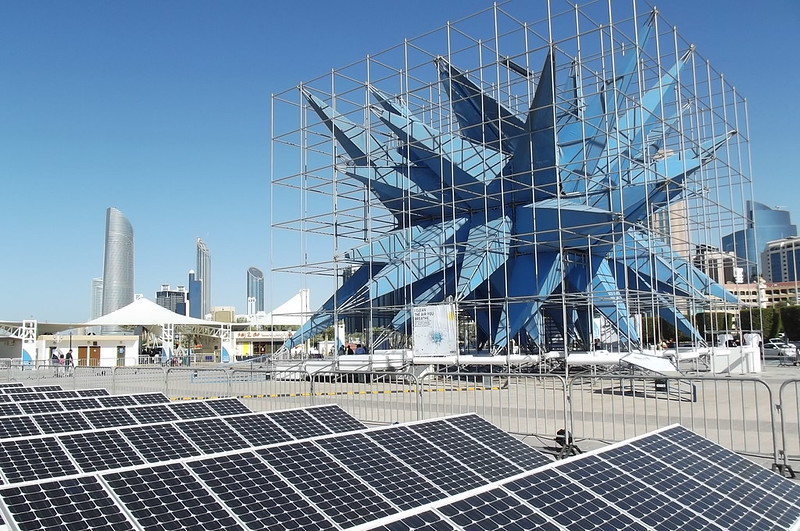
Photo Credit: Gordontour, “Solar & W’nd’ – Power!” (2013).
[1]Milder, Stephen. 2022, 29 July. “Making ‘Freedom Energies’? How 1980s Struggles over Market Access Shaped the Rise of Renewables in Germany.” Cambridge Core Blog. https://www.cambridge.org/core/blog/2022/07/29/making-freedom-energies-how-1980s-struggles-over-market-access-shaped-the-rise-of-renewables-in-germany/
[2] Joudeh, Safa. 2026, 23 June. “The China–Gulf axis is reshaping renewable energy in the Global South.” East Asia Forum 23 June. Available at: https://eastasiaforum.org/2026/06/23/the-china-gulf-axis-is-reshaping-renewable-energy-in-the-global-south/
[3]Kozhanov, Nikolay, and Saban Kardas. 2025. “Between Brussels and Beijing: Strategic Choices for the GCC Member States in the Era of Fourth Energy Transition.” Alternatives: Global, Local, Political, ahead of print, December 23, 2025. https://doi.org/10.1177/03043754251409476.
[4] Alhajraf, Salem 2026. Gulf Energy Transition. Houston: Rice University Baker Institute for Public Policy. Available at: https://www.bakerinstitute.org/sites/default/files/2026-02/20260226-Gulf%20Energy%20Transition.pdf
[5]Ansari, Dawud. 2022. The Hydrogen Ambitions of the Gulf States. SWP Comment 44. Berlin: Stiftung Wissenschaft und Politik. https://www.swp-berlin.org/10.18449/2022C44/
[6] Moneer, Zeina. 2023, 24 Feb. The intricacies of climate finance in the MENA region: Challenges and the way forward. Middle East Institute. https://mei.edu/publication/intricacies-climate-finance-mena-region-challenges-and-way-forward/
[7] Obeid, Jessica & Gower, Alice .2024, 22 March. The great financing gap: The state of climate funding in MENA. Middle East Institute. https://mei.edu/publication/great-financing-gap-state-climate-funding-mena/
[8] Burgess, James. 2022, 8 Nov.COP27: Fertiglobe commissions phase one of Egypt Green 100-MW hydrogen plant for ammonia production. S&P Global Commodity Insights. https://www.spglobal.com/energy/en/news-research/latest-news/agriculture/110822-cop27-fertiglobe-commissions-phase-one-of-egypt-green-100-mw-hydrogen-plant-for-ammonia-production
[9] Eljechtimi, Ahmed 2025, 6 March. Morocco approves green hydrogen projects worth $325 billion. Reuters https://www.reuters.com/sustainability/sustainable-finance-reporting/morocco-approves-green-hydrogen-projects-worth-325-bln-2025-03-06/
[10] Energy Recovery. 2026. ACWA Power Rabigh 3 IWP: A large-scale plant aimed at energy efficiency. https://energyrecovery.com/resources/acwa-power-rabigh-3-iwp-a-large-scale-plant-aimed-at-energy-efficiency/
[11] Smart Water Magazine. 2025, 20 April. Morocco, TAQA, and Nareva partner on $14.05 billion energy and desalination projects. Smart Water Magazine.
[12] Smart Water Magazine. 2026, 9 June. Egypt and ACWA Power explore expansion of seawater desalination capacity. Smart Water Magazine. https://smartwatermagazine.com/news/smart-water-magazine/egypt-and-acwa-power-explore-expansion-seawater-desalination-capacity
[13] Times of Israel. 2021, 25 Nov. Saudis attempted to block UAE-Israel-Jordan deal on energy, water — report. Times of Israel. https://www.timesofisrael.com/saudis-attempted-to-block-uae-israel-jordan-deal-on-energy-water-report/
[14] Voice of Africa. 2024, 23 Feb. UAE to Invest $35 Billion to Help Egypt Solve Currency Crisis, Prime Minister Says. Voice of Africa. https://www.voaafrica.com/a/uae-to-invest-35-billion-to-help-egypt-solve-currency-crisis-prime-minister-says/7500024.html
[15] Foreign Ministry of Oman. 2023, 1 June. Agreements signed for $20billion of green hydrogen projects. Foreign Ministry of Oman. https://archive.fm.gov.om/en/5929/
[16] Al-Sarihi, Aisha. 2022, 21 June. Gulf States Hedge Against Global Energy Transition, Now With Hydrogen Arab Gulf States Institute. https://agsi.org/analysis/gulf-states-hedge-against-global-energy-transition-now-with-hydrogen/
[17] Ibid
[18] Cornish, Chloe. 2025, 18 June. Gulf states tap cheap Chinese batteries to power renewable ambitions. Financial Times. https://www.ft.com/content/814baa49-3093-4aea-8227-2da9419b6a3f?syn-25a6b1a6=1
[19] Hussain, Tom. 2025, 8 April. Beyond oil: Gulf and Asia’s natural synergy ignites renewables revolution. South China Morning Post https://www.scmp.com/week-asia/economics/article/3305569/beyond-oil-gulf-and-asias-natural-synergy-ignites-renewables-revolution
[20] Ibid
[21] Fressoz, Jean-Baptiste. 2024. More and More and More : An All-Consuming History of Energy. London: Allen Lane, an imprint of Penguin Books.
[22] Iordache, Ruxandra. 2024, 12 Feb. Saudi energy minister pins Aramco’s oil capacity halt on green transition. CNBC. https://www.cnbc.com/2024/02/12/saudi-energy-minister-pins-aramcos-oil-capacity-halt-on-green-transition.html
[23] BBC. 2009, 29 June. June Abu Dhabi houses renewables body. BBC. http://news.bbc.co.uk/1/hi/world/middle_east/8124828.stm
[24]Renewable Energy Magazine. 2009, 30 June. United Arab Emirates chosen as headquarters of the International Renewable Energy Agency (IRENA). Renewable Energy Magazine https://www.renewableenergymagazine.com/panorama/united-arab-emirates-chosen-as-headquarters-of
[25] Thomas, Merlyn and Venema, Vibeke. 2002, 22 Feb. Neom: What’s the green truth behind a planned eco-city in the Saudi desert? BBC. https://www.bbc.co.uk/news/blogs-trending-59601335