
Introduction
Between 2023 and 2024, Egypt’s Suez Canal revenues collapsed from a historic high of $10.3 billion to $4 billion. The loss of $6.3 billion in foreign currency was predominantly driven by Houthi attacks on Red Sea shipping. Against that backdrop of acute revenue shock, Cairo negotiated the $35 billion Ras al-Hikma deal with the UAE in February 2024, exchanging a significant land asset for the liquidity it could no longer generate from its most strategically important infrastructure.
The American-Israeli war on Iran has since reshuffled the regional order again, driving canal recovery while simultaneously elevating Egypt’s strategic value to the Gulf states, on whom it remains financially dependent. All of which begs asking: has Egypt’s elevated strategic value to the Gulf changed the terms of the parties’ financial relationship?
Egypt’s Strategic Elevation During the Iran War
When the United States and Israel launched their military campaign against Iran in late February 2026, Egypt occupied an uncomfortable but undeniably central position in the regional order. Crisis Group described it as a state “too large and centrally located to ignore chaos around it” but “also too cash-strapped to project its power in regional affairs.”1
Egypt’s strategic value to the states of the Gulf Cooperation Council (GCC) rests on three pillars, all of which have been made more visible by the Iran war. The first is the Suez Canal. For Saudi Arabia, the canal is the primary northbound exit for crude and refined product exports destined for European markets: roughly 4.5 million barrels per day transited the Red Sea-Suez corridor in 2025, and any prolonged disruption forces Saudi Aramco onto longer, costlier Cape of Good Hope routings that compress export margins at scale. The UAE’s exposure runs through its role as a re-export hub: Dubai’s trade model depends on European consumer goods flowing southward through Suez. Sustained closure raises logistics costs across the entirety of the country’s import-dependent retail and manufacturing supply chain. Qatar’s stake is more specific but structurally significant: LNG tankers serving European customers under long-term contracts route through Suez, and the price penalties built into those contracts for late or rerouted delivery fall directly on QatarEnergy’s revenue. Each of the three major Gulf creditors therefore has a direct commercial interest in Egyptian canal continuity that is independent of Egypt’s own revenue position, and in some respects more pressing.2
The second pillar is the military. Egypt has one of the largest and most capable armed forces in the Arab world, and during the Iran war it moved to make that capability legible to its Gulf partners. According to the INSS, Egypt deployed Rafale fighter jets to the United Arab Emirates and an upgraded Skyguard Amoun air defence system to the UAE and Saudi Arabia, moves explicitly intended to signal that the economic backing Gulf states provide yields a tangible security dividend.3 Egypt also revived the concept of a joint Arab military force during the war, with Foreign Minister Badr Abdelatty and others noting that such a force would enable Arab states to counter regional threats more effectively. At the time of writing, the Egyptian parliament is debating dispatching military assets to support Saudi’s war effort in Yemen. These deployments have been an active performance of strategic value, a demonstration that Egypt’s military weight translates into concrete security outputs for its Gulf creditors.
The third pillar is logistics infrastructure. As the Strait of Hormuz closure created acute supply chain pressure, Egypt and Saudi Arabia quietly developed a new land-and-sea logistics corridor. Cargo arrives from Europe’s Trieste port at Egypt’s Mediterranean port of Damietta, crosses overland to Egypt’s Red Sea port of Safaga, then ships onward to Saudi Arabia’s Red Sea port of Duba. As Egyptian maritime transport expert Ahmed al-Shami explained to The New Arab, the corridor provides Gulf countries with a Strait of Hormuz-proof bridge for trade with Europe, reducing both time and cost while bypassing the war’s most dangerous chokepoints.4 Egyptian economist Ali al-Edrissi described it as one of six planned transportation routes through which Egypt intends to establish itself as an international logistics hub, a strategic repositioning that the Iran war has accelerated.
Across all three pillars, Egypt’s strategic value is discernible to the Gulf states. But that strategic value alone does not give Egypt room to manoeuvre in negotiating its relation to the Gulf. This is because Cairo’s financial dependence constitutes a binding constraint.
Cairo’s Gulf partners collectively hold the liquidity Egypt requires to service its external debt, maintain its IMF programme, and keep its import bill funded. As Crisis Group notes, that dependence limits Egypt’s ability to stray too far from Gulf preferences, even when its own strategic calculus points in a different direction.⁵ Egypt’s response to the war, calibrating its public position through solidarity visits, military deployments, and foreign ministry statements, reflects the outer boundary of what dependence permits. The financial architecture surely sets that boundary, and it is imperative to understand why the war has done little to shift it.
The Financial Dependency Baseline
Egypt’s financial vulnerability did not begin with the Iran war. It is the accumulated product of a decade of structural imbalances, external shocks, and an economic model that has consistently required outside capital to remain solvent. Understanding this baseline is essential to evaluating the war’s impact on Egypt’s bargaining position.
The scale of Egypt’s debt position entering the war is striking. Total external debt reached $163.9 billion by the end of 2025, with the external debt-to-GDP ratio climbing to 44.5 percent by March 2025, up from 38.8 percent in June 2024. External debt servicing obligations for 2026 stood at $29.18 billion – equivalent to roughly 8.1 percent of GDP – against gross financing needs expected to remain around 42 percent GDP (or $144 billion) per annum for the years to come. Interest payments alone reached 11 percent of GDP in FY2024/25. These figures describe a state whose central economic task, year after year, is finding enough external financing to roll over what it already owes.
Egypt has been managing this position under an IMF Extended Fund Facility since December 2022. The programme has delivered meaningful stabilisation: inflation fell from 38 percent in September 2023 to 11.9 percent in January 2026. Foreign reserves reached $53.8 billion in March 2026, and real GDP growth reached 5.3 percent in the second half of 2025. Stabilisation, however, is not structural reform. Significant vulnerabilities remain, particularly Egypt’s high state footprint in the economy and the absence of the military divestment programme the Fund has repeatedly pressed Cairo to implement. Egypt objected to military divestment on the grounds that it is too politically costly. Successive shocks, the Gaza war, the threat of Palestinian displacement into Sinai, and now the Iran war, have provided pretexts to defer it.
It is against this backdrop that Gulf capital has become, as Crisis Group describes it, the mainstay of the Egyptian economy.6 Saudi Arabia deposited $5.3 billion at the Egyptian central bank in 2022 and Kuwait deposited $4 billion in 2023. In February 2024, the UAE injected $35 billion through the Ras al-Hikma real estate acquisition, and Qatar committed to investing $29.7 billion in a further Mediterranean coastal development later that year. Gulf States have also moved into Egypt’s industrial and energy sectors: Abu Dhabi’s ADQ acquired a controlling stake in Abu Qir Fertilizers and a portfolio of Egyptian pharmaceutical and food companies in 2023, broadening Gulf capital’s footprint well beyond real estate. In aggregate, GCC States have committed tens of billions of dollars to Egypt’s financial stabilisation since 2022, dwarfing the IMF’s own programme disbursements.
As attested in this brief survey, the form through which Gulf capital has allocated to Egypt have changed over recent years. In earlier periods, Gulf support arrived primarily as central bank deposits, liquid, reversible, and relatively unconditional. From 2024 onward, Gulf states shifted toward direct investment in specific assets, particularly large-scale real estate development and industrial holdings. This shift reflected a deliberate choice: doubting that Cairo could reform its economy, Gulf investors put their capital into projects they believed could generate returns independently of Egypt’s macroeconomic trajectory. The Ras al-Hikma deal is the clearest expression of this logic, a $35 billion exchange of a prized coastal land asset for hard currency liquidity, completed at a moment of acute Egyptian financial stress. Egypt received the cash it needed to replenish reserves and reassure markets; the UAE received a long-term asset claim on Egyptian territory.
This distinction between asset classes matters for the conditionality argument that follows. When Gulf capital arrives as a central bank deposit, leverage is primarily political: the Gulf state can threaten to withdraw or not renew, and Egypt can absorb the signal without necessarily restructuring its economy. When it arrives as an equity stake in a specific asset—a coastal development, a fertiliser company, a pipeline—the Gulf investor becomes a stakeholder in Egyptian economic governance, with interests in the regulatory environment, property rights, and competitive market structure that extend well beyond the transaction itself. The two logics coexist: Ras al-Hikma was structured to generate returns regardless of Egypt’s broader macroeconomic performance, but Gulf investors in Egypt’s industrial sector require a functioning private sector environment—which military-dominated commercial conglomerates actively undermine—to extract those returns. The real estate bets are insulated from Egyptian governance; the industrial and infrastructure bets are not. The next section examines how this structural tension has played out under wartime conditions.
Conditionality and Asset Class: What Has the War Changed?
The dominant analytical frame applied to Gulf-Egypt financial relations since the Iran war has focused on volume: are the Gulf states maintaining their investment commitments or reducing and/or withdrawing them? This framing misses what matters. The more consequential question is what the war has changed about the terms and conditions attached to capital. The evidence on both conditionality and asset class suggests very little has changed.
The military commercial holdings question
Egypt’s military controls a vast commercial empire through the National Service Projects Organisation (NSPO) and affiliated entities, spanning construction, food production, hospitality, and infrastructure. Since Egypt’s 2022 IMF programme, diminishing the military’s economic footprint has been a central reform demand from the Fund, international investors, and nominally from Gulf states seeking a more competitive private sector environment in which their investments can generate returns.
Progress, alas, has been conspicuously absent. In its March 2026 programme review, the IMF recorded that “no material divestment has occurred over the last 24 months, while new military entities were created,” a finding that sits alongside the IMF’s September 2026 call for “more decisive implementation of the State Ownership Policy and divestment programme.”7 As of mid-2026, Egypt’s only concrete movement on military divestment is a proposed minority listing of Helwan Casting Company, a subsidiary of the National Authority for Military Production, described by Al Manassa as “a first tentative step,” with plans quietly revised following heightened regional tensions.8
This record of pushing back on divestment without consequence suggests, at first glance, that Egypt is managing to leverage its strategic importance into preferable treatment. The leverage demonstrated is, however, of a limited and defensive nature. Cairo retains a kind of veto power when it comes to divestment, taking advantage of creditors that ultimately value the country’s stability above its obedience to loan terms. Indeed, the threat of Egyptian financial collapse—with its attendant risks of social instability, canal disruption, and refugee flows toward Europe—constrains what Gulf states and the IMF are willing to do to enforce conditionality. But while strategic importance has allowed Cairo to protect existing military stakes in the economy, it has not allowed policymakers to extract better terms on new investment flows.
The asymmetry in Egypt’s leverage, then, is between the ability to resist a demand and the ability to make one. And though the defensive leverage Cairo asserts—the capacity to block reforms— is not without utility to the regime, it bears little relevance to negotiations over fresh capital injections. Creditors have priced in Egypt’s non-compliance to their loans, which means Egypt has already spent whatever value its strategic importance contains.
The asset class shift
Egypt’s enduring inability to make a demand on investors is attested in the kinds of equity investments that have flowed into the country following the start of the US-Israeli war on Iran. Broadly speaking, these capital deployments follow the template established with Abu Dhabi’s Ras al-Hikma deal in February 2024. As with Ras al-Hikma, investments have been commercially oriented, even if also retaining a geopolitical motivation. The Damietta-Safaga logistics corridor offers an instructive example. The project stands to at once serve Gulf’ commercial supply chain interests and their strategic interest in Strait of Hormuz alternatives. In many ways, this is very old hat: the SUMED pipeline, which runs 320 kilometres from Ain Sukhna on the Red Sea to Sidi Kerir on the Mediterranean and has a throughput capacity of 2.5 million barrels per day, has likewise carried a dual significance since it came into operations in 1977: it is a primary Egyptian channel through which Gulf crude can bypass the Suez Canal during periods of disruption, and it is jointly owned by Egyptian state entities and PETROLINE, in which Saudi Aramco holds a significant stake.9
The balance of evidence on investment conditionality and asset class allocation is therefore clear: Egypt’s elevated strategic importance has not materially improved its negotiating position over the terms of Gulf capital. This is a function of the structural asymmetry identified in the previous section—Egypt’s inability to credibly threaten to walk away from Gulf financing. Regardless of how indispensable Cairo’s geography, military, and logistics infrastructure have become, its singular reliance on cash flow from the Gulf undercuts negotiating leverage. Egypt’s financial desperation means that the terms of each successive deal are set at the time of maximum Egyptian vulnerability, and the war has created several such moments in quick succession.
Navigating Gulf Divides
Abu Dhabi’s move to request early repayment of a $3.5 billion loan to Islamabad, widely read in the region as leverage over Pakistan’s mediation role, was observed closely in Cairo. But the Pakistan case also illustrates a point that must be acknowledged: the Gulf does not act as a single creditor. Abu Dhabi was excluded from the Saudi-led, Pakistan-facilitated mediations that produced the first ceasefire. Riyadh and Abu Dhabi had distinct and sometimes competing interests in how the conflict is resolved. Egypt, likewise, cannot treat “Gulf pressure” as monolithic. Cairo’s financial exposure is heavily concentrated in the UAE – ADQ, ADNOC, and Mubadala are Egypt’s leading foreign investors – while Saudi Arabia has provided the largest central bank deposits. The UAE has the stronger commercial stake in Egyptian economic governance; Saudi Arabia has the deeper structural interest in Egypt’s stability and canal continuity.
Whether Cairo shows preference to Riyadh or Abu Dhabi in managing its “strategic balance” doctrine does not directly follow from financial exposure. It reflects a more complex set of factors: Historical relationship depth weighs heavily, as well as the specific demands attached to each creditor’s capital, and the distinct channels through which each exercises pressure. What the Pakistan precedent confirms is not that all Gulf states discipline client states uniformly, but that individual Gulf actors are willing to use financial instruments as tools of explicit political signalling when their specific interests are implicated.
Egypt’s adjustment of its public position—President Sisi’s solidarity visits to Abu Dhabi, Riyadh, Doha, and Manama, the intensification of foreign ministry condemnations of Iranian strikes—reflects a calibrated response to financial leverage, not a freely chosen alignment. The direction of that calibration, however, tracks more closely with UAE commercial pressure and Saudi stability interests than with a unified Gulf demand.
Gulf states’ own fiscal pressures
Going forward, another factor to consider in studying the Egypt-GCC economic relation is the Gulf states’ own economic strains. In its October 2026 World Economic Outlook, the IMF estimated economic contractions for Qatar at -15.76 percent, Kuwait at -16.7 percent, Bahrain at -11.3 percent, the UAE at -3.9 percent, and Saudi Arabia at -3.3 percent. Damage to over 80 energy facilities across Gulf states may cost $58 billion to repair, according to Rystad Energy.
These fiscal pressures have not reduced Gulf states’ willingness to maintain capital commitments to Egypt: the UAE explicitly affirmed its investment plans as of March 2026, and the Qatar coastal development commitment has proceeded. But Gulf states—facing reconstruction costs, rising defence budgets, and sovereign wealth fund drawdowns—do now have an even stronger incentive to ensure that their external investments generate returns. As the Middle East Council on Global Affairs notes, Gulf SWFs are being redirected toward domestic reconstruction and resilience, which means capital available for discretionary external deployment is contracting.10 The implication for Egypt is that Gulf creditors tolerance for returns foregone due to military-sector crowding-out is diminishing, not increasing, reinforcing rather than relaxing the structural pressure Cairo has so far absorbed without conceding.
Conclusions
Existing commentary on Gulf-Egypt financial relations during the Iran war has focused almost exclusively on volume, tracking whether Gulf capital flows have been maintained or disrupted. By that measure, the relationship looks resilient: the UAE has maintained its investment plans, Qatar’s coastal development commitment has proceeded, and Saudi and Kuwaiti central bank deposits remain in place.
Volume, however, is a lagging indicator of political leverage. The more sensitive measure is terms: what Egypt gives up in each successive deal, what conditions are attached, and what asset class Gulf investors insist upon. On all three dimensions, the war has either left the pre-existing conditionality architecture intact or deepened it. Ras al-Hikma exchanged a land asset for liquidity at a moment of acute Egyptian stress; the Qatar coastal deal replicated that structure at scale; ADQ’s Abu Qir acquisition gave Gulf capital a stake in Egyptian industrial governance. In each case, Egypt received cash and Gulf investors received long-term equity claims – a pattern the war has accelerated rather than disrupted.
Egypt’s case offers a broader lesson about how Gulf capital functions in wartime MENA. The conventional interprets Gulf sovereign wealth fund deployments as primarily responding to commercial incentives with political objectives being a mediating factor. To wit, investment return is the guiding concern, but geopolitical gain weighs on decision-making, too. The Egyptian case suggests the guiding logic of Gulf capital may be reversed under the exigency of war. Indeed, recent events point to Gulf investment servicing political needs first, and profit generation prospects second. The Pakistan precedent—where Abu Dhabi requested early loan repayment, a move widely read as punishment for Islamabad’s mediation role—lends further credence to the war-time primacy of politics when it comes to the Gulf states’ financial instruments.
Several Arab states, Jordan, Tunisia, Lebanon in its reconstruction phase, occupy analogous positions to Cairo, retaining strategic value for the Gulf, but also financial dependency. If Egypt’s experience is generalisable, strategic indispensability without a credible exit option does not produce leverage in financial negotiations. It produces a more elaborate form of dependency, in which the dependent state performs its strategic value continuously while the terms of its financial relationships remain set by the party with the greater capacity to absorb the cost of rupture.
As this goes to print, active hostilities between the United States, Israel, and Iran remain on tentative pause. The war between Saudi Arabia and Ansar Allah, contrarily, is escalating, and Gulf states’ threat perceptions regarding Iran remain dramatically elevated.
If Egypt’s strategic value was highest during active conflict, the question is whether it might retain sufficient leverage in the reconstruction period to renegotiate terms established under wartime financial stress, or whether, as the immediate crisis recedes, the political cover for doing so recedes with it. What this paper has established is that wartime strategic indispensability and chronic financial dependency can coexist without resolving in favor of the indispensable party. Egypt controls the Suez Canal, fields one of the Arab world’s most capable militaries, and sits at the geographic hinge of the conflict’s most consequential logistical corridors. It remains, nonetheless, a price-taker in the financial relationship that underwrites its stability. Egypt is, in short, indispensable but insolvent, and until that second condition changes, the first will never translate into leverage.
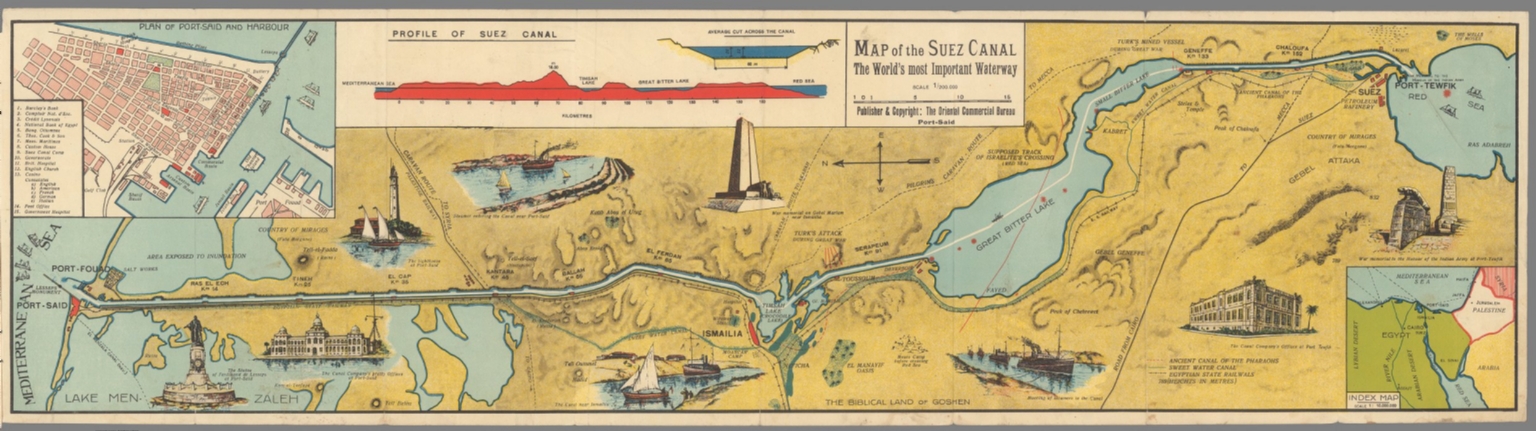
Photo Credit: Oriental Commercial Bureau & Rosenberg, August, Public domain, via Wikimedia Commons

- International Crisis Group (2026), ‘Strategic Balance’ under Stress: Egypt and the U.S.-Israeli War with Iran. https://www.crisisgroup.org/cmt/middle-east-north-africa/egypt/strategic-balance-under-stress-egypt-and-us-israeli-war-iran
- Ports Directory / Marine Link (2026), Suez Canal Authority Reports Q1 2026 Revenue Dip Amid Red Sea Disruptions. https://ports.marinelink.com/ports/port/ontonagon/news/suez-canal-authority-reports-q1-2026-revenue-dip-amid-red-sea-disruptions. * When Houthi attacks resumed following the outbreak of the Iran war, canal revenues fell by 12 percent year-on-year in the first quarter of 2026, a figure that captures Egypt’s fiscal exposure but understates the canal’s significance to its Gulf partners.
- INSS (2026), More Than a Mediator: The Egyptian Stake in Ending the War with Iran. https://www.inss.org.il/publication/iran-egypt/
- The New Arab (2026), Egypt and Saudi Arabia Are Building Alternatives to Hormuz. https://www.newarab.com/news/egypt-and-saudi-arabia-are-building-alternatives-hormuz
- International Crisis Group (2026), as above.
- International Crisis Group (2026), as above.
- IMF (2026), Resilience Under Pressure: Egypt’s Economy Defied Expectations. https://www.imf.org/en/news/articles/2026/09/21/cf-resilience-under-pressure-egypts-economy-defied-expectations
- Al Manassa (2026), Egypt Weighs Partial Listing of Military-Linked Helwan Casting. https://manassa.news/en/news/31659
- Washington Institute for Near East Policy (2026), Egypt’s Gulf-Iran Dilemma. https://www.washingtoninstitute.org/policy-analysis/egypts-gulf-iran-dilemma
- Middle East Council on Global Affairs (2026), Gulf Sovereign Wealth Funds and the Cost of Crisis Resilience. https://mecouncil.org/publication/gulf-sovereign-wealth-funds-and-the-cost-of-crisis-resilience/