
Introduction
“In five to ten years, an industrial cooperation platform based in Morocco and focused on Europe, the Americas, and Africa will gradually take shape.” This sentence opens the country guide that the Chinese Ministry of Commerce (MOFCOM) has dedicated to Morocco, in a message signed in June 2025 by the Economic and Commercial Office of the Chinese Embassy in Rabat.[1] The guide presents the kingdom as a “bridge” to the European and American markets. As in its 2021 and 2023 editions, its authors praise the successful establishment of “Chinese companies producing auto parts and batteries for electric vehicles that supply European and American automakers.”
This “bridge” is a cause for concern in Brussels. On May 31, 2026, the Financial Times published an investigative report on the industrial base China is building in Morocco.[2] Maroš Šefčovič, the European Commissioner for Trade, is quoted denouncing the “transshipment” of Chinese overcapacity to Europe via Morocco, calling it “a very, very big problem for the European economy.” The London-based daily estimates that Chinese investments announced in the kingdom since the pandemic total $6 billion. Four days later, Ryad Mezzour, Minister of Industry and Trade, attempted to correct the record, telling the press that there is a wide gap between announcements and actual investments. By his count, Chinese firms had deployed a mere $1.2 billion during the period in question. He also reminded his European readers that “the two major manufacturers we have in Morocco operate under European flags.”[3]
Regardless, restrictive measures were soon forthcoming from Brussels. In July, the European Commission imposed definitive anti-dumping duties on Chinese-made tires for cars and light trucks. Given the presence of Chinese firms in the Moroccan market, the move posed immediate consequences for Rabat. Around the same time, the U.S. Trade Representative raised its own duties on Moroccan exports—set at 10 percent by U.S. Department of Commerce in February—to 12.5 percent, notionally in response to the country’s use of “forced labor.”[4][5] Then in October, the French and German governments agreed on a new policy framework for governing benefits afforded to the automobile industry. Starting in 2028, a vehicle eligible for subsidies and public procurement contracts would need be assembled in Europe and derive at least 70 percent of the value of its components (excluding batteries) from Europe.[6] “We don’t want Germany to simply assemble components sourced from Asia,” said Lars Klingbeil, the German finance minister.[7] The scope covers the twenty-seven EU member states and European partners that were part of the single market as of January 1, 2020. Morocco, which has never been part of the single market, is excluded, as is Turkey.[8] As such, parts manufactured in-country—including by Chinese suppliers—will not count toward the 70 percent threshold, even though Morocco’s supply chains offer a critical feedstock for European heavyweights Renault and Stellantis.[9]
The policy turn in Brussels and Washington undermines a key selling point that Moroccan authorities highlight to Chinese investors. After all, it is the backdoor to western markets that Morocco’s free trade agreements (FTAs) with the European Union and the United States provide that has helped make the country so attractive to Chinese capital. This is doubly so for players in electric vehicle (EV) and battery manufacturing industries, where the Chinese domestic market can no longer absorb expanding production capacity. Pressed by issues of oversupply and price wars at home, firms in these sectors have needed seek profit margins abroad. The geography of their investments testifies as much: In 2024, EV and battery investments outside of China exceeded those inside the country for the first time, with the domestic total declining from $41 billion the year prior to just $15 billion.[10] Much of the foreign investment in this period went in search for benefits conferred through U.S. Inflation Reduction Act, and hence to Morocco, whose FTA with the United States offered an opportunity to tap into the Biden White House’s green energy push.[11]
Such developments beg a number of questions: How deep does the stake of Chinese manufacturers in Morocco run, will these firms continue to set up operations in Morocco despite the shifting tides of trade regulations, and who ultimately benefits from their capital commitments?
A Survey of Chinese Investment in Morocco
The breadth and depth of China’s investments in Morocco are striking. Broadly speaking, Chinese capital arrives in country to take advantage of Morocco’s advantageous positioning as an export hub, itself a function of trade arrangements, geography, and well-developed port infrastructure. In many instances, Chinese manufacturers have sought to stake a claim within the supply chains serving European automakers based in the country. Battery technology production has offered a prime perch in this regard, with Moroccan phosphate deposits creating additional synergies. Chinese investment follow Morocco’s demand for equipment and infrastructure as well. In 2024 alone, Chinese firms signed construction and engineering contracts for new public works worth $1.42 billion.
Figure 1 : Three Primary Channels of Chinese Investment
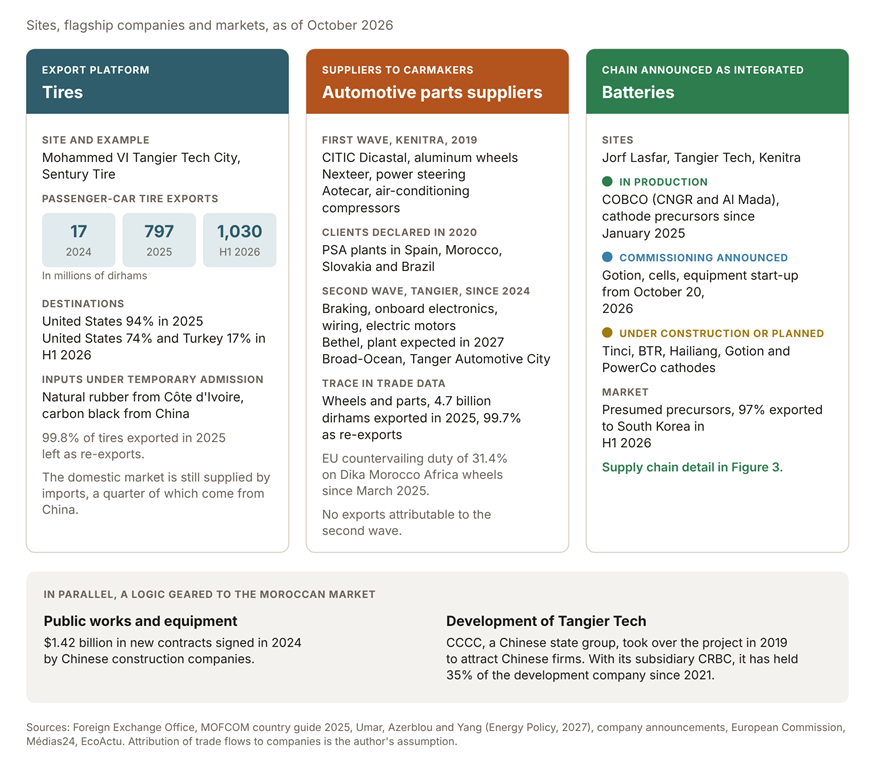
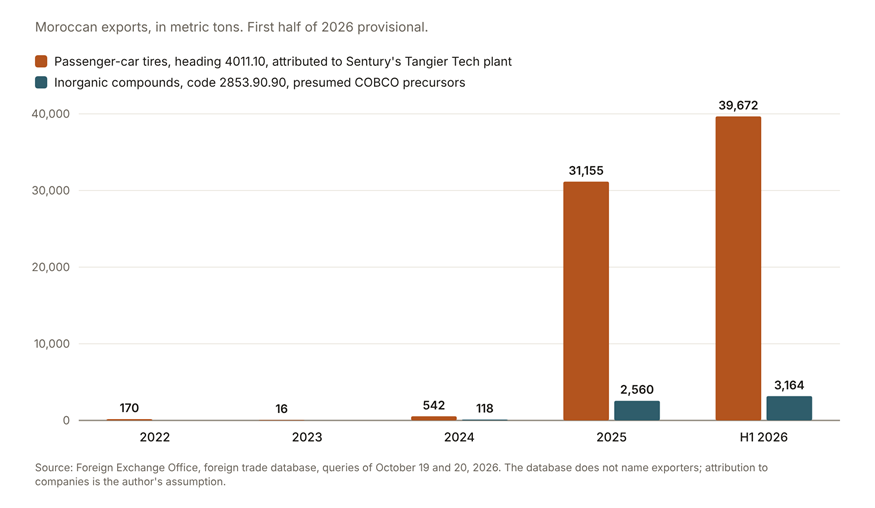
When it comes to tires, Chinese investment in Morocco is predominantly export-oriented. The example of Sentury Tire, operating out of the Tanger Tech free zone since 2025, is instructive. The firm’s Moroccan factory was set up with eyes trained tightly on the U.S. market. Evidence of this, a U.S. subsidiary of Sentury expanded its Florida warehouse in precise coordination with the opening of the factory in Tanger.[12] By virtue of arrangements like these, Moroccan exports of passenger tires would rise from 17 million dirhams in 2024 to nearly 800 million in 2025, with sales to the United States representing 94 percent of the total. The ascent has continued this year, with exports receipts hitting one billion in H1 2026.[13] Notably, the share earned in the U.S. has declined significantly, falling to 74 percent, partially as a result of Washington’s tariff measures. Sales to Turkey, contrarily—a major assembly hub for cars destined for Europe, and a country linked to Morocco by a free trade agreement since 2006[14]—have leaped so as to account for 17 percent of shipments.
Figure 2: Moroccan Exports of Tires and Battery Inputs
Chinese positions in Morocco’s automotive parts sector, meanwhile, are focused on the supply chains that Europe’s grand automakers maintain in-country. Expectantly, factories are set up near European clients. In terms of temporality, 2019 marked an initial wave of investment, when five Chinese parts manufacturers began production in the Kenitra Free Zone, including CITIC Dicastal (aluminum wheels) and Nexteer (electric power steering systems). Aotecar, the parent company of one of these manufacturers, informed its investors as early as January 2020 that its Moroccan plant was supplying air conditioning compressors to the plants of Peugeot, Citroën, DS Automobiles, Opel, and Vauxhall in Spain, Morocco, Slovakia, and Brazil. A second wave came in 2024. Concentrating in Tanger, this one expanded the product range to braking systems, onboard electronics, and wiring harnesses.[15] Indicative of the wider trend, the factory of Bethel, scheduled to open next year, is working to ensure its braking systems “serve local automakers in Morocco and win over European customers.” The long-term objective is to become a “central hub” for the European market.[16] The wave also reaches electric motors. In July 2025, Broad-Ocean Motor confirmed a 1.245-billion-dirham plant in Tanger Automotive City, the automotive zone run by Tanger Med.
Chinese groups are thus investing in a range of sectors—from wheels and braking systems to motors, various segments of wiring harnesses, interior textiles, and other components.[17] In total, Morocco is home to more than 250 automotive suppliers, most of them subsidiaries of European (Spanish, French, or German), American, and Japanese multinationals.[18] Despite their sizable recent investments, Chinese suppliers remain a clear minority in the sector.
In the battery sector, contrarily, Chinese companies stand out as leading players. In fact, it is here that the bulk of Chinese investment announcements have concentrated. Driving these capital flows are two factors. The first is Moroccan industrial policy. In 2022, planners in Rabat recognized that electrification threatened “the death of our automotive platform.”[19] Incentives were installed thereafter to help nurture the platform’s adaptation to the electronic vehicle (EV) industry, with battery technology a point of emphasis. The second factor is on the investor side. Many Chinese battery manufacturers cite Morocco’s preferential access to the U.S. and European markets as a reason for their entry into the country: through the Kingdom, these firms can sell components to Western automakers without the latter running into home country regulations that discriminate against relations with Chinese suppliers.[20]
Battery technology investments in Morocco cover nearly every stage of the manufacturing process, from building precursors to the cell (Figure 3) to assembling batteries. In Jorf Lasfar, COBCO, a subsidiary of China’s CNGR, has been producing cathode precursors since January 2025, with an announced capacity of 40,000 metric tons per year. Tinci is building an electrolyte plant in the same industrial park. Further north, Tanger Tech is home to BTR’s materials projects and Hailiang’s copper foil projects. Finally, in Kenitra, Gotion is building a factory for cell assembly. Through a €480 million joint venture with PowerCo—Volkswagen’s battery subsidiary—the firm is also set to produce cathode materials on-site. This project was approved by Gotion’s shareholders on October 20, 2026, though is still subject to approval by Chinese and foreign authorities.[21]
Figure 3: Contours of the Battery Supply Chain
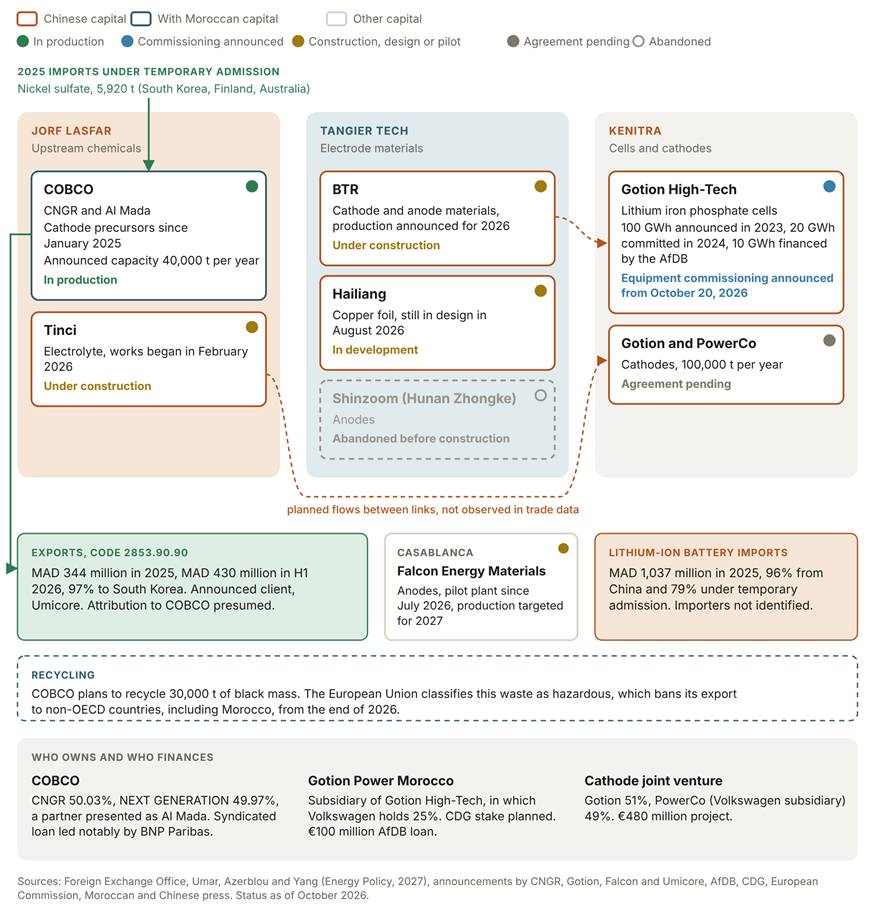
But for all the fanfare, uncertainty still pervades the ledger of Chinese battery investments in Morocco. This can be most easily observed with Gotion’s big battery cell project. In May 2023, the firm signed an agreement with the Moroccan government that called for 65 billion dirhams in investment and the production of 100 GWh in battery cell production capacity. A year later, however, the agreement was revised to reduce the initial commitment to a mere 12.8 billion dirhams and the output target to just 20 GWh. (Loans from the African Development Bank is covering half the financing). As the example attests, gaps often open between public statements and actual capital deployed. In this regard, a canary in the coalmine was BYD’s pledges concerning a bus factory in 2017, pledges that ultimately came to naught.[22] Overall, research indicates that only one operational battery facility—that of COBCO—is currently up and running.[23] Saliently, Hunan Zhongke Shinzoom, which specializes in anode materials, appears to have abandoned its Tanger Tech project before any substantial construction began. The production of cells at a commercial scale, then, is still aspirational.
Tanger Tech: A Chinese Free Trade Zone?
As previous sections evince, several Chinese investment projects concentrate in a single area: the Mohammed VI Tanger Tech City. This is not by accident. The zone itself is itself the fruit of Moroccan-Chinese cooperation, part of Beijing’s New Silk Roads Initiative and developed after the Moroccan king’s visit to the capital in 2016.[24]
Launched in March 2017, Tanger Tech—whose land preparation and infrastructure development required $1 billion in investments—promised to generate $10 billion in industrial investments across ten years, and approximately 100,000 jobs.[25] The Moroccan government’s financial contribution to the venture was estimated at more than 2.4 billion dirhams ($240 million) in 2019, covering both the expropriation of the 486 hectares in the first phase and the zone’s connection to roads and utility networks. But these figures exclude tax expenditures incurred by Rabat’s treasury: Companies operating in the zone benefit from “industrial acceleration zone” status, which exempts them from VAT, customs duties, and corporate income tax for five years and exempts them from foreign exchange controls, as is the case in the eight other industrial acceleration zones currently in operation, including those in Kenitra and Tanger Automotive City.[26]
Tanger Tech stands out from other Moroccan industrial zones because of its developer. The MOFCOM guide describes it as the only industrial zone that China is developing in Morocco. And as a point of fact, Tanger Tech is the only Moroccan zone that a Chinese group is developing and operating: Since 2021, China Communications Construction Company (CCCC), a Chinese state-owned enterprise, and its subsidiary China Road and Bridge Corporation, have held a 35 percent stake in the holding company that is owner and director of the zone. (Bank of Africa holds percent, while the Tanger-Tetouan-Al Hoceima region and the Tanger Med Special Agency each hold 20 percent.[27]) An April 2019 memorandum of understanding tasks CCCC with attracting Chinese manufacturers while reserving 90 percent of jobs for Moroccans.[28] To this end, a Chinese team is on site to provide support to investors from China year-round. As of May 2025, 28 of the 32 companies that had signed agreements to set up operations there were from mainland China. According to the People’s Daily, the official newspaper of the Chinese Communist Party, their projects represent approximately $3 billion in planned investments.[29] However, no Moroccan figures are available to verify this. Regardless, these sums fall far short of the numbers bandied about in 2017, when Tanger Tech opened.
Temporary Admission Carveouts: Corporate Welfarism in Moroccan Industrial Zones
It isn’t solely the gaps between pledged and actual investment which raise questions about the benefit Morocco derives from its investment relations with external partners, China included. There are also the state’s sizable tax expenditures to consider.
Many of these are incurred through the temporary admission clauses that govern imports into Moroccan industrial zones. These clauses, in effect in Tanger Tech as well as every other special enclave for industrial investment, suspend customs duties on inputs that are processed in Morocco before being re-exported. Revenues thereby deprived to the treasury are significant.This can be gleaned from the Foreign Exchange Office’s database, which separates temporary admission transactions from ordinary trade (Table 2). As the database shows, a large portion of the inputs brought in under this special legal status come from China. But it isn’t Chinese firms alone that take advantage of the set-up. Among others, Renault also uses the provision to import all its engines from the European Union without needing to pay customs fees.[30]
On the Chinese side, the Sentury Tire plant at Tanger Tech demonstrates the mechanism at active work. In 2025, 99.8% of Sentury’s products would be exported under temporary admission rules. As such, its imports of raw material feedstocks arrived tax-free, and at massive scale: Indeed, between 2024 and 2025, when the Sentury factory commenced operations, Morocco’s imports of rubber and carbon black under the temporary admission regime rose from less than 900 metric tons to nearly 46,000 metric tons, with Chinese synthetic rubber and carbon black doing the heavy lifting.[31] (Note that Morocco’s domestic demand for rubber and carbon black is also met via imports: China furnished one-quarter of the supply in the first half of 2026.) Aluminum rims produced by CITIC Dicastal in Kenitra follow the same pattern. Across all exporters, 99.7% of exports of wheels and parts in 2025 were re-exports, and more than 60% of imports of the same product line under temporary admission originated in China.
The battery sector is less straightforward to analyze, as the Foreign Exchange Office’s database does not identify the exporting firms. But by cross-referencing the nature of the product, the timeline, and the volumes of trade, some sense for the use of the temporary admission carveout can be acquired.[32] On the balance of evidence, it appears that COBCO has used this legal provision to import inorganic compounds—a critical feedstock for manufacturing cathode precursors, inclusive of nickel sulfate—starting in November 2024. Import volumes of inorganic compounds reached 2,560 metric tons in 2025, with 99% of nickel sulfate entering under temporary admission provisions. 97% of cathode precursors produced, meanwhile, were shipped to South Korea.[33] COBCO’s dealings with South Korea are in keeping with a wider trend: In June 2026, Morocco exported a stark 1,001 metric tons of cathode precursors to the country.[34]
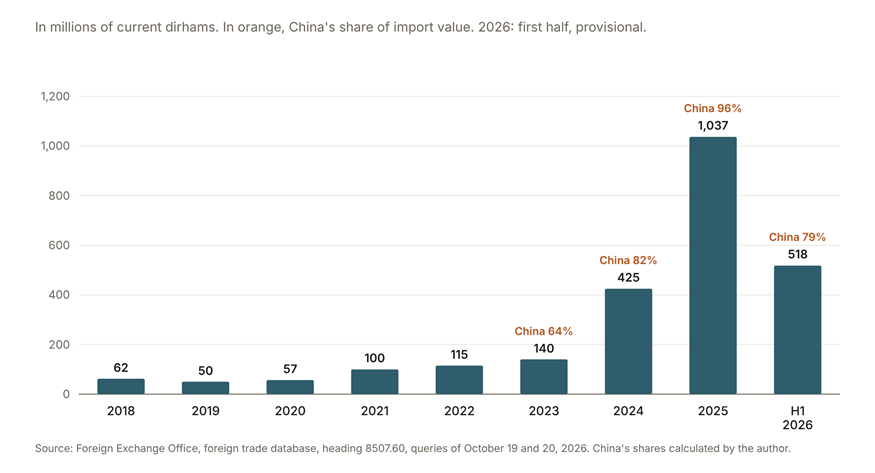
Other firms operating in the battery supply chain, including the BTR and Hailiang projects at Tanger Tech, are yet to report trade data, even though Ryad Mezzour announced in December 2025 a “complete value chain.”[35][36] Batteries which arrive fully assembled in Morocco are almost entirely sourced from China, with 79% brought in under temporary admission status in 2025 (Figure 4).[37] Many are re-exported in the electric quadricycles and tricycles that Stellantis assembles in Kenitra.[38]
Figure 4: Moroccan Battery Imports
Targeting China, Hitting Morocco
As touched upon in the introduction, the United States and the European Union are responding to China’s presence in Morocco through two approaches (Table 4). Washington is targeting capital. The One Big Beautiful Bill Act of July 2025 designates any entity more than 50% controlled by Chinese interests as a “prohibited foreign entity.”[39] Materially, this means that materials supplied by such firms, for example, in battery components, are ineligible for tax credits. Several Chinese groups hold their Moroccan subsidiaries in Singapore—such as APG, Ningbo Gaofa, and Sanlian—or in Hong Kong, in the case of Gotion. But Washington is cognizant of these kinds of reflagging arrangements and treats the subsidiaries in question as Chinese-owned in the final instance. For COBCO, this stands to create real trouble. In March 2025, the firm committed in to supply the Belgian company Umicore with cathode precursors, who in turn intends to process the input before shipping on the more advanced product to North America and Asia.[40] Under the terms of the Big Beautiful Bill, however, the buyer in the United States will no longer be eligible for tax credits, courtesy of CNGR’s 50.03% equity stake in COBCO.[41] This may soon force Umicore or its American consumer-base to look for alternative suppliers, to the clear detriment of COBCO.
Brussels, meanwhile, is targeting the origin of products and their financing. In March 2025, the Commission imposed a 31.4% duty on wheel rims produced by Dika Morocco Africa, a subsidiary of CITIC Dicastal, while other products dispatched from Morocco faced only a 5.6% levy.[42] The discrepancy derived from how Brussels is interpreting the origins of firms’ subsidy benefits. In operating under the incentive regime provided in Kenitra’s industrial zone, Dika Moroco Africa is being treated as having received subsidies from the Chinese state. And going forward, the disciminatory regime will likely widen. The European Union’s Industrial Accelerator Act, proposed in March 2026, contains provisions that would restrict tax and subsidy benefits for EVs to cars assembled within the Union itself. For countries responsible for 40 percent of global capacity in certain industrial lines, the Act would also limit ownership of assets within the Union to 49 percent.[43] These are shots against the bow for Chinese investors in Morocco. If past is precedent, the consequences downstream for Moroccan communities could be pronounced.
The examples of Egypt and a handful of countries in southeast Asia, where this style of anti-China regulation has been pioneered, make this plain. In 2020, the European Commission imposed countervailing duties on fiberglass fabrics produced by two Chinese-owned companies in the Sino-Egyptian Zone of Suez.[44] The decision was made in light of the preferential loans that Chinese public financial institutions had extended to two firms incorporated in Egypt but owned by Chinese parties. In 2024, the Court of Justice of the European Union upheld the Commission’s decision.[45] Largely by consequence, EU imports of the targeted Egyptian glass fibre fabrics fell by 84 percent between 2018 and 2024. Curiously, the main producing firm on the Egyptian side, Jushi, opted to expand its Suez operations in 2022, after the duties were initially imposed.In April 2025, meanwhile, the U.S. Department of Commerce applied a similar rationale, imposing duties on solar cells manufactured in Cambodia, Malaysia, Thailand, and Vietnam on the claim that the producing firms, though not operating on Chinese territory, had benefited from Chinese government subsidies.[46] The rates reach 3.521 percent for one Cambodian manufacturer. With the squeeze pushing many Chinese manufacturers to exit the country, the Malaysian Photovoltaic Industry Association estimates that more than 5,000 jobs are presently at risk.[47]
That Washington and Brussels are taking this tact with Morocco despite the regulations in question being certain to hurt American and European firms speaks to the contradictions of the geoeconomic moment. Volkswagen, after all, holds a 24.28 percent stake in Gotion. Its subsidiary PowerCo, furthermore, is set to acquire a 49 percent stake in a Kenitra cathode plant controlled by Gotion, but one whose production will now be classified as that of a prohibited foreign entity under U.S. law.[48] More generally, European automakers, who have invested billions in assembly operations in Morocco, stand to lose access to European subsidies and public procurement contracts for the electric vehicles because of relations with Chinese suppliers. It is with reason that the European Automobile Manufacturers’ Association (ACEA) asks European legislators to “provide targeted protection for existing investments by European automakers in certain countries (Turkey, Morocco).”[49]
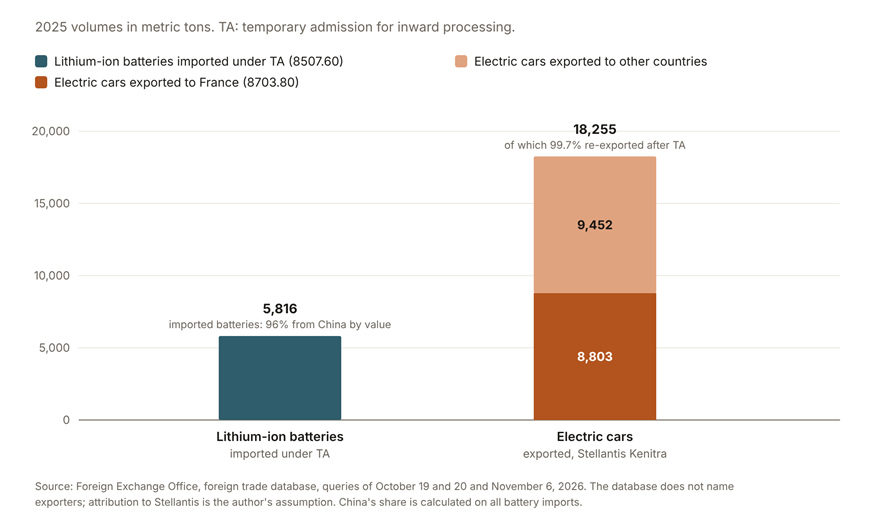
Seen in full, the picture shows Europe condemning Chinese “transshipment” and working to choke it out, even though European groups own, finance, consume, or participate in said transshipment.[50] A few examples can drag this tangled mess into relief. Morocco’s Caisse de dépôt et de gestion (CDG)—a subsidiary of which acquired a 47.6 percent stake in Renault Tanger Méditerranée in 2009[51]—signed a memorandum of understanding with Gotion in November 2024 that provides for its acquisition of a stake in Gotion Power Morocco.[52] On July 24, 2026, the African Development Bank (AfDB) approved a 100-million-euro loan for the project and plans to mobilize up to an additional 141 million euros from other lenders (likely the IFC, France’s AFD, and Germany’s KfW, amongst othes).[53] BNP Paribas, Standard Chartered, and the Paris branch of China Construction Bank, with support from Sinosure, the Chinese state-owned export credit insurer, drew up a green syndicated loan for COBCO in September 2025.[54] To wit, the financial risks conveyed through Europe’s targeting of Chinese manufacturers very much abound within Europe itself.[55]
Morocco is aware of the dangers presented to its own economy. According to a source within the Moroccan Agency for Investment and Export Development (AMDIE), Chinese investments projects are currently being closely scrutinized.[56] This is not, however, only due to regulatory dangers introduced by Brussels and Washington. By the source’s account, Morocco is weighing Chinese investment proposals against its own interests. Where proposals are too large for the country to accommodate—or where their water and electricity use is too pronounced, or their yield in terms of pollution too great—they are being paused or turned down altogether. Reports from the field indicate that Morocco has recently denied Chinese operators a concession at the Port of Nador West Med, a decision likely made to curry favor in Brussels and Washington.[57]
In the final instance, the cost of great power bickering will likely fall in the Moroccan labor market. Legal experts who analyzed the Egyptian precedent in 2023 estimated that host countries were paying for Europe’s anti-China turn in terms of jobs, tax revenue, and industrialization.
Figure 5: Battery Imports and EV Exports
Cracks in Morocco’s outward-oriented developmental model
The troubles facing Chinese factories reflect underlying troubles with Morocco’s outward-oriented development model. Reduced to its basic parts, Morocco’s model is built upon attracting foreign investment and producing for export.
This policy mix creates problems on two-fronts. Attracing foreign investment requires that corporate tax revenues be foregone and subsidies extended. Regarding taxes, “free zone” status and temporary admission carveouts—which apply to export-oriented foreign investors more broadly, not solely Chinese firms—confers substantive relief.[58] Regarding subsidies, the Moroccan state extends supports, through a number of forms, to a range of sectors considered “strategic” by the Moroccan government. Evaluated in full, the bill incurred to entice investment is quite steep, and even more so when one considers opportunity costs.
As for export-orientation, here the problem lies in Morocco’s a heavy reliance on re-exports. By dint of this feature, linkages between firms selling products abroad and the local economy have always been relatively weak.[59] The upshot is that investments received into the country’s industrial enclaves have done little to spur a wider transformation of the economy.
Royal Capital in COBCO
The only channel through which Chinese capital receives special benefits in Morocco is via relations with Al Mada, the investment fund that manages the bulk of the royal family’s wealth. Al Mada is partnered with CNGR in COBCO. Notably, this is the only instance of private Moroccan capital being involved at an equity level with a Chinese industrial project (Table 1). The business relation ties the royal family’s interests to the battery sector and can be interpreted as a sign of support for this industry at the highest levels of government. It stands in stark contrast to the limited role of domestic capital in the automotive sector, where the royal family’s interests are concentrated primarily in distribution rather than production. In 2024, foreign capital thus held nearly 88% of the automotive sector’s capital, compared to 29.8% for the entire industrial sector, and the automotive sector accounted for only 2.6% of the industrial capital held by Moroccans.[60]
Al Mada’s stake in COBCO has not yielded a positive financial return.[61] From January through November 2025, COBCO reported a net loss of 134.6 million yuan on revenue of 308 million. Recent research finds no evidence of local procurement, technology transfer, or domestic value added by COBCO, and concludes that Chinese groups retain control over key technologies and production decisions, while Al Mada, the majority shareholder of the Managem mining group, produces manganese and cobalt—strategic inputs in COBCO’s precursors.
On balance, then, any benefit that Morocco derives from its export-oriented development model centers in the labor market. And on this front, foreign investment has again long left a great deal to be desired. Saliently, in Morocco’s automotive industry—controlled almost entirely by foreign investors—the most common wage remains the minimum wage.
Chinese capital has largely moved within the well-trodden tracks of foreign investment disappointments. The agreement that the Moroccan state signed with Gotion in 2023 estimated that the investment would in total generate 17,000 jobs.[62] But by the African Development Bank’s count (AfDB), the first phase of the project only directly created in the area of 600 jobs.[63] A review of Gotion’s construction site in Kenitra in October 2025, meanwhile, showed 220 direct employees, 70 percent of whom were Chinese.[64] The compliance audit commissioned by Gotion also noted that the employment of certain foreign workers does not comply with immigration regulations. A year later, Gotion Power Morocco reported that it had recruited more than 400 Moroccans.[65] Hardly a windfall.
But there are some signs of promise. The battery materials industry being established is placing Moroccans at the corporate helm. Khalid Qalam, who previously headed the automotive sector at Morocco’s investment and export promotion agency, AMDIE, has chaired Gotion Power Morocco since September 2024.[66] Moroccan executives have also been appointed to senior roles elsewhere in the sector, including at COBCO, the joint venture between Morocco’s Al Mada and China’s CNGR Advanced Materials. These appointments follow a pattern established in Morocco’s automotive and aerospace industries, where subsidiaries of international groups have frequently recruited Moroccan professionals for middle management roles and often appointed Moroccan executives to senior leadership positions. And on the factory floor, too, hundreds of young Moroccans are being trained in and working with production processes new to the country. This experience can help Morocco’s automotive industry move into higher-value activities. For now, the underlying technology remains Chinese.
Conclusion: Strains in the Labor Market Threaten
In the third quarter of 2026, unemployment hit 10.5% in Morocco, 30.5% for 15- to 24-year-olds.[67] These are figures auguring social unrest.
On September 15, 2024, 3,000 would-be emigrants attempted to reach Sebta from Fnideq.[68] Two years later, during the last week of July 2026, 72,000 people entered Sebta.[69] And in the intervening period, the Generation Z protests were launching, demanding decent education and healthcare.
The Generation Z protests highlighted the economic exclusion of young people, which unemployment figures only partially reflect. In 2024, out of 5.9 million young people aged 15 to 24, only 850,000 were employed, and nearly 2.3 million were neither employed, nor in training, nor looking for a job. Agriculture lost 967,000 jobs between 2018 and 2023, and rural exodus drives more than 150,000 people to the cities each year.
To date, the export industry has not stepped in to fill the gap. It employed fewer than 488,000 people in 2022 and absorbed only a fraction of the 180,000 college graduates entering the labor market each year. Its least-skilled jobs, in textiles and automotive wiring, are primarily filled by young, poorly trained female workers. Free trade agreements and the exchange rate regime, which favor imports, in turn weigh on industries geared toward the domestic market.[70]
The European Union, for its part, is seeking to stem the outflow of Moroccan migrants. In 2023, the Commission signed a 152-million-euro program with the Moroccan government to strengthen border management in the face of smuggling networks.[71] In August 2026, it approved a budget of 148 million euros—112 million for the kingdom’s economic and social resilience and 16 million for youth initiatives—to address the root causes of emigration.[72]
The MOFCOM guide lists political and social stability among Morocco’s three main strengths and presents it as the country’s “greatest asset” for international cooperation. But what will become of this asset if the factories supposed to employ these young people lose access to markets in Europe and the United States?
This publication has been supported by the Rosa-Luxemburg-Stiftung. The positions expressed herein do not necessarily reflect the views of Rosa-Luxemburg-Stiftung.
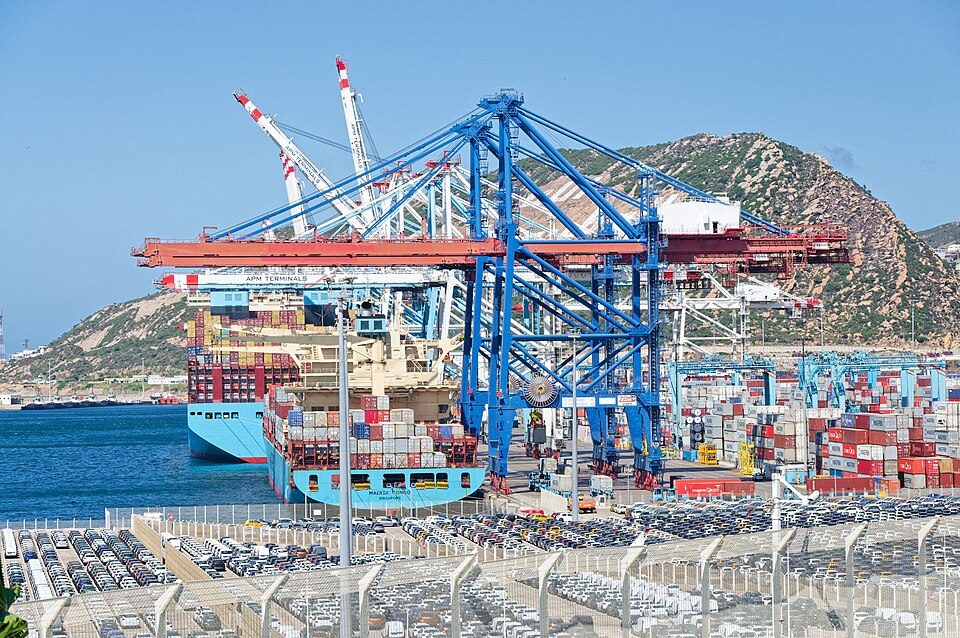
Photo Credit: Bertrand SOUBEYRAND, CC BY-SA 4.0, via Wikimedia Commons

Appendix. Tables (indicative)
The following tables are indicative. Values are in current dirhams. Data for 2026 cover January to June and remain provisional. Attributing a tariff line to a company is an assumption, as the Foreign Exchange Office database names no companies. TA stands for temporary admission for inward processing.
Table 1. Investment logics, status and trade footprint, October 2026
| Investment | Logic | Status according to Umar, Azerblou and Yang (2027) | Footprint in Foreign Exchange Office statistics |
| COBCO (CNGR and Al Mada), Jorf Lasfar | Battery chain, precursors | Operational | Nickel and cobalt sulfates imported under TA since 2024; probable exports under code 2853.90.90.90 since November 2024 |
| Gotion, Kenitra | Battery chain, cells | Contracted | No new cell exports as of June 2026 |
| BTR, Tanger Tech | Battery chain, materials | Under construction | No change in scale of lithium hydroxide imports |
| Tinci, Jorf Lasfar | Battery chain, electrolyte | Under construction | No flows of complex fluorine salts from 2022 to June 2026 |
| Hailiang, Tanger Tech | Battery chain, copper foil | In development | No copper foil exports |
| Shinzoom (Hunan Zhongke), Tanger Tech | Battery chain, anodes | Abandoned | None |
| Sentury Tire, Tanger | Export platform | Outside scope | Tire exports of MAD 797 million in 2025, 94% to the United States, 99.8% re-exported after TA |
| CITIC Dicastal, Kenitra | Supplier to carmakers | Outside scope | Wheels and parts line, all exporters combined: MAD 4.7 billion exported in 2025, 99.7% re-exported after TA. EU share of 73% in 2024, 57% in 2025 and 11% in H1 2026 |
| Parts suppliers announced in 2024-2026 | Suppliers to carmakers | Outside scope | No attributable signal |
| Broad-Ocean Motor, Tanger Automotive City | Supplier to carmakers, electric motors | Outside scope | No attributable exports as of June 2026. Imports of small motors (8501.10.80) from China under TA without payment rose from MAD 4.2 million in 2025 to MAD 17.9 million in H1 2026; importers not identified |
Sources: Umar, Azerblou and Yang, Energy Policy 220 (2027), p. 10; Foreign Exchange Office, queries of October 19 and 20, 2026; MOFCOM country guide 2025; Tanger Med, July 1, 2025; Foreign Exchange Office, query of November 16, 2026, heading 8501; author’s mapping.
Table 2. Imports, exports and re-exports in 2025, in millions of current dirhams
| Product | Imports (CIF) | of which under TA | Exports (FOB) | of which re-exports after TA | Main partners |
| New passenger-car tires (4011.10) | 2,742.7 | 950.1 | 796.9 | 795.1 | Exports: United States 94% |
| Wheels and parts (8708.70) | 1,636.9 | 1,332.2 | 4,727.6 | 4,713.7 | Exports: United States 33%, France 16%, Spain 15%; imports under TA: China 61% |
| Lithium-ion accumulators (8507.60) | 1,036.6 | 820.1 | 29.0 | 28.6 | Imports: China 96% |
| Nickel sulfate (2833.24) | 186.2 | 185.0 | 0 | 0 | South Korea 56%, Finland 23%, Australia 20% |
| Cobalt sulfate (2833.29.00.20) | 118.0 | 117.9 | 11.5 | 11.5 | South Korea 34%, Finland 27%, China 26% |
| Inorganic compounds, national label “amalgams other than of precious metals” (2853.90.90.90) | 162.3 | 161.7 | 344.1 | 344.0 | Imports: China 90%; exports: South Korea 90% |
Source: Foreign Exchange Office, foreign trade database, queries of October 19 and 20, 2026.
Table 3. Tire inputs imported under temporary admission, 2024 to June 2026
| Input imported under TA | 2024, metric tons | 2025, metric tons | H1 2026, metric tons | 2025, MAD million | Main supplier in 2025, by value |
| Natural and synthetic rubber, carbon black (4001.22, 4002.19, 4002.20, 2803.00) | 896 | 45,909 | 26,990 | 720.3 | China for synthetic rubber and carbon black, Côte d’Ivoire for natural rubber |
| Passenger-car tire exports (4011.10.90.00) | 542 | 31,155 | 39,672 | 796.9 | United States 94% |
Source: Foreign Exchange Office, imports under temporary admission for inward processing with payment, and FOB exports, extracted October 20, 2026. Totals are calculated before rounding. The ratio of these inputs to tires exported is 90% of value in 2025 and 40% in the first half of 2026. This ratio does not measure value added, as it ignores energy, other inputs and possible use of these products by other manufacturers under the same regime.
Table 4. U.S. and European measures cited
| Date | Jurisdiction | Measure | Relevance for Morocco |
| 2022 | European Union | Implementing Regulations 2022/301 (countervailing duties) and 2022/302 (anti-dumping), extension | Glass fibre fabrics consigned from Morocco |
| March 13, 2025 | European Union | Implementing Regulation 2025/500, corrected by 2025/828 | Countervailing duties on aluminum wheels, 31.4% for Dika Morocco Africa |
| July 4, 2025 | United States | One Big Beautiful Bill Act, prohibited foreign entity rules | Control above 50% by a covered country; foreign influence from 25% held by a prohibited entity; 60% threshold of non-prohibited costs for battery components in 2026 |
| March 4, 2026 | European Union (proposal) | Industrial Accelerator Act, COM(2026) 100, Annex III | Electric vehicle assembled in the Union. Countries with a free trade area deemed of European origin unless excluded by delegated act. Morocco not named |
| July 6, 2026 | European Union | Implementing Regulation 2026/1540, definitive anti-dumping duties of 4.3% to 45.3% on Chinese tires | Chinese tires competing with those made in Tanger on the European market |
| July 7, 2026 | United States | Anti-dumping and countervailing duties on Chinese tires maintained | Chinese tires competing with those made in Tanger on the U.S. market |
| July 24, 2026 | United States | Section 301, additional duties related to forced labor | 12.5% duty on Moroccan exports, excluding Section 232 products and exclusions |
| October 15, 2026 | France and Germany (joint position) | Declaration on car production “in Europe”, scope limited, according to the press, to single-market members as of January 1, 2020 | Morocco excluded from European content for subsidies and public procurement |
Citations
[1] MOFCOM, Guide pays. Maroc, éditions 2021, 2023 et 2025. https://www.mofcom.gov.cn/dl/gbdqzn/upload/moluoge.pdf
[2] Financial Times, 31 mai 2026. https://www.ft.com/content/706c1db4-effa-4e53-9bdd-f66496407626
[3] Médias24, émission 12/13, 4 juin 2026. https://medias24.com/2026/06/04/maroc-chine-ryad-mezzour-defend-les-investissements-industriels-face-aux-critiques-europeennes-1692363/
[4] USTR, décision finale section 301, 23 juillet 2026. https://ustr.gov/sites/default/files/files/Press/Releases/2026/FLIP%20301%20Investigation%20Final%20Action%20FRN%207-23-26%20FINAL.pdf
[5] Règlement d’exécution (UE) 2026/1540 et Federal Register 91 FR 43608, juillet 2026.
[6] Auto-Infos, 16 octobre 2026, d’après Le Monde. https://www.auto-infos.fr/article/automobile-paris-et-berlin-s-accordent-sur-2035-et-un-made-in-europe-a-70.293989
[7] AFP, 16 octobre 2026. https://www.lalibre.be/dernieres-depeches/2026/10/16/automobile-paris-et-berlin-officialisent-un-accord-qui-ralentit-le-passage-au-tout-electrique-MZXNSBERN5FN3CNILSOYBP3N2A/
[8] L’argus, 27 octobre 2026. https://www.largus.fr/pros/actualite-automobile/accord-franco-allemand-sur-le-made-in-europe-linclusion-du-maroc-et-de-la-turquie-en-question-40014846.html
[9] En 2025, le secteur automobile a exporté pour 154,7 milliards de dirhams, dont 61,4 milliards pour la branche construction automobile. La même année, Renault a produit 394.474 véhicules dans ses usines de Tanger et de Casablanca et en a exporté 327.552 vers 63 pays. Stellantis produit de l’ordre de 190.000 véhicules par an à Kénitra. Autour de ces constructeurs, la filière compte plus de 260 équipementiers et emploie jusqu’à 260.000 personnes selon les autorités.
[10] Rhodium Group, 18 août 2025. https://rhg.com/research/the-global-investments-powering-chinas-ev-push/
[11] Rhodium Group, 29 février 2024. https://rhg.com/research/pole-position-chinese-ev-investments-boom-amid-growing-political-backlash/
[12] Sentury Tire USA, 28 février 2025. https://www.senturytireusa.com/press-releases/sentury-tire-usa-expands-to-larger-warehouse-to-meet-growing-market-demand
[13] Office des changes, base du commerce extérieur, requêtes des 19 et 20 octobre 2026. Source de toutes les données d’échanges citées, calculs de l’auteur.
[14] OMC, Accord de libre-échange entre la Turquie et le Maroc (marchandises), WT/REG209/3, 27 septembre 2007. https://rtais.wto.org/rtadocs/29/FactualDocs/French/WT-REG209-3f.doc
[15] Ingin fabrique des coffres motorisés à Tanger Tech et compte Stellantis parmi ses principaux clients. Tianyouwei prévoit d’y fabriquer des tableaux de bord électroniques, APG des systèmes de freinage et Jundinda des gaines de protection pour faisceaux de câbles. Shanghai Kaizhong justifie sa filiale marocaine par la demande de clients européens qui veulent une production locale.
[16] Bethel, rapport annuel 2025. https://www.btl-auto.com/upload/2026-04/15/2025nianniandubaogao.pdf
[17] Lodi, Noria Research, 2025. https://noria-research.com/mena/against-fifa-2030-or-dependent-capitalism-the-thread-between-genz-revolt-and-moroccos-subordination-in-the-automotive-gvc/
[18] Challenge, 1er janvier 2024. https://www.challenge.ma/industrie-automobile-la-chasse-gardee-des-constructeurs-francais-274286/
[19] Umar, Azerblou et Yang, Energy Policy, 2027. https://doi.org/10.1016/j.enpol.2026.115632
[20] Umar et Yang, Contemporary Social Science, 2025. https://doi.org/10.1080/21582041.2025.2571579
[21] Gotion High-Tech, annonce n° 2026-072, 29 septembre 2026, https://vip.stock.finance.sina.com.cn/corp/view/vCB_AllBulletinDetail.php?stockid=002074&id=12623146, et annonce n° 2026-080, 29 octobre 2026, https://static.cninfo.com.cn/finalpage/2026-10-29/1225634491.PDF
[22] TelQuel, 17 novembre 2025. https://telquel.ma/2025/11/17/stella-li-deballe-lusine-de-bus-promise-a-mohammed-vi-et-le-casse-tete-des-bornes_1961258
[23] Umar, Azerblou et Yang, op. cit., note 19, p. 10.
[24] MOFCOM, op. cit., note 1, édition 2025, section 5.6.2.
[25] Médias24, 30 avril 2019. https://medias24.com/2019/04/30/tanger-tech-le-chinois-cccc-exige-les-memes-avantages-que-renault-et-psa/
[26] Les zones d’accélération industrielle sont les anciennes zones franches d’exportation, créées en application de la loi 19-94 promulguée en janvier 1995. La loi de finances 2020 les a rebaptisées et a révisé leur régime fiscal. Les sociétés qui s’y installent depuis 2020 sont exonérées d’impôt sur les sociétés pendant cinq ans, puis imposées au taux de 15%.
[27] L’Agence spéciale Tanger Méditerranée (TMSA) est une société anonyme créée en 2003 pour aménager et gérer le complexe portuaire et industriel de Tanger Med, dont les zones Tanger Free Zone et Tanger Automotive City. Selon son rapport annuel de 2018, elle est détenue à 87,5% par le Fonds Hassan II pour le développement économique et social et à 12,38% par l’État.
[28] Médias24, op. cit., note 25.
[29] Quotidien du peuple, 17 mars 2025. http://paper.people.com.cn/rmrb/pc/content/202503/17/content_30062235.html
[30] Lodi, op. cit., note 17.
[31] Les importations sous admission temporaire de caoutchouc naturel, de caoutchouc butadiène, de caoutchouc styrène-butadiène et de noir de carbone passent de 896 tonnes en 2024 à 45.909 tonnes en 2025, puis à 26.990 tonnes au premier semestre 2026. En valeur, le caoutchouc naturel vient à 95% de Côte d’Ivoire, le noir de carbone à 99% de Chine et le caoutchouc butadiène à 85%. Le caoutchouc styrène-butadiène vient à 51% de Chine, à 24% d’Allemagne et à 22% de Pologne. En 2025, ces intrants pèsent plus lourd que les 31.155 tonnes de pneus exportés, ce qui suggère une constitution de stocks au démarrage de l’usine. Au premier semestre 2026, ils représentent 68% du poids des 39.672 tonnes exportées. Le rapport en valeur ne mesure pas la valeur ajoutée, car il ignore l’énergie, les autres intrants et l’usage éventuel de ces produits par d’autres industriels sous le même régime.
[32] U.S. Customs and Border Protection, décision de classement N182613, 23 septembre 2011, position 2853 « Other inorganic compounds ». https://rulings.cbp.gov/ruling/N182613
[33] La nomenclature marocaine intitule cette ligne (2853.90.90.90) « amalgames autres que de métaux précieux ». En 2025, la quasi-totalité de ses importations entre sous admission temporaire et la quasi-totalité de ses exportations sort en réexportation. Ses importations, chinoises à 90% en 2025, tombent à 2 millions de dirhams au premier semestre 2026. Le sulfate de nickel importé atteint 7.510 tonnes au premier semestre 2026, contre 5.920 tonnes sur toute l’année 2025.
[34] Umar, Azerblou et Yang, Energy Policy, 2027. https://doi.org/10.1016/j.enpol.2026.115632
[35] Selon le ministère de l’Investissement, les deux usines de BTR devaient entrer en production en 2026. Tinci a lancé en février 2026 le chantier de son usine d’électrolyte. La ligne de feuille de cuivre de Hailiang était encore en conception en août 2026. Falcon a ouvert en juillet 2026 une usine pilote d’anodes près de Casablanca et vise une production commerciale au second semestre 2027.
[36] Financial Times, 31 mai 2026. https://www.ft.com/content/706c1db4-effa-4e53-9bdd-f66496407626
[37] En poids, ces importations passent de 418 tonnes en 2023 à 6.902 tonnes en 2025. Au premier semestre 2026, les batteries conçues pour les véhicules automobiles atteignent 305 millions de dirhams, autant en valeur que sur toute l’année 2025, dont 97% sous admission temporaire. Les exportations d’accumulateurs lithium-ion reculent de 38 millions de dirhams en 2023 à 29 millions en 2025.
[38] Les quadricycles sont la Citroën Ami, l’Opel Rocks-e et la Fiat Topolino, le tricycle la Fiat Tris. Stellantis, 16 juillet 2025, https://www.media.stellantis.com/me-fr/corporate/press/maroc-stellantis-et-le-gouvernement-marocain-consolident-leur-partenariat-industriel-a-kenitra-inauguration-de-l-extension-de-l-usine-de-kenitra-et-lancement-de-nouveaux-projets ; Wandaloo, 24 juillet 2025, https://www.wandaloo.com/autonews/fiat/modele/nouveau-fiat-tris-produit-a-kenitra-et-commercialise-au-maroc-en-afrique-et-au-moyen-orient/4690.html
[39] Hogan Lovells, 2025. https://www.hlc.com/en/publications/one-big-beautiful-bill-act-signed-into-law-clean-energy-credits-and-new-feoc-prohibited-foreign
[40] Umicore, 27 mars 2025. https://www.umicore.com/en/media/newsroom/pcam-ev-battery-supply-agreements-with-cngr-and-ecodream
[41] Umar et Yang, op. cit., note 20, p. 209.
[42] Règlement d’exécution (UE) 2025/500 du 13 mars 2025. https://eur-lex.europa.eu/eli/reg_impl/2025/500/oj
[43] Commission européenne, COM(2026) 100 et annexe III, 4 mars 2026. https://single-market-economy.ec.europa.eu/publications/industrial-accelerator-act_en
[44] Règlements d’exécution (UE) 2022/301 et 2022/302. https://eur-lex.europa.eu/eli/reg_impl/2022/301/oj
[45] Cour de justice de l’Union européenne, arrêt du 28 novembre 2024, affaires jointes C-269/23 P et C-272/23 P, Hengshi Egypt Fiberglass Fabrics et Jushi Egypt for Fiberglass Industry contre Commission.
[46] U.S. Department of Commerce, International Trade Administration, 21 avril 2025. https://trade.gov/press-release/opa-us-department-commerce-announces-final-determinations-antidumping-and
[47] Eco-Business, 23 avril 2025. https://www.eco-business.com/news/new-record-high-us-solar-tariffs-leave-uneven-impact-across-southeast-asias-solar-industry/
[48] Gotion High-Tech, annonce n° 2026-080, 29 octobre 2026. https://static.cninfo.com.cn/finalpage/2026-10-29/1225634491.PDF
[49] ACEA, 1er juillet 2026. https://www.acea.auto/press-release/acea-publishes-position-on-the-industrial-accelerator-act/
[50] Statistics reveal how deeply on European automaker is tied into Chinese manufacturers. Chinese batteries imported under temporary admission are found installed in Stellantis electric vehicles, 99.7% of which are re-exported—nearly half of them to France—in 2025 (Figure 5). Carlos Tavares, then CEO of Stellantis, described Morocco in 2024 as “a country with magnificent conditions for investment” and advocated for production outside Europe to reduce costs in the face of Chinese competition. The Industrial Accelerator Act considers products from the EU’s free-trade partners—including Morocco—to be European, but excludes electric cars assembled there. This double standard targets China and harms the EU’s allies.
[51] La CDG est un établissement public créé en 1959 sur le modèle des caisses publiques de gestion de l’épargne à long terme. Elle est le dépositaire légal des fonds de la Caisse nationale de sécurité sociale et de la Caisse d’épargne nationale, reçoit des dépôts et des consignations, et gère la Caisse nationale de retraites et d’assurances, qui gère elle-même le régime collectif d’allocation de retraite. Le gouvernement la mobilise régulièrement pour soutenir des investissements jugés stratégiques, dans le tourisme, l’aménagement urbain, les zones d’activités ou l’industrie. Sa filiale Fipar-Holding a pris en 2009 47,6% du capital de Renault Tanger Méditerranée, et sa filiale MEDZ aménage la zone franche de Kénitra.
[52] CDG, 13 novembre 2024. https://cdg.ma/sites/default/files/CP%20-%20Visite%20d%27une%20d%C3%A9l%C3%A9gation%20du%20Groupe%20CDG%20au%20si%C3%A8ge%20de%20Gotion%20Chine.pdf
[53] BAD, 24 juillet 2026. https://www.afdb.org/en/news-and-events/african-development-bank-approves-eu100-million-gotion-power-morocco-develop-africas-first-lithium-ion-phosphate-battery-gigafactory-95727
[54] CNGR, septembre 2025, repris par Guofu. https://news.goalfore.cn/topstories/detail/87274.html
[55] Crochet et Zhou, International and Comparative Law Quarterly, 2023. https://doi.org/10.1017/S0020589323000192
[56] Entretien de l’auteur avec une source à l’AMDIE, sous couvert d’anonymat.
[57] Informations recueillies par l’auteur auprès de sources de terrain, sous couvert d’anonymat.
[58] Note that import duties on lithium-ion cells were reduced in November 2021 from 40% to 17.5%. Batteries imported under temporary admission, which accounted for nearly eight out of ten batteries in 2025, were entirely exempt from customs fees.
[59] An AfDB loan to Gotion sets a target “local industrial integration rate” of 70%. Its safeguard documents, however, contain no quantified commitments regarding local procurement, and the supplementary impact assessment from March 2026 omits data on raw material consumption and the production process on the grounds that they are “market-sensitive and confidential.”
[60] Ministère de l’Industrie et du Commerce, Baromètre de l’industrie marocaine, édition 2025, p. 47-48. https://drh-ma.s3.amazonaws.com/wp-content/uploads/2025/11/04140518/Rapport_Enquete_industrielle_2025.pdf
[61] CNGR, annonce n° 2026-005, 24 janvier 2026. https://disc.static.szse.cn/download/disc/disk03/finalpage/2026-01-24/cf0ecf66-be5c-4d1c-a246-e8adff9d963f.PDF
[62] Umar, Azerblou et Yang, Energy Policy, 2027. https://doi.org/10.1016/j.enpol.2026.115632
[63] BAD, 24 juillet 2026. https://www.afdb.org/en/news-and-events/african-development-bank-approves-eu100-million-gotion-power-morocco-develop-africas-first-lithium-ion-phosphate-battery-gigafactory-95727
[64] ERM, audit environnemental et social de Gotion Power Morocco, 2025. https://www.afdb.org/sites/default/files/fr_gotion_audit_summary.pdf
[65] Médias24, 12 octobre 2026. https://medias24.com/2026/10/12/batteries-gotion-mettra-en-service-les-equipements-de-sa-gigafactory-de-kenitra-la-semaine-du-20-octobre-1777351
[66] La Vie éco, 5 septembre 2024. https://www.lavieeco.com/affaires/batteries-electriques-khalid-qalam-prend-la-tete-de-gotion-power-morocco/
[67] HCP, marché du travail au troisième trimestre 2026. https://www.hcp.ma/attachment/2927551/
[68] Médias24, 19 septembre 2024. https://medias24.com/2024/09/19/evenements-de-fnideq-premiere-reaction-officielle-du-gouvernement/
[69] EFE, reprise par Infobae, 4 août 2026. https://www.infobae.com/america/agencias/2026/08/04/gobierno-espanol-asegura-que-han-vuelto-70000-de-las-72000-personas-que-llegaron-a-ceuta/
[70] Médias24, 5 octobre 2025. https://medias24.com/2025/10/05/manifestations-des-genz212-symptomes-dun-modele-economique-sans-emplois-pour-les-jeunes/. D’après le HCP, Bank Al-Maghrib et le baromètre 2022 de l’industrie.
[71] Commission européenne, 2 mars 2023. https://enlargement.ec.europa.eu/news/eu-launches-new-cooperation-programmes-morocco-worth-eu624-million-green-transition-migration-and-2023-03-02_en
[72] Bladi.net, 16 août 2026. https://www.bladi.net/europe-millions-euros-maroc-agir-envie-emigrer,123130.html