
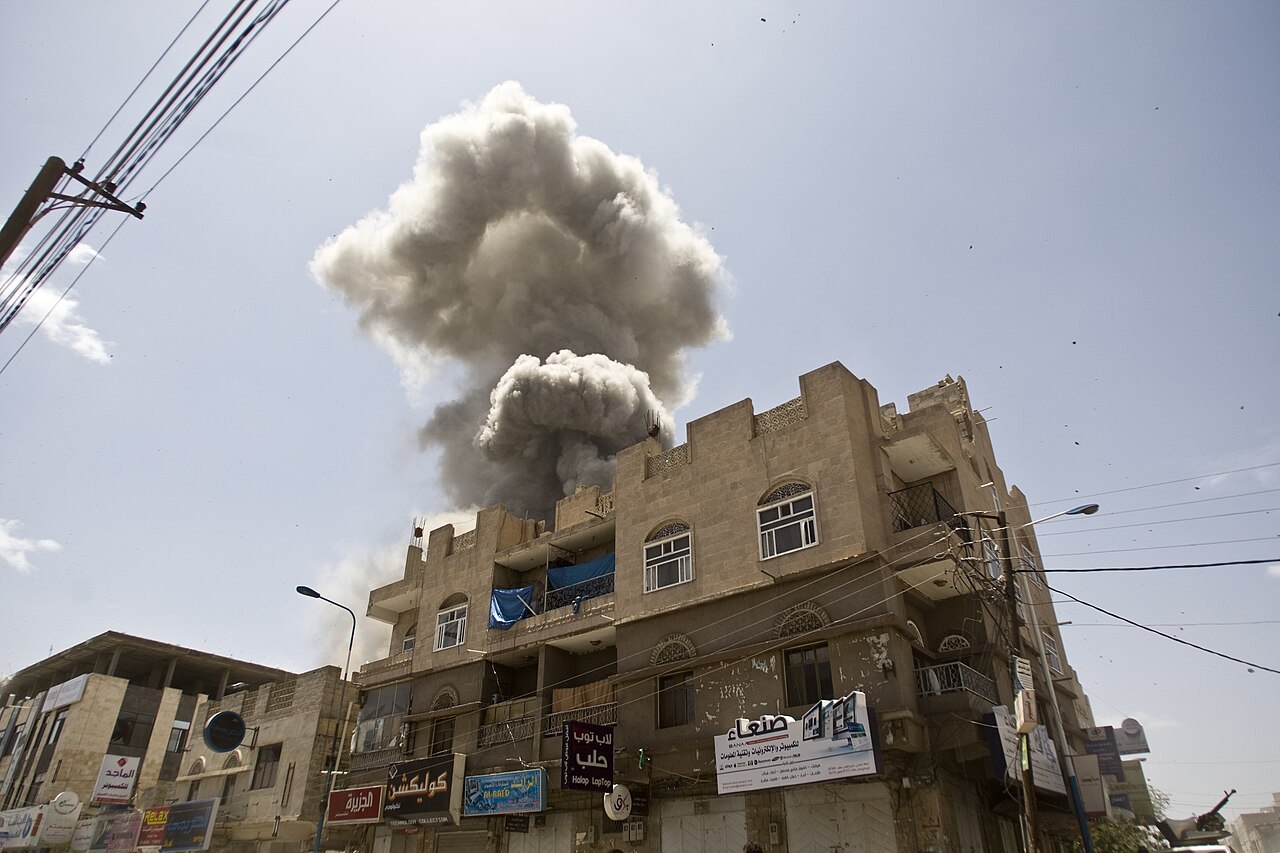
Over recent weeks, the conflict in Yemen has swiftly escalated. With the country again attracting attention from western media, one aspect of the war remains notably under-scrutinized: Namely, the strategy of Saudi Arabia, and the consequences of this strategy for the Yemeni people.
After more than a decade’s long campaign, Riyadh’s designs for Yemen continue to hinge on the achievement of a military victory over Ansar Allah. But this remains as distant a prospect today as it was in 2015. In fact, with each round of violence, Ansar Allah’s power and territorial holdings have only increased. And despite Saudi Arabia now cobbling together an international coalition to persecute the latest round of violence, all signs point to enduring quagmire and intensifying humanitarian crisis.
A Historical Retrospective on the Saudi-Ansar Allah Relation
The war presently being contested between Saudi Arabia and Ansar Allah commenced in 2015. But this is not the first time the two adversaries locked horns. In 2009, Saudi Arabia entered the Sadaa wars, which commenced five years prior and pitted tribal forces loyal to President Ali Abdullah Saleh against Ansar Allah.[1] Then as now, Riyadh’s primary means of intervention were airstrikes. And then as now, aerial bombardment failed to shift the military tides. Rather, they served to further fracture Yemen while exacerbating tensions and mistrust between Saudi Arabia and border communities in Yemen. Inasmuch as the emergence of Ansar Allah can be at least partially traced to Saudi-backed wahhabist proselytization efforts in the 1980s, this made for a troubling set-up.[2]
In 2015, Saudi Arabia initiated a second round of fighting with Ansar Allah. This time, efforts were organized via Operation Decisive Storm. The objective was to re-install the government of Abd Rabbuh Mansur Hadi, which was displaced following Ansar Allah’s takeover of Sana’a in 2014. Though skeptical of the move, the Obama administration ultimately supported the Saudi effort: the priority of the White House was to calm the waters in Riyadh, which had been disturbed after the United States signed onto the Joint Comprehensive Plan of Action (JCPOA) agreement with Iran.
As in 2009, Operation Decisive Storm ran aground militarily and politically. On the second of these fronts, Riyadh’s influence helped undermine the legitimacy of the internationally recognized government of President Hadi. Hadi had run unopposed for the office of interim President in 2012 and as such, lacked a robust popular mandate from the start. After the loss of Sana’a, he was forced to establish his government-in-exile in Riyadh, which ate further into his credibility. Come 2022, Saudi Arabia demanded that Hadi resign and hand power to a newly formed body called the Presidential Leadership Council (PLC). But for reasons that also plagued Hadi’s tenure, the PLC has struggled to lay roots. Tellingly, selection of the members of the PLC, eight in total, were divvied up between powerbrokers in Saudi Arabia and Abu Dhabi. As a government operating mostly in exile, the PLC has remained distant from key constituencies, and in a physical sense, with members being housed in fancy hotels in Saudi Arabia and the UAE.[3] Four years into its existence, the PLC has failed to inspire confidence in its independence and ability to govern Yemen.
Running it Back
After years of futility, Saudi Arabia’s long-term strategy and goals within Yemen begs questioning.
In 2025, Saudi’s defense spending reached $83.2 billion, roughly 6.5% of the country’s GDP, with the figure expected to be even higher this year.[4] Yet these levels of expenditures have hardly secured the homefront. In addition to drone and ballistic missile attacks from Tehran aside, since July, Saudi Arabia’s airports, urban areas, and oil infrastructure have been subjected to unbreaking assaults from Ansar Allah, and its oil can no longer pass through the Bab al Mandab. The effects have been enormous: oil revenues tanked in the third quarter of 2026, and a number of crucial events have needed to be canceled. In these conditions, realizing Vision 2030 becomes ever more unlikely.
In response to Ansar Allah’s attacks, Saudi Arabia has pursued more international and regional partnerships, most notably through the Mecca Agreement. Recruiting external parties to join the war effort, however, may do little to change realities on the ground: Military failures of 2015 make that clear. The further internationalization of the conflict is most likely to lend scale to civilian suffering while achieving no strategic aims.
Already, the past few weeks have seen mass displacements and countless deaths of innocents. October 2026 was the worst month for civilian harm since 2017. 437 Saudi air raids yielded 426 casualties, and almost one fourth of those killed were children. In one day in November, thirty-three Yemenis were killed by a Saudi Air Force assault on the village of Bani Hushaysh. Notably, the Saudi military’s deployment of double tap bombings killed paramedics and other first responders. The outcry within Yemen has been palpable, and amplified by videos of PLC forces driving over or stripping prisoners-of-war. Taiz, meanwhile, faces a blockade, one that has already resulted in hospital closures, mass hunger, and human rights violations.
The Need for a Political Solution
In the final report of the UN experts on Yemen, the authors described Yemen as a nation abandoned. With painstaking detail, they outlined a wide array of war crimes committed by Ansar Allah, the PLC, STC, and affiliated armed groups over recent years. The analysis demonstrates that in Yemen, there are no military solutions or victors. If Saudi Arabia failed to learn this lesson in 2009, perhaps it will in 2026.
Four years ago, a truce between Ansar Allah and Saudi Arabia was implemented. This diplomatic effort demonstrated that political engagement can yield meaningful results where military efforts cannot. Indeed, the only path forward for Yemen and the region at large is diplomacy. This time around, however, ambition must extend well beyond a truce: a comprehensive peace deal, grounded in a political program that the people of Yemen can see credibility and value in, needs to be established. The urgency of such a deal is clear for the Yemeni people, who have, over fifteen years, endured levels of pain and dislocation that are difficult to overstate. With Saudi Arabia’s plans for economic diversification collapsing under fire from Ansar Allah, perhaps it will become clear to Riyadh soon as well.
Photo Credit: fahd sadi, CC BY 3.0, via Wikimedia Commons

[1] Carnegie Endowment for International Peace, Yemen: On the Brink
[2] Helen Lackner, “Yemen’s Ansar Allah”, Middle East Research and Information Project (January 2025).
[3] Patrick Wintour, “Yemen’s President sacks ministers and officers in attempt to turn tide of war”, The Guardian (November 5, 2026).
[4] Stockholm International Peace Research Institute, SIPRI Yearbook 2026