
Lebanon’s debt crisis is frequently framed through a “politics of numbers,” in which macroeconomic indicators such as public debt ratios, bank balance sheets, and fiscal deficits, operate as “hegemonic” metrics that render the crisis legible primarily as a problem of state solvency while obscuring the social relations and everyday practices of indebtedness that sustain it.[1] In each instance, debt is framed as a technical flaw rather than a distributive struggle. Depoliticized thusly, its management allows for social conflict to be waged without any declaration of war. In the name of bringing the state’s obligations back under control, real wages are inflated away and public spending eroded through fiscal constraint and institutional paralysis.
Sexuality (and alongside it, gender) enters through a fundamentally different, non-numeric logic. Unlike debt ratios, it is not counted or incorporated into formal diagnostics. This separation is not unique to Lebanon, but it takes on particular force within the country’s debt crisis. As the collapse has unfolded, the costs of adjustment have not been managed through formal redistribution or public welfare provisioning ;rather, they have been carried via intimate relations, which have been tasked with absorbing the withdrawal of the state.
It is precisely this asymmetry, through which certain forms of social life become economically legible while others are relegated to the supposedly private domain of intimacy, that feminist and queer political economy has long interrogated. Against any view of “the economy” as a bounded sphere with an autonomous rationality, this scholarship insists that capitalist social relations are forged through historically contingent arrangements of kinship, gender, sexuality, race, and citizenship.[2] Unpaid care, familial obligation, emotional and sexual labor, and other disciplined forms of intimacy do not simply appear after the fact as compensatory supports for economic crisis. They are constitutive of the reproduction of labor power and social life itself, and therefore integral to the reproduction of accumulation and the making of class relations.
Because debt regimes shift the work of social reproduction onto households, they depend on kinship arrangements capable of absorbing economic risk. Sexuality therefore becomes politically significant insofar as it aligns with, or disrupts, the heteronormative family structures through which debt capitalism stabilizes everyday survival.
From this perspective, debt regimes do not simply redistribute crisis onto households as residual sites of social reproduction. They operate through a series of intimate conversions that reorganize how lives are oriented toward one another under conditions of profound economic collapse. Mounting poverty, hyperinflation, and severe shortages of electricity, food, and fuel have meant that the everyday work of provisioning life has become a continuous crisis demanding both material and relational laborfrom households.[3],[4] In this context, debt reorganizes intimate relations by assigning unequal responsibilities within these households. Roles such as the reliable son, the caregiving daughter, or the financially productive migrant are transformed into obligations that determine who is expected to pool credit, who must suspend personal autonomy through strategies like emigration or prolonged co-residence, and who quietly absorbs capitalist economic risk through unpaid care.[5] The fact that remittances have at times constituted over a quarter of Lebanon’s national output highlights how intimate networks of obligation have become entangled with macroeconomic instability, effectively substituting for state support.[6] Meanwhile, informal lending networks have proliferated, embedding financial obligations within communal and sectarian infrastructures.
The intersections between debt, gender, and sexuality in Lebanon
Debt reorganizes intimacy by shifting the burden of survival onto households. Yet this redistribution does not unfold in a neutral sense. The relations through which crisis is absorbed are themselves legally constituted and unevenly structured by the state. What is commonly described as sectarian power-sharing at the level of governance also functions, at the level of everyday life, as a legal architecture for organizing social reproduction. As Maya Mikdashi shows in her work on queering citizenship,[7] Lebanese citizenship is not a singular universal status but an assemblage produced through overlapping regimes of civil law and sect-specific personal status laws governing marriage, inheritance, and the transmission of nationality. It is straightforward to see how the latter shape the kinship relations through which households are expected to pool resources and sustain life under conditions of collapse.
Scholars have long challenged the idea of universality when speaking of ‘citizens’ by emphasizing the real material difference between the legal form of citizenship and its lived everday practice. In Lebanon, this gap is structured through a dense legal architecture that differentiates citizens along lines of gender, sect, and familial belonging. The country recognizes eighteen religious sects and maintains fifteen separate personal status laws governing marriage and divorce as well as inheritance and other forms of resource transfer. These regimes produce multiple, legally differentiated forms of citizenship, as Mikdashi precisely argues. For example, Lebanese women across sects cannot transmit their nationality to foreign partners or children, creating households in which some members may be denied legal employment or residency rights. Personal status laws also organize access to property differently across sects. These distinctions are not merely symbolic. They structure the material relations through which households organize survival, particularly in the context of financial destabilization. Legal definitions of kinship determine who is recognized as a dependent, who inherits property, who is legally obligated to provide financial support, and whose labor is mobilized during periods of crisis. Citizens themselves often navigate these legal differences strategically. Individuals convert between sects to remarry or to access more favorable inheritance regimes. In this sense, citizenship in Lebanon is not simply a fixed legal status but a differentiated and negotiated practice enacted through the overlapping regimes of sectarian family law.
Under conditions of debt-driven collapse, this legal framework becomes a critical mechanism through which austerity is lived. As public welfare erodes, survival depends on access to family-based resources, such as housing, inheritance, remittances, as well as unpaid care. Access to these resources, however, is often mediated in advance by personal status regimes that privilege heterosexual, patrilineal households while rendering others precarious or illegible. Queer people, women married to non-citizens, and those without legally recognized kin are thus positioned differently within the economy of crisis. Lebanon’s debt regime does not merely displace responsibility onto “the family”; it relies on a differentiated legal ordering of intimacy that determines whose lives can be sustained through kinship and whose are structurally exposed to abandonment.
A longer genealogy of debt in Lebanon: from monetization and land to the production of a ‘sexual hegemony’
Expansion of monetary exchange, export-oriented silk production, and liberal reforms
The centrality of debt in Lebanon cannot be confined to the postwar period. It has a longer genealogy tied to Lebanon’s nineteenth-century integration into global capitalism. That transformation was propelled by three interlocking shifts: the expansion of monetary exchange, export-oriented silk production, and liberal reforms around private land ownership.[8] These were not mere “developments.” They were reorganizations of social reproduction.
The expansion of monetary taxation under the Ottoman Tanzimat reforms rendered livelihoods legible to the state only insofar as they were monetized. This shift created a structural contradiction. While survival increasingly required cash, access to cash remained seasonal and precarious. Debt emerged here not simply as a financial instrument but as a mechanism for governing this contradiction. By binding households to future income, debt stabilized taxation and production while transferring risk downward. Those unable to meet monetary obligations, such as small cultivators and land-poor households, became visible as socially problematic within an emerging capitalist order.
Export-oriented silk production intensified this contradiction. Credit tied households to global market cycles over which they exercised no control, pledging future harvests and labor in advance. Debt, here, reorganized temporality, forcing families to live in arrears to uncertain futures. In this context, instability did not appear as a failure of markets, but as a moral problem located in households themselves, namely in their failure to reproduce stable laboring units.
The liberalization of land ownership further sharpened these tensions. As land became mortgageable collateral, its loss threatened not only economic survival but social status and the continuity of lineage. Debt now mediated access to property and inheritance–to wit, to futurity. Kinship networks that failed to stabilize their obligations risked dispossession, while those able to align property transmission with market logics reaped sizable benefits. It is within this moment that migration emerged as a response to the impasse standing before the Lebanese populace. Indebted households mortgaged or sold land to finance emigration, binding reproduction to transnational circuits of labor and remittance.[9] Here again, the imposition of debt displaced systemic instability onto intimate arrangements and reorganized family life across distance, a reality that persists in Lebanon today.
This genealogy clarifies that debt is a governing relation that requires the stabilization of social reproduction in order to function. Economic integration generated forms of dependency that could not be managed through markets alone. They required normative frameworks capable of assigning obligation, most notably family responsibility. Evidence from Lebanon’s contemporary crisis illustrates how these conditions shape who can be treated as a reliable borrower. Survey data , with a sub-sample including LGBTQ+ populations, a group often excluded from formal employment and family-based safety nets, show an average monthly income of roughly $256, substantially below the overall average incomes of men ($359) and women ($285). In the absence of assets or any meaningful household backing for many, borrowing occurs primarily through informal arrangements. These may include seeking ‘credit’ from shopowners or acquaintances, where repayment is enforced through social pressure or under exploitative conditions, with trans persons facing the harshest terms.[10] For example, in some cases, some trans women reported being asked for sex in exchange for support or had their papers withheld in the process.
Those embedded in stable kinship structures and asset-holding households are thus better positioned to access more formal or predictable credit or financial buffers, while those excluded from such arrangements are rendered effectively unbankable and confined to precarious and coercive debt relations. Rather than functioning as a neutral financial instrument, debt here becomes a mechanism through which survival itself is governed, redistributing risk onto intimate relations and exposing those without durable reproductive infrastructures to heightened precarity. In this sense, Lebanon’s debt regime did not merely accompany capitalist integration; it actively produced it by reorganizing the moral and intimate-social terms of survival.
Production of sexual hegemony
Indeed, long before the postwar period, debt had already begun to function as a technology through which economic crisis was rendered governable. Seen through this lens, the stabilization of debt as a regulatory tool required more than fiscal instruments or market discipline; it demanded a hegemonic reorganization of intimacy itself. With economic volatility displaced onto households, the endurance of debt as a mechanism of control was to hinge on normative forms of social reproduction. It is at this conjuncture that sexuality becomes highly relevant.
As Lebanon’s debt drive intensified, pressures generated by dispossession and migration destabilized established relations of dependency and authority within households and across class lines. Intimate relations that failed to reproduce clear hierarchies of gender, particularly those not anchored in the patriarchal nuclear family, came to be framed not merely as deviant but as sources of social disorder requiring intervention. This perception is evident in the legal and policing apparatus governing sexuality across time, including the continued invocation of public-morality laws and Article 534 of the Penal Code, which criminalizes relations deemed “contrary to the order of nature.” Periodic police raids on spaces associated with non-normative intimacy, especially after 2019,[11] illustrate how such relations are treated as threats to social stability. Historically, the story persisted. In 2012, security forces stormed a cinema in the working-class district of Bourj Hammoud, arresting thirty-six individuals who were subsequently subjected to torture and forced anal examinations; in 2014, authorities raided a Beirut sauna, detaining twenty-seven people, including Syrian refugees, many of whom were later charged with unrelated offences.[12] [13]
These operations disproportionately targeted lower-income and migrant populations, while middle- and upper-class individuals retained access to relatively protected queer-friendly spaces, revealing a deeply stratified geography of repression. Waves of hostility toward LGBTIQ+ communities have also intensified during periods of political and economic crisis, suggesting that the regulation of sexuality functions as a mechanism for reasserting authority when existing structures of dependency are under strain.[14] Sexual difference thus emerged not as a purely cultural phenomenon but as a terrain of hegemony, following Christopher Chitty, a site where consent to normative social arrangements was enforced and perceived disorder disciplined through moral policing.[15]
In the Lebanese case, the figure that ultimately condenses these contradictions is neither the homosexual nor the debtor, but the unbankable and uninheritable subject, namely a body whose intimate life cannot be smoothly translated into some sort of collateral. Under successive debt regimes, this figure emerges wherever social reproduction slips out of alignment with the heteronormative household that underwrites creditworthiness. Sexual nonconformity becomes politically salient here not because it is transgressive per se, but because it signals a failure of incorporation into the forms and structures through which debt persists, such as marital pooling or privatized care.
The reorganization of social reproduction under neoliberal restructuring did not operate solely through the intensification of familial responsibility. It also produced new forms of market-friendly intimacy. As welfare provision retreated and urban economies increasingly relied on services, tourism, and consumption, certain forms of sexual difference became legible as market niches. Queer visibility thus emerged not outside the debt economy but within it, as part of the broader privatization of survival and value creation under financialized capitalism.
Postwar Neoliberal queer politics: homonormativity, donor drives, and queer markets
The uneven politics of sexual liberation in contemporary Lebanon cannot be understood apart from the reorganization of labor and social reproduction produced by successive cycles of debt accumulation. As recurrent crises loosened the material bases of extended kinship and displaced welfare responsibilities onto households, intimate life became partially disembedded from the material guarantees historically provided by family structures. These transformations created conditions under which same-sex relations and non-normative lives could proliferate, particularly in urban centers in Beirut. Yet, as with debt itself, possibilities were sharply stratified. Among elite and professionalized strata, partially shielded from proletarianization through property ownership, education, or access to transnational networks, queer life could be articulated through unbounded consumption. Here, sexual nonconformity was not opposed to accumulation but folded into it, refigured as a form of distinction.
This is what queer Marxists such as Peter Drucker describe as a combined and uneven politics of sexual liberation, in which conditional inclusion for some coexists with abandonment or repression for others. For those pushed deeper into precarity by indebtedness, queerness assumed a markedly different form. Exclusion from stable labor and familial support produced modes of intimacy oriented less toward identity or recognition than toward survival economies. This includes shared housing, informal care exchanges such as mutual aid, and improvised kinship beyond the nuclear household. These relations emerged not despite economic dislocation, but through it, as responses to the intensified separation of production from reproduction under debt capitalism. What appears from above as sexual excess or irresponsibility is, from below, the life-making labor of endurance under conditions where neither the family nor the market reliably sustain life.[16]
It is within this frame that homonormativity takes shape in Lebanon. Donor-funded and NGO-ized queer politics frequently operate within homonormative global rights and ‘empowerment’ frameworks. These frameworks privilege legibility through mechanisms such as professionalization and rights claims that travel easily across donor funding regimes. To wit, this is a queer politics anchored to the non-disruptive and economically productive. The proliferation of queer markets intensifies this contradiction. As John Nagle (2022) notes, homo-entrepreneurialism and the promotion of “gay-friendly” districts for tourism have expanded, positioning queer visibility as economic branding and as a marker of liberal modernity, without necessarily expanding substantive protections in a context of deepening indebtedness. The result is a form of what Ghassan Moussawi calls queer exceptionalism, namely the selective elevation of homonormative subjects, gender-conforming, class-privileged, often proximate to cosmopolitan whiteness, as signs of progress, while other queer subjects such as working-class, trans, migrant, refugee, and otherwise non-normative individuals remain exposed to policing and abandonment.
Research on queer life in Beirut shows that access to “queer-friendly” spaces is sharply stratified by class and nationality, with middle- and upper-class individuals able to inhabit relatively protected urban enclaves while poorer and racialised populations face disproportionate surveillance and violence, particularly during periods of crisis.[17] In an interview with multiple queer people, many repeatedly described how being in debt has further narrowed access to many such spaces, effectively pricing out poorer queer people. A trans activist involved in community safety planning contrasted the vulnerability of informal gathering places with “higher-class” venues that felt untouchable precisely because “their financial and social capital insulated them,” highlighting how visibility becomes tolerable only when it is already embedded within elite infrastructures.
Humanitarian assessments during the collapse similarly found trans people, queer refugees, and other multiply marginalised groups experiencing crisis impacts at dramatically higher rates, underscoring that the category of “the queer community” masks profound internal inequalities structured by class and citizenship.
Debt thus operates as the hinge through which political economy becomes articulated through sexuality. It is the mechanism through which crisis is displaced into households and intimate life, sorting queer relations into those that can be privatized, commodified, and rendered respectable, and those that reveal the structural impossibility of reproducing life under conditions of permanent crisis.
Debt and sexual liberation
This essay began by questioning how Lebanon’s crisis is rendered through numbers that present themselves as neutral facts, while relegating intimacies to the realm of the non-economic. Tracing the genealogy of debt back to Lebanon’s nineteenth-century integration into global capitalism, we showed how finance reorganized social reproduction long before the postwar period, transforming obligation into a privatized burden borne by households.
Within this architecture, we can see that heteronormative family forms are not incidental in Lebanon, but essential infrastructures for absorbing crisis. Sexuality has emerged not as a cultural add-on to political economy, but as one of the terrains through which capitalist order is streamlined and contested. Periods of economic crisis have only intensified the regulation of intimacy, selectively incorporating some queer lives into regimes of value, while marking others as disposable or unworthy. In Lebanon’s postwar and neoliberal period, this uneven sexual politics takes the form of homonormative inclusion, where donor-funded activism, queer markets, and visibility-based recognition align with debt-driven reconstruction and the privatization of welfare.
In the final instance, queerness is tolerable in Lebanon only insofar as it does not disrupt the mechanisms through which debt externalizes loss into intimate life. What is “queer” about debt and capitalism in Lebanon, then, is not that queer people are simply more harmed by an otherwise neutral crisis. It is that debt capitalism depends on heteronormative infrastructures of social reproduction, namely households that can buffer shocks, families that can absorb care costs, subjects that can be disciplined into productivity. Queer life, positioned at the fault lines of these arrangements, renders the violence of debt unusually visible. Indeed, debt is not merely an instrument of finance, but a mediator of intimacy. Through time depletion, emotional violence, coerced dependency, and familial entrapment, it polices possibilities for sexuality and gender expression.
But repressive conditions created through debt may also generate insurgent forms of social reproduction. Mutual aid, chosen kinship, informal care, and other intimate economies emerge within the wreckage of debt, refusing the creditor’s logic by organizing obligation around solidarity rather than extraction. Following Alan Sears, these practices are best understood not as utopian solutions or substitutes for structural change, but as infrastructures of dissent through which people learn to survive and struggle otherwise. They reveal both the possibility of queer life and the impossibility of sustaining it indefinitely through unpaid community labor alone. To look at debt through the lens of sexuality, then, is to refuse the narrowing of queer politics to the aesthetics of inclusion within the existing horizon of capital. It is to insist that sexual liberation must be tethered to a struggle over the conditions of social reproduction itself, through housing, healthcare, labor protections, safety, and the decommodification of everyday life.
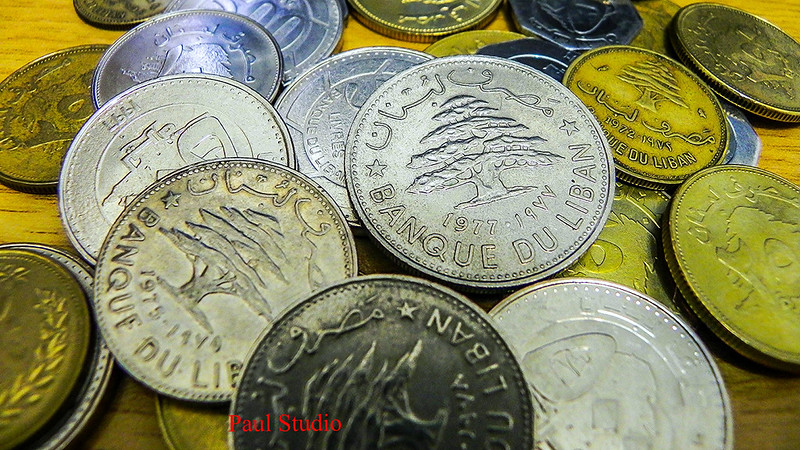
Photo Credit: Paul Saad, “Lebanese coins” (2014)
[1] Isabelle Guérin and Govindan Venkatasubramanian, “Debt and the Politics of Numbers: Hegemonic Numbers, Political Numbers, Ordinary Numbers”, Review of Political Economy 36:2 (2024).
[2] Laura Bear, Karen Ho, Anna Lowenhaupt Tsing, and Sylvia Yanagisako, “Gens: A Feminist Manifesto for the Study of Capitalism”, Theorizing the Contemporary, Cultural Anthropology Fieldsights (March 30, 2015).
[3] Karen Ravn, “The Permanent Crisis of Social Reproduction in Lebanon: From Past to Present”, Kohl: A Journal for Body and Gender Research 7:2 (Fall 2021).
[4] Anna Lowenhaupt Tsing, The Mushroom at the End of the World: On the Possibility of Life in Capitalist Ruins (Princeton, NJ: Princeton University Press, 2015).
[5] Laura Bear, Lines of the Nation: Indian Railway Workers, Bureaucracy and the Intimate Historical Self (New York: Columbia University Press, 2007).
[6] Richard Salame, “Pockets Full of Cash, but Not Lira”, L’Orient Today (2024).
[7]Maya Mikdashi, “Queering Citizenship, Queering Middle East Studies”, International Journal of Middle East Studies 45:2 (May 2013).
[8]Dominique Chevallier, La société du Mont-Liban à l’époque de la révolution industrielle en Europe (Paris: Librairie Orientaliste Paul Geuthner; Institut Français d’Archéologie de Beyrouth, 1971).
[9]Dominique Chevallier, La société du Mont-Liban à l’époque de la révolution industrielle en Europe (Paris: Librairie Orientaliste Paul Geuthner; Institut Français d’Archéologie de Beyrouth, 1971).
[10]Jessica Moujabber, Mirdza Abele, Yara Shamlati, Maxime Bazin, Mariana Makoukji, Lara Makhlouta, and Elisa Bountoktzi, Borrowing to Survive: Why Cash Assistance Needs a Debt Lens — and What That Looks Like (Oxfam, 2025).
[11] Hussein Cheaito, “State Power, Fragile Masculinities and Queerness in Lebanon”, The New Arab (2023).
[12] BBC News, “Outraged Lebanese Demand End to Anal Exams on Gay Men”, BBC News (8 August 2012).
[13] Sarah Wansa, “Torture at Every Stage: The Unofficial Narrative of the Hammam al-Agha Raid”, The Legal Agenda (12 November 2014).
[14] Hussein Cheaito, “State Power, Fragile Masculinities and Queerness in Lebanon”, The New Arab (2023).
[15] Christopher Chitty, Sexual Hegemony: Statecraft, Sodomy, and Capital in the Rise of the World System (Durham: Duke University Press, 2020).
[16]Alan Sears, Eros and Alienation: Capitalism and the Making of Gendered Sexualities (London: Pluto Press, 2025).
[17]Hossein Cheaito and Andrew Delatolla, “Lebanon’s LGBTIQ+ Activism: Between Global Representation and Neoliberalism”, European Journal of Politics and Gender (12 January 2026).