
Executive Summary
This report offers a study in the economic crisis that befell Egypt between early 2022 and the middle of 2024. Aiming for comprehensiveness, it considers the causes of the crisis, effects that were set into motion by the crisis, and the prospects of the Egyptian economy going forward.
Regarding causes, findings are largely in line with consensus. In our researcher’s estimations, policymaker folly undoubtedly bears the greatest responsibility for the crisis. By pursuing an investment-led growth model but failing to mobilize sufficient levels of capital expenditure, the policy team assembled by Abdel-Fattah el-Sisi locked Egypt into a low growth trajectory. Macrostability was further compromised by failures to improve the country’s terms of trade, boost productive capacity, or limit exposure to international commodity markets, all of which served to create recurring strains on Egypt’s balance of payments. Moreover, in attempting to ease such strains through selling local currency debt to foreign carry traders, it was policymakers that added the flint which would ultimately set the tinderbox aflame. But other factors contributed to the crisis as well. Variables of a structural nature—the workings of the global financial system in particular—imposed restraints and incentives non-supportive to healthy economic performance. And historical contingency undoubtedly helped spark the crisis, too. Critical here were shifts in the global credit cycle and the Russian invasion of Ukraine.
If our report’s findings affirm most of the prevailing wisdom on the causes of Egypt’s crisis, they strike out on their own when it comes to the effects that the crisis has generated. The primary claim put forth is that the crisis acted to restore the general rate of profit. Empirically, the rate of profit increased from ~14% in 2021 to ~19% in 2024. Per our investigation, the mechanism that most propelled the jump was extreme levels of disinvestment. In conjunction with normal capital depreciation, disinvestment functioned to increase the ratio between capital income and a (declining) capital stock. Also supporting the rise in profit rates were an intensified squeeze on labor and debt-based extraction, respectively. The secondary claim put forth is that the crisis acted to facilitate khaliji capital’s ascension to a dominant position within the Egyptian economy. Alongside the Egyptian Armed Forces, khaliji capital can be said to now represent a co-hegemonic fraction within the capitalist class—and a necessary condition for regime reproduction.
On the prospects of the Egyptian economy going forward, our report edges toward pessimism. Prognostication is partially informed by concerns over the sustainability of the current rate of profit. According to our analysis, none of the levers which helped lift the rate of profit between 2022 and 2024 can be pushed further without triggering social or financial rupture. As there are few signs of the bygone crisis unleashing a pulse of creative dynamism in its wake, the non-viability of the formula previously used to restore profitability points to danger. Also pointing to danger—and also informing our prognostication—are concerns over the continuities and change which mark the post-crisis economy. Pertaining to continuities, the Egyptian economy remains every bit as predisposed to external imbalances as it was before, and every bit as exposed to the whims of global commodity and financial markets. Distressingly, policymakers are again relying on portfolio investment for hard currency, too, enormous risks be damned. As for changes, three related developments stand out. Firstly, Egypt’s subordination within a Gulf-dominated regional economy has deepened. Secondly, capital ownership has concentrated into even fewer hands than before. Thirdly, Egyptian capitalism’s social base has narrowed. In our reading, neither the changes nor continuities in question can be deemed auspicious for stability or long-term capital profitability.
This publication has been supported by the Rosa-Luxemburg-Stiftung. The positions expressed herein do not necessarily reflect the views of Rosa-Luxemburg-Stiftung.
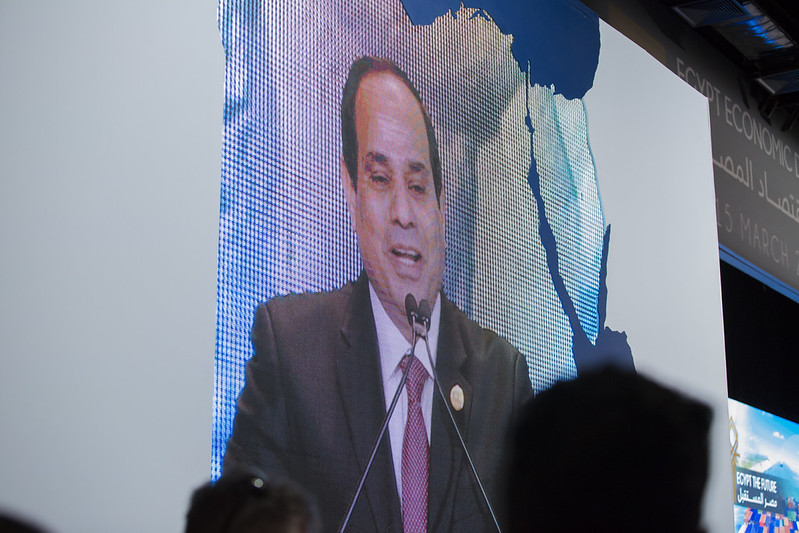
Photo Credit: Paul Kagame, “Egyptian President Abdel Fattah el-Sisi delivers remarks at the Egyptian Economic Development Conference – Sharm el-Sheikh” (March 2015)