
In the four and a half years since the coup of July 2021, a common refrain emerged amongst the supporters of Kaïs Saïed. To justify the President’s imposition of restrictions on basic freedoms, Saïed’s backers argued that though his actions might violate bourgeois interpretations of liberty, they were conducive to the advance of social liberties. Recent events in Gabès put this framing to the test. In the face of a mass mobilization charged by social and ecological grievance, the President’s has needed to balance his alignment with “the people” against the wishes of capital and the Tunisian security state. A clarifying moment, these events have offered profound insights into the nature of Saïed’s regime at the end of 2025.
Background
At independence, the young Tunisian state set out to rebuild the economy upon a planned industrial policy. In the 1960s, several production hubs (mainly state-owned) were established throughout the country. The Bizerte region in the north became the primary host of steel production and oil refining. Mindful of the sugar beets harvested there, the city of Béja in the northwest became home to a sugar factory processing. In Kasserine of Tunisia’s center-west, a paper factory was set up to transform the esparto grass native to the lands. In the south, meanwhile, path dependencies from the colonial period ensured that the region remained the linchpin of the country’s extractive industries. Minerals extracted from across Tunisia’s geography—principally, phosphates, gas, and oil—wound up processed in factories along the Gulf of Gabès. These operations, which were predominantly overseen by the Tunisian Chemical Group (GCT), tightly linked Tunisia’s second largest city, Sfax, to its fourth, Gabès. Socially, developmentally, and ecologically, the two cities were indelibly and unevenly bound. While the capital gains accrued from mineral extraction disproportionately accumulated in Sfax, damages to local ecosystems and to the health of the population were disproportionately suffered in Gabès.
These damages are today visible in a handful of key statistics. Uranium sediments in the Gulf of Gabès have a concentration of 38 mg/kg, more than 14 times authorized levels1. Air quality, as measured by the number of airborne particles with a diameter of 10 micrometres (PM10) or less, is woeful as well. Daily peaks of PM10 are around 200 to 260 µg/m³ in Gabès2, despite Tunisia’s regulatory limit being set at 45 µg/m³. More than 14,000 tons per day of phosphogypsum is directly deposited into the sea around Gabès3, with disastrous effect on water quality and marine life. Finally, the fluoride content in sediments in the area is nearly 33 times higher than the regulatory limit4 defined by Tunisian authorities (8,117 mg/kg compared to a maximum permitted level of 250 mg/kg).
The frustrations and resentments created by industry’s environmental impacts in Gabès famously came to a head in 2008 when the Gafsa mining basin erupted in a revolt. The uprising, a key precursor to those of 2010-2011, raised health and environmental demands just as it denounced the nepotism and corruption of the Ben Ali regime. And when that regime fell some two-odd years later, there was a brief moment when such demands were actually heard.
A Social Movement Grounded in History
Indeed, the fall of Ben Ali created an opportunity, rare in recent history, for all kinds of demands to be made. As early as 2011, leaders of Gabès’ civil society began pressing for the consequences of local industry to be meaningfully addressed. The movement gained national attention on June 5, 2012, when a large march was organized under the slogan “Stop pollution – I want to live” to mark World Environment Day (June 5). From 2013 onwards, this movement became more structured, connecting local associations with national organizations such as the Tunisian Human Rights League (LTDH), the Tunisian Forum for Economic and Social Rights (FTDES), and the regional branch of the Tunisian General Labor Union (UGTT).
The protesters linked environmental issues to economic and political ones. Their aim was to denounce pollution, poor management, and regional inequalities. In 2017, the movement gained further momentum and massive marches were organized under the slogan “Gabès rises up against pollution.” Per Khaled Tabbabi, a sociology researcher and specialist in social and migratory movements, “After Ben Ali’s fall, social and environmental movements were able to flourish thanks to greater freedoms. New actors joined former activists who had previously been underground or working in the few spaces that allowed political and social action, such as certain opposition parties or civil society organizations. The new context made it possible to highlight issues related to mining but also to the textile sector. Small farmers also attempted to have their environmental and social concerns heard and to raise issues relating to food sovereignty and an agricultural model premised around servicing big agribusinesses and multinationals.”
In response to the 2017 marches, the government, led by Youssef Chahed, committed to gradually dismantling the most polluting facilities in the area and to move many processing operations away from major urban centers5. However, such promises were not followed through on. Thus, in 2018, in line with the trend toward the empowerment of social movements—such as the El Kamour movement6—a collective called “Stop Pollution7” was created and became the main voice of environmental protest in the region. Structured in a relatively horizontal manner, the movement was young in membership and highly skilled when it came to communications on social media. It also operated independently of Tunisia’s main institutional intermediaries—namely, political parties and the UGTT—all of whom had shed credibility in the previous years.
Untethered to the political fabric, the “Stop Pollution” movement was ripe for alignment with a Presidential candidate rejecting affiliation with any of the institutions that had risen to prominence during the democratic transition. As it played out, Saïed would support these youth of Gabès and train many of their leaders8. Once in power, Saïed also made numerous statements to signal his commitment to their cause, including referring to the situation in Gabès as “ecological assassination.”
Indeed, the period after the coup d’état of July 25, 2021 was auspicious for social movements like “Stop Pollution”. Based outside the channels previously dominated by the political parties and trade unions Saïed developed such ire for, they became privileged interlocutors in the new political moment. “In several parts of the country, social and environmental movements gained momentum in connection with local issues that were more or less politicized. Some of their actions took on a national dimension,” says Khaled Tabbabi. So long as contentiousness was steered clear of what Carthage deemed political, it was given a long leash.
The Mood Sours
On March 5, 2025, the Tunisian government reclassified phosphogypsum as a “reusable/co-product”9 material and thereby removed it from the list of “hazardous waste” products. At this point, popular anger, largely contained in Gabès for a number of years, came to a simmer. Things then reached a full boil at the start of the 2025 school year. The precipitating cause was when thirty or so residents of the town of Ghannouch (a northern suburb of Gabès)10 reported suffering breathing difficulties following toxic gas emissions from the industrial zone. Two weeks later, on September 27, 2025, thirty-five students from Chatt Essalem middle school, located in the part of town adjacent to the industrial zone, would also be treated at the Gabès University Hospital for symptoms of suffocation, a further indicator of the increasing seriousness of the health situation. The lid blew off the pot on October 10, 2025 when new cases of asphyxiation among students at the same school sparked families into action11. “The mothers of the students who suffered from suffocation were the first to protest in front of the polluting units, leading to a broader movement,” reports Elyes Ben Romdhane, an activist involved in the protests in Gabès.
In the days that followed October 10, tires were burned and the road leading to the industrial zone was blocked by residents of Essalem beach, who denounced the authorities’ inaction in the face of repeated toxic gas leaks. From October 15, 2025, the mobilization grew in scale, with several thousand people taking to the streets to demand the closure of the most polluting units of the Tunisian Chemical Group12. At this juncture, the “Stop Pollution” collective and other civil society groups promoted the slogan “the right to breathe13.” Over the next week, Gabès would experience one of the most significant social movements in its recent history, with daily demonstrations and sporadic clashes with the police. On October 21, 2025, a general strike, backed by the UGTT and a host of environmental groups, paralyzed businesses, schools14, and government offices. In rapid succession, then, a series of poisonings affecting mainly children turned into a nationwide social crisis, exposing both the “ecological assassination” that had been denounced for years and the inability of the populist authorities to offer anything other than promises of plans and commissions. At the time of writing, the end of November 2025, protests continue.
Move and Counter-move: The Protesters and the State
The movement in Gabès initially provoked an ambiguous response from the Tunisian authorities. Its demands garnered public support from the President. Security forces, however, first greeted the mobilizations with violent repression, dispersing some marches and making arrests. Some of Carthage’s leading propagandists, moreover, attempted to muddy the waters around the protests in the early days: “They blamed Morocco (a competitor in phosphate production, ed.) and called the demonstrators traitors and conspirators,” says Elyes Ben Romdhane.
At this stage, the President’s outlook on the protests looks to have carried the day. As Ben Romdhane recounts, “When the president took up our slogans, the discourse of his supporters changed. They began to support our demands while warning against any ‘political exploitation’.” Repression eased significantly after the visit of the Secretary of State to the Minister of the Interior, Sofiane Bessadok, on October 21, the day of the general strike. “He is from Gabès, a detail that matters here,” notes Elyes Ben Romdhane. “He made sure that the demonstration went off without a hitch. And in fact, we have seen a radical change in the doctrine of law enforcement. Today, the marches are fairly secure.”
Despite the President bearing broad powers, one of the confounding aspects of the protests in Gabès is that most protesters absolve him of blame for what has transpired. “A very large majority of demonstrators believe that Saïed is sincere and honest and that he is fighting against his own administration, which is putting obstacles in his way,” says Elyes Ben Romdhane, who recounts this anecdote: “At every demonstration, the slogan ‘a minister (of industry, editor’s note) who can’t make decisions should go home’ is chanted. However, when ‘minister’ is replaced with ‘president,’ most people refuse to blame the head of state.”
We see the same logic among parliamentarians. The new Constitution gives very few powers of control to parliament, leaves the president of the Republic largely unaccountable to either chamber, and ensures that members of the government serve at the behest and pleasure of the President. Despite this being the case, MPs sometimes violently attack ministers while almost always sparing the occupant of Carthage of their vitriol. The example of Representative Faouzi Daas is instructive in this regard. During a debate held on October 20 in the Assembly of People’s Representatives15 to discuss the situation in Gabès, Daas, who is from the region and a long-time companion of Saïed, violently criticized the government’s inaction and the repression executed by the authorities. When it came to the President, alas, Daas merely called for him to stop settling for slogans.
Conclusions
In the face of the Gabès mobilization’s long duration, Saïed recently tasked petrochemical engineer Ali Ben Hammoud with leading a mission to find a lasting solution to the situation. The appointment of this Shanghai University graduate was viewed as a positive within the protest movement. “The fact that he is from the city and respected made his appointment difficult to criticize,” says Elyes Ben Romdhane. Ben Hammoud has already consulted with “Stop Pollution”, and his ad hoc commission submitted its first report to Saïed on November 18. For the moment, the content of this document has not been made public. Regardless, the crisis in Gabès has been embarrassing for the regime in that it highlights the gap between the slogans espoused by a president who has held full powers for more than four years and his inability to deliver on them.
There is grounds in thinking that the political fallout from events in Gabès may be contained partially due to the wave of repression that civil society and independent media have been subjected to under Saïed. As discussed in a previous note16, in his desire to reduce intermediary bodies, Saïed has relentlessly targeted political parties, national organizations, and mainstream media. The state’s actions in May 2024, sweeping up journalists and activists from associations helping migrants, greatly reduced the striking power of the mainstream media and anti-racist activists. And after the outbreak of the Gabès crisis, several associations saw their activities frozen. This was notably the case for the Tunisian Association of Democratic Women (ATFD), the largest autonomous feminist organization. Also targeted were the Tunisian Forum for Economic and Social Rights (FTDES) and the independent media outlet Nawaat, which has the legal status of an association. This administrative crackdown was preceded by a media campaign on social networks and in pro-regime newspapers such as Al Chourouk. The NGOs in question were accused of being instruments of “Soros,” to use the terms employed in the attacks.
The cases of Nawaat and FTDES speak to a touch of desperation creeping in within Carthage. The former, an opposition website created in 2004, devotes much of its coverage to social and ecological movements. As such, it often lays plain the disjuncture between the president’s words and actions. The latter focuses its activities on supporting movements in favor of economic and social rights and is in constant contact with activists in the field, including those in Gabès. As such, the FTDES’ activities are in competition with those of a President who seeks to be the sole spokesperson for the poor and marginalized. In the light of the Gabès mobilization, the President seems to be uneasy with anyone or anything that might challenge his self-regard as “the people’s” champion.
While it is too early to predict how the Gabès movement might evolve, it is already clear that it has become entrenched in an authoritarian context. The coming months will show whether the regime will be able to offer the region’s inhabitants a lasting solution, whether the temptation to resort to repression will prevail, or whether the protest movement will die out like other movements in Zarzis17 or Agareb18.
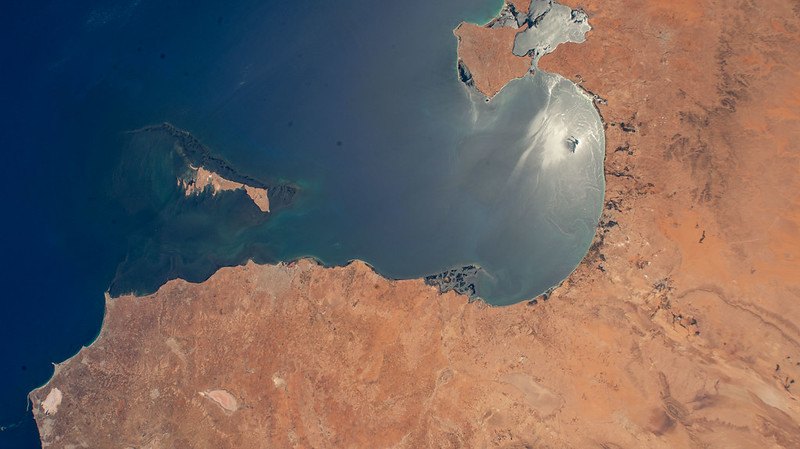
Cover Photo Credit: NASA Johnson, “The sun’s glint beams off the Gulf of Gabes” (August 2, 2024)
1 https://www.mdpi.com/2071-1050/17/3/1283
2 https://www.sciencedirect.com/science/article/abs/pii/S0048969724068839
3 https://www.pjoes.com/pdf-67529-24028?filename=Spatial+Distribution+and.pdf
4 https://link.springer.com/article/10.1007/s11356-023-27518-9
5 https://businessnews.com.tn/2017/06/30/article-1146357/1146357/
6 https://www.middleeasteye.net/fr/decryptages/tunisie-el-kamour-tataouine-ressources-petrole-manifestations-inegalites
7 https://www.facebook.com/StopPollution2
8 https://www.facebook.com/reel/25277059795221402
9 https://nawaat.org/2025/08/06/ce-phosphogypse-qui-empoisonne-gabes
10 https://businessnews.com.tn/2025/09/10/gabes-trente-habitants-intoxiques-le-ftdes-denonce-un-ecocide-impuni/1364927
11 https://www.lapresse.tn/2025/10/10/gabes-plage-essalem-des-eleves-etouffent-pour-la-seconde-fois-suite-a-linhalation-de-gaz-toxiques
12 https://www.mosaiquefm.net/fr/actualite-regional-tunisie/1467537/gabes-des-cas-d-asphyxie-parmi-les-eleves-du-college-chott-essalem
13 https://www.pressegauche.org/La-ville-de-Gabes-dans-le-Sud-tunisien-suffoque-et-se-souleve
14 https://www.reuters.com/sustainability/climate-energy/general-strike-protests-paralyse-tunisias-gabes-over-pollution-crisis-2025-10-21/
15 https://www.facebook.com/reel/1116087960292952
16 https://noria-research.com/mena/breaking-what-remains-of-intermediation-saiedism-in-late-2025/
17 https://www.lemonde.fr/afrique/article/2022/12/29/a-zarzis-dans-le-sud-est-de-la-tunisie-le-naufrage-de-jeunes-habitants-partis-pour-l-europe-nourrit-la-colere-de-la-population_6155950_3212.html
18 https://www.lemonde.fr/afrique/article/2021/11/23/en-tunisie-la-bombe-a-retardement-de-la-gestion-des-dechets_6103313_3212.html