
Introduction
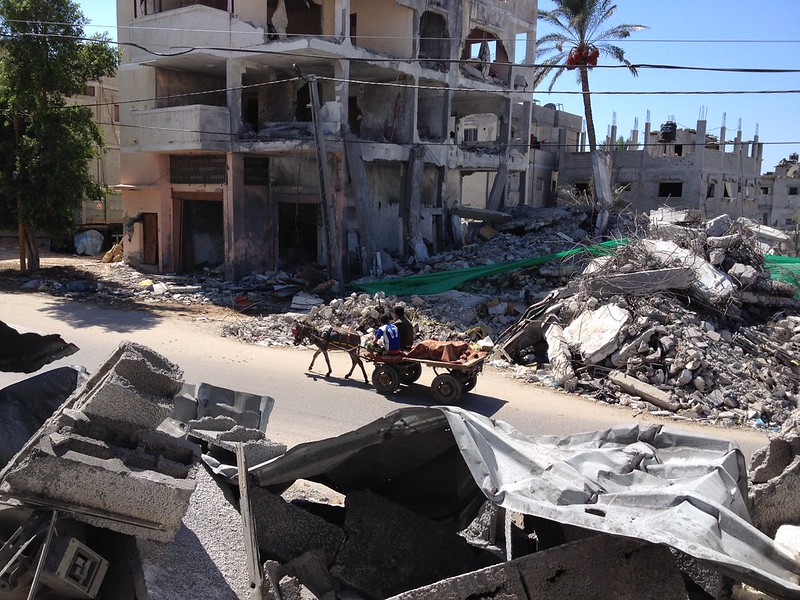
Over the past two years, Gaza has been subjected to a genocidal assault that has brought about the near-total destruction of the society’s physical, economic, and social foundations. Israel’s campaign has killed tens of thousands of Palestinians and erased hundreds of neighbourhoods from the map.
A recent UNCTAD report highlights that the assault “propelled [Gaza] from de-development to utter ruin”.[1] By April 2025, an estimated 70% of all physical structures had been damaged or destroyed, including homes, hospitals, schools, factories, and vital infrastructure for energy, water, telecommunications, and agriculture.[2] The study concludes that the post-October 2023 assault has led to one of the worst economic crises documented “anywhere in recent decades”.[3]
While the perpetrators of this destruction and mass killing are yet to face meaningful accountability, international actors have begun planning Gaza’s political and economic future. In November 2025, the United Nations Security Council adopted Resolution 2803, endorsing a reconstruction blueprint anchored in the Trump administration’s Comprehensive Plan to End the Gaza Conflict.[4] The resolution establishes an internationally mandated transitional administration – the Board of Peace (BoP) – alongside a temporary international security force (ISF). It expressly places reconstruction, economic recovery, and administrative restructuring under external and donor oversight.
Drawing on Patrick Wolfe’s insights on the relationship between genocide and settler colonialism, this article argues that the emerging reconstruction regime risks functioning as a settler-colonial reconfiguration of Gaza. I examine three interrelated aspects through which this may unfold: the absence of self-determination, the spatial reordering of Gaza’s territory, and the multi-dimensional erasure of Gaza’s social life.
Beyond the Neoliberal Framework
Security Council Resolution 2803 embeds Gaza’s future within a familiar set of post-conflict reconstruction logics: donor governance, technocratic planning, and large-scale market-oriented redevelopment. The resolution calls upon the World Bank and other financial institutions to establish a “dedicated trust fund… governed by donors” to finance reconstruction.[5] It also endorses the creation of an economic development plan crafted by “a panel of experts who have helped birth some of the thriving modern miracle cities in the Middle East,” a thinly veiled reference to the Gulf monarchies.[6]
The UN resolution itself remains vague about the precise plans for Gaza’s economic future, but the direction of U.S. policy may be inferred from the various reconstruction blueprints circulated to the Trump Administration over the past year. The Comprehensive Plan itself alludes to this, noting that numerous “thoughtful investment proposals” have been made by “well-meaning international groups”, adding that these proposals will be considered to “attract and facilitate [the] investments that will create jobs, opportunity, and hope for future Gaza”.[7]
One of the most influential of the proposals in question was the Gaza Reconstitution, Economic Acceleration and Transformation Trust, or the GREAT Trust.[8] This plan was developed by a group of Israeli businessmen led by Michael Eisenberg, an Israeli-American venture capitalist, and Liran Tancman, a former Israeli military intelligence officer.[9] The pair used financial models developed by partners in Boston Consulting Group to craft their vision for Gaza. Staff members from the Tony Blair Institute for Global Change (TBI) were also reportedly involved, although TBI has stated that its own contribution did not align with the final GREAT Trust proposal that reached the White House.[10]
The GREAT Trust envisions a complete remaking of Gaza’s political and economic structures, beginning from the premise that Gaza today has “$0” worth of economic value and must be re-engineered from the ground up.[11] The plan portrays Gaza’s demolition as an opportunity to transform it into a profitable regional hub integrated into the Abraham Accords’ emerging economic order and the IMEC (India–Middle East–Europe Corridor) initiative. The plan proposes a series of investor-led mega-projects: an “Abraham Gateway” logistics hub, new industrial zones, desalination and solar energy complexes, an airport, and a network of AI-administered “smart cities.” Its most spectacular proposal is the “Gaza Trump Riviera,” a Dubai-style waterfront with luxury resorts and artificial islands. The plan forecasts $97 billion in donor financing and $36 billion in private investment over ten years, alongside returns of $185 billion for donor-country industries, $37 billion in tax revenue, and $24 billion in direct income for the Trust itself.[12]
The plan also leverages regional partnerships, particularly with Gulf states, to integrate Gaza into a broader U.S.-Gulf-Israeli economic landscape. In this regard, it proposes a series of investor-financed “mega-projects,” including a ring road and tram line around Gaza’s perimeter, branded the “MBS Highway”, and a north-south corridor through the centre of the Strip named for UAE President Mohammed bin Zayed al-Nahyan.[13] Regardless of these specific initiatives, regional states are clearly positioning themselves to seek political and economic influence through the reconstruction process.[14] Trump’s Comprehensive Plan also explicitly states that tariff and access rates for the proposed Special Economic Zone will be “negotiated with participating countries,” underscoring how reconstruction is being structured around regional bargaining and new economic relations.[15]
Taken together, these elements lend strong support to a neoliberal interpretation of Gaza’s reconstruction plans.[16] Gaza’s future economy is imagined as a highly profitable engine for foreign investors and regional states. This model mirrors post-conflict patterns seen in Iraq, Afghanistan, and Haiti, where destruction was also reframed as a commercial opportunity for external actors. As Arafeh and Turner have claimed, Gaza thus becomes another instance of what Naomi Klein coined as disaster capitalism[17]: a crisis opening up new spaces for capital accumulation.[18]
However, with the adoption of Resolution 2803, the disaster capitalism framework has become insufficient to comprehensively capture the dynamics underpinning Gaza’s reconstruction. To understand what is unfolding, reconstruction must also be situated within the structural logic of settler-colonialism. Here, Patrick Wolfe’s insights offer a crucial lens.
For Wolfe, settler colonialism is defined by enduring structures of elimination rather than distinct historical episodes.[19] These structures of elimination manifest through both negative and positive dimensions, and reshape themselves according to the imperatives of the moment.[20] Negatively, they seek the dissolution of Indigenous societies by displacing them, fragmenting their social bases, and severing their collective attachment to land. Positively, they construct new social orders on the expropriated territory through the remaking of laws, property regimes, political institutions, and social norms. In both cases, the aim is to eliminate indigeneity as a collective form of life.[21] Wolfe therefore understands genocide as not merely the physical destruction of a social group, but also the legal, economic, and spatial transformations that destroy a group’s capacity to reproduce itself as a people.
Wolfe’s contributions are central to understanding the implications of Gaza’s reconstruction. The severing of Indigenous attachments to land and modes of livelihood is endemic to settler colonialism, and Gaza’s destruction has created the conditions through which this logic can be advanced under the banner of rebuilding. Neoliberal reconstruction mechanisms intersect with this process by offering economic participation as a pathway to survival in the wake of mass displacement and killing. Indeed, inasmuch as participating in the economy on these terms reorganises social life around individualised competition and speculative investment, thereby weakening communal structures and collective political ambitions, the direction of travel under the neoliberal reconstruction regime is toward the erosion of indigeneity. As Agathangelou et al. note, imperial projects cultivate certain ways of being while erasing others based on their priorities.[22] In Gaza, this means reconstruction frameworks may extend settler-colonial ambitions and reorder social and political life in line with external agendas rather than Palestinian national objectives.
Settler Colonialism in Gaza’s Reconstruction
Palestinian Self-Determination
As mentioned, UNSC Resolution 2803 establishes a new administrative architecture for Gaza, centred on the creation of the Board of Peace (BoP) as the territory’s transitional governing authority.[23] The resolution “welcomes the establishment of the Board of Peace as a transitional administration with international legal personality,” mandating it to “set the framework, and coordinate funding for, the redevelopment of Gaza”.[24] According to the Comprehensive Plan, the BoP is to be “headed and chaired by President Donald J. Trump,” with additional members to include figures such as former British Prime Minister Tony Blair.[25] The Resolution also authorises the BoP to establish a “technocratic, apolitical Palestinian committee” composed of “qualified Palestinians and international experts,” responsible for Gaza’s day-to-day administrative, economic, and humanitarian operations during the transitional period.[26] This committee is to function “under the oversight and supervision” of the BoP.[27]
By placing Gaza under a transitional governance system led by the Board of Peace and supervised by foreign heads of state, the resolution effectively suspends Palestinian political agency at one of the most consequential moments in their modern history. This is not altogether surprising. As Arafeh and Turner note, disaster capitalism operates by taking advantage of crisis moments to strip local communities of political agency: With politics frozen under the conditions of emergency, external actors use these moments to impose economic frameworks that facilitate appropriation and dispossession.[28] Such dynamics are certainly at play in Gaza. Under the direction of the BoP, policies like privatisation and foreign-directed investment function to shift control over Gaza’s economy, land, and political future away from Palestinians and into the hands of foreign states and private actors.
The UN resolution stipulates that the transitional administration will continue “until such time as the Palestinian Authority (PA) has satisfactorily completed its reform program”. This decision conditions Palestinian political agency on the acceptance of reforms stipulated by U.S. and Gulf-backed proposals.[29] A pathway toward Palestinian self-determination “may” emerge once the designated reforms are “faithfully carried out”.[30] But the Israeli government has already firmly rejected such an eventuality, calling it an “existential threat”.[31] Therefore, while framed as technocratic adjustments or a search for ‘responsible’ actors, the reconstruction process in fact moulds Palestinian representation into a form acceptable to the United States, Israel, and key regional states.
This reshaping of Palestinian leadership also intersects with the formation of allied economic classes. Tariq Dana has demonstrated how the post-Oslo political economy produced a class of economic elite whose interests became tightly aligned with donor priorities and Israeli constraints.[32] Resolution 2803 likewise sets the stage for the emergence of new political and economic actors aligned with external interests. The Board of Peace structure invites a new set of international consultants, private investors, and politically connected intermediaries to shape Gaza’s future.
Figures like Tony Blair illustrate the kinds of embedded networks poised to shape Gaza’s reconstruction. His institute has received over $300 million from Oracle chairman Larry Ellison, a prominent supporter of the Israeli military,[33] and it has also been contracted by regional actors like Saudi Arabia, the UAE, and Bahrain.[34] Recent reporting highlighting the mobilisation of commercial actors at the regional level show the other type of parties likely to be involved in Gaza. According to Al-Shorouk, Egyptian contracting and building-materials companies are seeking to secure a leading role in the rebuilding effort following the adoption of UNSC Resolution 2803.[35] The Middle East Monitor likewise reports that global competition for reconstruction contracts has begun, with major firms from the UAE, Qatar, Bahrain, and Turkey vying for participation.[36] As in the post-Oslo period, such dynamics are likely to generate a new class of Palestinian business actors and technocrats whose access to reconstruction opportunities will depend on their alignment with the interests and priorities of these foreign companies and donor states.
As the International Court of Justice affirmed in its 2024 Advisory Opinion, self-determination is an inalienable right of the Palestinian people, and any reconstruction process must contribute to its realisation.[37] This requires meaningful local participation in Gaza and a unified national leadership accountable to its own communities. Yet, as UN Special Rapporteur Francesca Albanese notes, Resolution 2803 replaces these obligations with a “security-first, capital-driven model of foreign control”.[38] By placing Gaza’s future under a Board of Peace chaired by the United States, a principal enabler of the ongoing genocide, the resolution leaves Palestinians to be governed by a “puppet administration” in which external powers, rather than the Palestinian people, shape the future of Gaza.[39] Through reconstruction, Resolution 2803 embeds a system in which Palestinian political life is reconfigured, constrained, and aligned with external priorities.
Territorial Fragmentation and Securitisation
UNSC Resolution 2803 introduces an extensive security architecture that reshapes Gaza’s territorial landscape. It authorises the establishment of a temporary International Stabilization Force (ISF) operating under a unified command approved by the Board of Peace, with troops contributed by participating states and coordinating closely with Egypt and Israel. According to the resolution, the ISF will “help secure border areas,” oversee the “demilitarizing [of] the Gaza Strip,” and ensure the “destruction and prevention of rebuilding” of all military and offensive infrastructure.[40] Crucially, Israeli forces will not fully withdraw: the resolution stipulates that the IDF will leave Gaza only once a set of demilitarisation “standards, milestones, and timeframes” has been met, and will maintain a “security perimeter presence” inside Gaza until it is deemed “properly secure” against any perceived threat.[41]
In parallel with these arrangements, a new territorial demarcation has already consolidated on the ground. After the ceasefire’s announcement, Israel established what has become known as the Yellow Line, a military boundary marking the zones from which Israeli forces were required to withdraw.[42] Although initially presented as a temporary operational measure, the Yellow Line has effectively partitioned Gaza. Roughly 58 percent of Gaza is to the east of the line and remains under Israeli military control, while the vast majority of the population is forced into the western coastal zone.[43] Reports describe this division as creating a “green zone” under Israeli authority. It is there that early reconstruction efforts would begin. The “red zone”, corresponding to the aforementioned coastal area, looks to be left under de facto Hamas influence and excluded from rebuilding projects.[44]
The result is an acute humanitarian landscape, with over two million Palestinians crowded into makeshift shelters amid rubble, minimal aid, and the collapse of basic services. Those attempting to return to homes beyond the Yellow Line are threatened, expelled, or killed, with these violations now justified as part of the ‘implementation’ of the ‘peace’ plan.[45] History shows that Israel’s ‘temporary’ lines rarely remain temporary. From the 1948 Green Line to the post-1967 security borders and the West Bank separation barrier, provisional boundaries have consistently solidified into long-term territorial dispossession.[46] The Yellow Line has already shifted nearly a kilometre beyond all the published maps.[47]
These security arrangements reflect the logic of disaster capitalism, where militarised control is deemed necessary to create the ‘stability’ required to attract private capital. Across multiple post-war plans that have gained attention, investor protection and capital interests are expressly linked to continued security measures. Proposals by neoconservative, pro-Israel think tanks such as The Vandenberg Coalition[48] and the RAND Corporation[49] similarly envision a multinational security force working closely with Israel to foster economic activity. At the same time, though, these territorial developments also reflect a core aspect of the settler-colonial logic of elimination. For Wolfe, settler colonialism advances through the reorganisation of space in ways that confine, displace, or immobilise Indigenous populations.[50] The ISF’s mandate to control borders and movement, the IDF’s establishment of an indefinite “security perimeter,” and the consolidation of the Yellow Line all function as mechanisms that determine who may inhabit Gaza, where they may live, or under what conditions they may return. Reconstruction thus becomes a means to weaken Palestinian collective presence and entrench durable structures of control. Another dimension of this securitised spatial reordering is the deliberate fragmentation of the native population. As Chiniara Charrett notes, Israeli security regimes divide Palestinians into ‘good’ and ‘bad’ subjects, making access to land and mobility dependent on compliance with the imposed security norms.[51] In this sense, Gaza’s emerging militarised zones extend settler-colonial practices that fracture communal cohesion and replace collective rights with individualised and securitised forms of existence.
The Assault on Culture, Knowledge, and the Environment
A third dimension of Gaza’s reconstruction concerns the erasure of the social, cultural, and ecological foundations that sustain Palestinian collective life. This destruction forms a critical layer of the settler-colonial logic shaping Gaza’s present and its reconstruction. The destruction of Gaza’s cultural heritage has been systematic and overwhelming.[52] Dozens of archaeological, religious, and historic sites have been damaged or erased since the assault began. This includes mosques, churches, cemeteries, Roman and Byzantine structures, Ottoman markets, and museums, many of which embody over 3,000 years of civilisation. A report by Heritage for Peace documents at least 104 heritage sites struck in the first month of the genocide alone, including the complete destruction of the Jabaliya Byzantine Church, Perferius Orthodox Church, and parts of the Great Omari Mosque.[53] Other cultural repositories have also been lost, such as the Center for Manuscripts and Ancient Documents and large sections of Gaza’s old city, where historic houses dating back centuries have collapsed under Israeli shelling. All this represents the targeted destruction of cultural memory, identity, and historical continuity.
The systematic destruction of educational life, or scholasticide, is another core pillar of Israel’s genocide. As Desai et al. document, the Israeli military has annihilated Gaza’s entire higher education sector: all 12 universities and affiliated colleges have been damaged or destroyed, along with 97% of Gaza’s schools.[54] Entire campuses, like the Islamic University of Gaza and Al-Azhar University, have been bombed or repurposed as military bases. Additionally, between October 2023 and August 2025, Israel’s assault killed more than 17,000 schoolchildren, 739 teachers, 1,261 university students, and 226 academics.[55] This is a deliberate attempt to dismantle the institutions that sustain knowledge and future collective capacity.
Gaza’s environment has likewise been devastated in ways that represent ecocide, where environmental destruction functions as a tool of elimination by making life on the land materially unsustainable. As Shourideh Molavi shows, settler-colonial domination restructures Indigenous ecologies by destroying land, severing environmental relationships, and reshaping landscapes to suit the coloniser’s interests.[56] In Gaza, massive bombardment has flattened agricultural fields and contaminated soil and groundwater with toxic debris.[57] The war has also destroyed irrigation networks and wells and crippled desalination and waste systems. At this stage, large areas of Gaza are uninhabitable, undermining food sovereignty and increasing dependency on external actors.
Together, the destruction of heritage, education, and the environment reflect a logic of elimination at work. Scholasticide and the eradication of Gaza’s heritage sites destroy the institutions that reproduce knowledge and political memory. Ecocide destroys the material foundations of survival. These are interlocking strategies that create grounds for new social and ecological orders imposed by occupying or external powers. Yet, none of this cultural, intellectual, or ecological devastation is addressed in UNSC Resolution 2803 or the Comprehensive Plan. Instead, both documents reduce Gaza’s crisis to a technical challenge of security, administration, and redevelopment, without acknowledging the irreparable losses that underpin the fabric of Palestinian social life.[58] As Charrett notes, such future-oriented and technocratic approaches overwrite Indigenous claims to land, memory, and political agency by recasting genocidal assaults as a developmental problem to be managed by outside powers.[59] The resolution’s silence on cultural, intellectual, and ecological destruction is therefore supportive of a settler-colonial logic that enables reconstruction without justice or accountability. By treating Gaza as a space to be ‘deradicalised’ and reshaped into a ‘peaceful’ and investment-friendly zone, the reconstruction framework obscures the responsibility of Israel and its allies for what has been permanently lost.
Conclusion
The reconstruction arrangements set out in UNSC Resolution 2803 and the Comprehensive Plan reflect structural hierarchies that have long governed Gaza. They most certainly do not offer a pathway towards recovery. Neoliberal development schemes transform crises into an investment opportunity. All the while, deeper structures of external administration, territorial reordering, and the multi-dimensional erasure of social life enable the settler-colonial logic of elimination. These processes restructure the political, spatial, and social foundations of Palestinian life in ways that diminish collective agency and entrench the long-term domination of the occupying power.
The continuation of Israeli violence following the announced ceasefire makes plain that Gaza cannot be rebuilt while the settler-colonial forces that produced its destruction remain in place. In the first month of the ceasefire alone, Israeli forces reportedly violated the ceasefire agreement nearly 500 times, killing hundreds of Palestinians and intensifying attacks around the Yellow Line.[60] At the same time, continued restrictions on aid have left more than a million displaced people without shelter, clean water, or medical care.[61]
Sustainable recovery requires addressing the root causes of Gaza’s devastation, including the blockade, the occupation, and the denial of Palestinian political rights.[62] It also requires reconstruction to be led by representative Palestinian institutions and rooted in Gaza’s communities, who must be empowered to make decisionvs about funding, contracts, and priorities. International assistance should support, rather than direct, these processes by coordinating resources around Palestinian-defined needs. Anything less risks rebuilding the very structures of domination that made Gaza’s destruction possible.
Photo Credit: EU Civil Protection and Humanitarian Aid, “Gaza visit 31/08-04/09/2014” (2014).
[1] Report on UNCTAD Assistance to the Palestinian People, 13.
[2] UNCTAD, Report on UNCTAD Assistance to the Palestinian People.
[3] UN News, ‘Gaza Facing Worst Economic Collapse Ever Recorded, UN Trade Agency Warns’.
[4] ‘Resolution 2803’.
[5] ‘Resolution 2803’, 2.
[6] ‘Resolution 2803’, 3.
[7] ‘Resolution 2803’, 3.
[8] The GREAT Trust.
[9] DeYoung and Brown, ‘Gaza Postwar Plan Envisions “Voluntary” Relocation of Entire Population’.
[10] Foley and Pickard, ‘Tony Blair’s Staff Took Part in “Gaza Riviera” Project with BCG’.
[11] The GREAT Trust.
[12] The GREAT Trust.
[13] The GREAT Trust.
[14] PIC, ‘Reconstruction of Gaza’.
[15] ‘Resolution 2803’, 4.
[16] Robinson, ‘Global Gaza’.
[17] Klein, The Shock Doctrine: The Rise of Disaster Capitalism.
[18] Arafeh and Turner, ‘Destruction, Disempowerment, and Dispossession: Disaster Capitalism and the Postwar Plans for Gaza’.
[19] Wolfe, ‘Settler Colonialism and the Elimination of the Native’.
[20] Wolfe, ‘Settler Colonialism and the Elimination of the Native’.
[21] Wolfe, ‘Settler Colonialism and the Elimination of the Native’.
[22] Agathangelou et al., ‘Intimate Investments’.
[23] ‘Resolution 2803’.
[24] ‘Resolution 2803’, 2.
[25] ‘Resolution 2803’, 3.
[26] ‘Resolution 2803’, 3.
[27] ‘Resolution 2803’, 3.
[28] Arafeh and Turner, ‘Destruction, Disempowerment, and Dispossession: Disaster Capitalism and the Postwar Plans for Gaza’.
[29] ‘Resolution 2803’, 1.
[30] ‘Resolution 2803’, 1.
[31] Bajec, ‘Yellow Lines and Green Zones’.
[32] The Paris Economic Protocol enabled Israeli economic control, donor financing, and PA patronage networks to create a system that empowered a small circle of politically-connected capitalists able to dominate key sectors. This class formation produced a leadership configuration structurally oriented toward the neoliberal priorities of external powers.
Dana, ‘Crony Capitalism in the Palestinian Authority’.
[33] Asher, ‘First Raze Gaza, Then Build a Playground for Global Capital’.
[34] PA Media, ‘Tony Blair Institute Continued Taking Money from Saudi Arabia after Khashoggi Murder’.
[35] Issam, ‘شركات المقاولات ومواد البناء المصرية تطمح فى اقتناص الحصة الأكبر من إعادة إعمار غزة [Egyptian construction and building materials companies seek to capture the largest share of Gaza’s reconstruction]’.
[36] MEMO, ‘Egyptian Companies Eye Major Role in Gaza Reconstruction Effort’.
[37] ICJ, ‘Advisory Opinion of 19 July 2024 – International Court of Justice’.
[38] UN OHCHR, ‘UN Security Council Resolution a Violation of Palestinian Right of Self-Determination and UN Charter, UN Expert Warns’.
[39] UN OHCHR, ‘UN Security Council Resolution a Violation of Palestinian Right of Self-Determination and UN Charter, UN Expert Warns’.
[40] ‘Resolution 2803’, 2.
[41] ‘Resolution 2803’, 2.
[42] Williamson, ‘Israel’s “yellow Line” in Gaza Gives Netanyahu Room for Manoeuvre’.
[43] Bajec, ‘Yellow Lines and Green Zones’.
[44] Bajec, ‘Yellow Lines and Green Zones’.
[45] Euro-Med Human Rights Monitor, ‘Gaza’s Yellow Line’.
[46] Euro-Med Human Rights Monitor, ‘Gaza’s Yellow Line’.
[47] Bajec, ‘Yellow Lines and Green Zones’.
[48] JINSA, Gaza Futures Task Force.
[49] RAND, Pathways to a Durable Israeli-Palestinian Peace.
[50] Wolfe, ‘Settler Colonialism and the Elimination of the Native’.
[51] Chiniara Charrett, ‘Gaza, Palestine, and the Political Economies of Indigenous (Non)-Futures’.
[52] Veltman, ‘More than 100 Gaza Heritage Sites Have Been Damaged or Destroyed by Israeli Attacks’.
[53] Heritage for Peace and ANSCH, Report on the Impact of the Recent War in 2023 on the Cultural Heritage in Gaza.
[54] Desai et al., ‘Scholasticide and Resilience’.
[55] Desai et al., ‘Scholasticide and Resilience’.
[56] C. Molavi, Environmental Warfare in Gaza.
[57] Mishra, ‘Poisoned Water and Shattered Grid: Gaza Left in Environmental Freefall after War, Report Says’.
[58] Arafeh, ‘Governing Gaza After the War’.
[59] Chiniara Charrett, ‘Gaza, Palestine, and the Political Economies of Indigenous (Non)-Futures’.
[60] Bajec, ‘Yellow Lines and Green Zones’.
[61] Bajec, ‘Yellow Lines and Green Zones’.
[62] Arafeh and Turner, ‘Destruction, Disempowerment, and Dispossession: Disaster Capitalism and the Postwar Plans for Gaza’.
Bibliography
Agathangelou, Anna M., M. Daniel Bassichis, and Tamara L. Spira. ‘Intimate Investments: Homonormativity, Global Lockdown, and the Seductions of Empire’. Radical History Review 2008, no. 100 (2008): 120–43. https://doi.org/10.1215/01636545-2007-025.
Arafeh, Nur. ‘Governing Gaza After the War: Palestinian Debates’. Carnegie Endowment for International Peace, 9 February 2024. https://carnegieendowment.org/posts/2024/02/governing-gaza-after-the-war-palestinian-debates?lang=en.
Arafeh, Nur, and Mandy Turner. ‘Destruction, Disempowerment, and Dispossession: Disaster Capitalism and the Postwar Plans for Gaza’. Carnegie Endowment for International Peace, 24 July 2025. https://carnegieendowment.org/research/2025/07/destruction-disempowerment-and-dispossession-disaster-capitalism-and-the-postwar-plans-for-gaza?lang=en.
Asher, Abe. ‘First Raze Gaza, Then Build a Playground for Global Capital’. 19 November 2025. https://jacobin.com/2025/11/gaza-trump-israel-plan-capital.
Bajec, Alessandra. ‘Yellow Lines and Green Zones: The de Facto Partition of Gaza’. Https://Www.Newarab.Com/, The New Arab, 24 November 2025. https://www.newarab.com/analysis/yellow-lines-and-green-zones-de-facto-partition-gaza.
C. Molavi, Shourideh. Environmental Warfare in Gaza: Colonial Violence and New Landscapes of Resistance. Pluto Press, 2024. http://ebookcentral.proquest.com/lib/oxford/detail.action?docID=7130350.
Chiniara Charrett, Catherine. ‘Gaza, Palestine, and the Political Economies of Indigenous (Non)-Futures’. In Political Economy of Palestine: Critical, Interdisciplinary, and Decolonial Perspectives, edited by Alaa Tartir, Tariq Dana, and Timothy Seidel. Springer International Publishing, 2021. https://doi.org/10.1007/978-3-030-68643-7_9.
Dana, Tariq. ‘Crony Capitalism in the Palestinian Authority: A Deal among Friends’. Third World Quarterly 41, no. 2 (2020): 247–63. https://doi.org/10.1080/01436597.2019.1618705.
Desai, Chandni, Sundos Hammad, Ahmed Abu Shaban, and Abdel Razzaq Takriti. ‘Scholasticide and Resilience: The Gaza Genocide and the Struggle for Palestinian Higher Education’. Curriculum Inquiry, no. 0 (October 2025): 1–37. https://doi.org/10.1080/03626784.2025.2558520.
DeYoung, Karen, and Cate Brown. ‘Gaza Postwar Plan Envisions “Voluntary” Relocation of Entire Population’. The Washington Post, 31 August 2025. https://www.washingtonpost.com/national-security/2025/08/31/trump-gaza-plan-riviera-relocation/.
Euro-Med Human Rights Monitor. ‘Gaza’s Yellow Line: Where Genocide Is Internationally Acceptable’. Euro-Med Human Rights Monitor, 30 November 2025. https://euromedmonitor.org/en/article/6931/Gaza%E2%80%99s-Yellow-Line:-Where-genocide-is-internationally-acceptable.
Foley, Stephen, and Jim Pickard. ‘Tony Blair’s Staff Took Part in “Gaza Riviera” Project with BCG’. Gaza. Financial Times, 6 July 2025. https://www.ft.com/content/0b1bc761-c572-4b61-882a-fb4467259dcd.
Heritage for Peace, and ANSCH. Report on the Impact of the Recent War in 2023 on the Cultural Heritage in Gaza. Heritage for Peace, 2023. https://www.heritageforpeace.org/wp-content/uploads/2025/04/Report-on-the-Impact-of-the-Recent-War-in-2023-on-the-Cultural-Heritage-in-Gaza-Strip-Palestine-English.pdf.
ICJ. ‘Advisory Opinion of 19 July 2024 – International Court of Justice’. International Court of Justice, 19 July 2024. https://www.icj-cij.org/index.php/node/204160?utm_source=chatgpt.com.
Issam, Mohammad. ‘شركات المقاولات ومواد البناء المصرية تطمح فى اقتناص الحصة الأكبر من إعادة إعمار غزة [Egyptian construction and building materials companies seek to capture the largest share of Gaza’s reconstruction]’. Al-Shorouk, 13 October 2025. https://www.shorouknews.com/news/view.aspx?cdate=13102025&id=7430e62b-5428-4d2c-9688-3f35baf306db.
JINSA. Gaza Futures Task Force. 28 January 2025. https://jinsa.org/policy-projects/gaza-futures-task-force/.
Klein, Naomi. The Shock Doctrine: The Rise of Disaster Capitalism. Penguin, 2008. https://www.penguin.co.uk/books/55595/the-shock-doctrine-by-naomi-klein/9780141024530.
MEMO. ‘Egyptian Companies Eye Major Role in Gaza Reconstruction Effort’. Middle East Monitor, 14 October 2025. https://www.middleeastmonitor.com/20251014-egyptian-companies-eye-major-role-in-gaza-reconstruction-effort/.
Mishra, tuti. ‘Poisoned Water and Shattered Grid: Gaza Left in Environmental Freefall after War, Report Says’. The Independent, 19 October 2025. https://www.independent.co.uk/news/world/middle-east/gaza-israel-war-hamas-water-ecosystems-ceasefire-b2847085.html.
PA Media. ‘Tony Blair Institute Continued Taking Money from Saudi Arabia after Khashoggi Murder’. Politics. The Guardian, 12 August 2023. https://www.theguardian.com/politics/2023/aug/12/tony-blair-institute-continued-taking-money-from-saudi-arabia-after-khashoggi.
PIC. ‘Reconstruction of Gaza: An International Race for Economic, Political Influence in the Devastated Enclave’. The Palestinian Information Center, 27 October 2025. https://english.palinfo.com/reports/2025/10/27/350571/.
RAND. Pathways to a Durable Israeli-Palestinian Peace. 2025. https://www.rand.org/pubs/research_reports/RRA3486-1.html.
‘Resolution 2803’. With UN Security Council. UN, 17 November 2025. https://digitallibrary.un.org/record/4093207.
Robinson, William I. ‘Global Gaza: The Political Economy of Genocide’. Noria Research, 4 November 2025. https://noria-research.com/mena/global-gaza-the-political-economy-of-genocide/.
The GREAT Trust: From a Demolished Iranian Proxy to a Prosperous Abrahamic Ally. 2025. https://www.washingtonpost.com/documents/f86dd56a-de7f-4943-af4a-84819111b727.pdf.
UN News. ‘Gaza Facing Worst Economic Collapse Ever Recorded, UN Trade Agency Warns’. UN News, 25 November 2025. https://news.un.org/en/story/2025/11/1166444.
UN OHCHR. ‘UN Security Council Resolution a Violation of Palestinian Right of Self-Determination and UN Charter, UN Expert Warns’. United Nations Office of the High Commissioner for Human Rights, 19 November 2025. https://www.ohchr.org/en/press-releases/2025/11/un-security-council-resolution-violation-palestinian-right-self.
UNCTAD. Report on UNCTAD Assistance to the Palestinian People: Developments in the Economy of the Occupied Palestinian Territory. Seventy-Second session. Trade and Development Board. Geneva, 2025. https://unctad.org/system/files/official-document/tdb72_d3_en.pdf.
Veltman, Chloe. ‘More than 100 Gaza Heritage Sites Have Been Damaged or Destroyed by Israeli Attacks’. Parallels. NPR, 3 December 2023. https://www.npr.org/2023/12/03/1216200754/gaza-heritage-sites-destroyed-israel.
Williamson, Lucy. ‘Israel’s “yellow Line” in Gaza Gives Netanyahu Room for Manoeuvre’. BBC News, 21 October 2025. https://www.bbc.co.uk/news/articles/cx2y9ny653no.
Wolfe, Patrick. ‘Settler Colonialism and the Elimination of the Native’. Journal of Genocide Research 8, no. 4 (2006): 387–409. https://doi.org/10.1080/14623520601056240.